
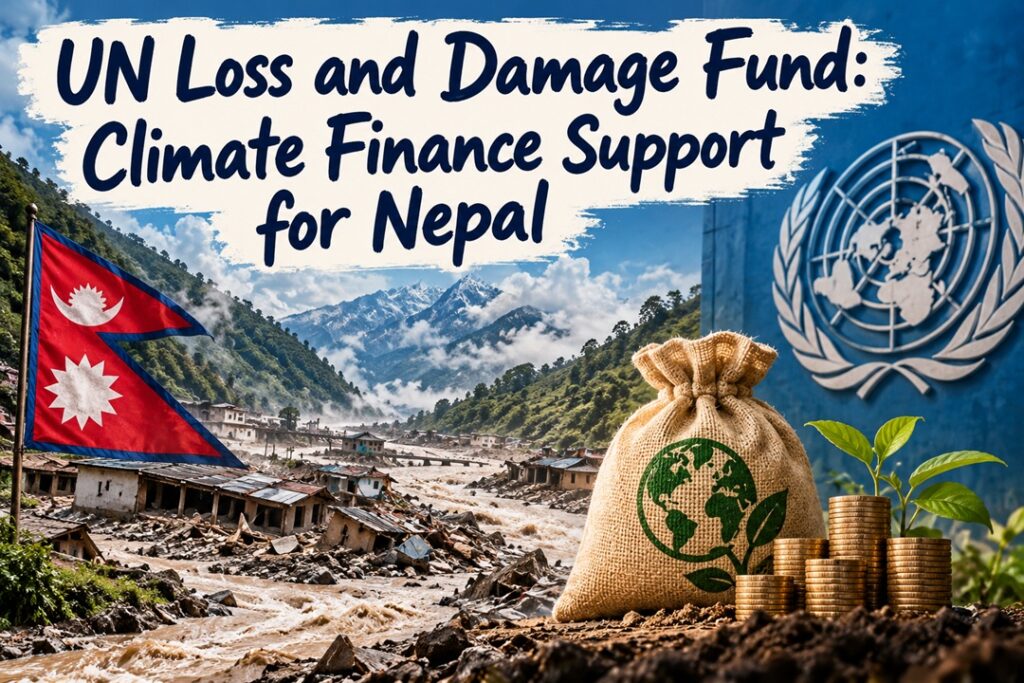
UN Loss and Damage Fund: Climate Finance Support for Nepal
Context
The United Nations’ Fund for Responding to Loss and Damage (FRLD) has approved a payout of $21.6 million to Nepal following a major climate-related disaster. The decision highlights the growing importance of international climate finance in helping vulnerable developing countries recover from climate-induced losses.
Understanding the Loss and Damage Fund
The Fund for Responding to Loss and Damage (FRLD) is an international climate finance mechanism designed to assist developing countries in addressing the economic and non-economic impacts of climate change that cannot be adequately prevented through mitigation or adaptation alone.
- Institutional framework: Operates under the United Nations Framework Convention on Climate Change (UNFCCC).
- Origin: Agreed upon at COP27 in 2022, with its governing instrument adopted at COP28 in 2023.
- Financial commitments: As of March 15, 2026, 27 countries had pledged approximately $822.06 million, including $629.70 million in grants.
- Initial funding allocation: A start-up allocation of $342 million was established, with at least half reserved for Least Developed Countries (LDCs) and Small Island Developing States (SIDS).
- Demand for assistance: The first funding call received 176 requests from 119 countries, seeking approximately $2.8 billion.
- Financial administration: The World Bank serves as the Fund’s interim trustee.
Climate-Related Losses in Nepal
Nepal faces increasing climate risks because of its mountainous terrain, glacier-fed rivers and vulnerability to extreme weather events.
On August 26, 2026, an ice-and-rock avalanche triggered flooding across the Bhotekoshi–Trishuli–Narayani river system. Experts linked the disaster to climate change and human-induced global warming.
The scale of the damage was substantial:
- Estimated economic losses: At least $2.69 billion.
- Estimated recovery requirements: At least $4.71 billion.
- Major impacts: Damage to infrastructure, disruption of livelihoods and increased pressure on public finances and reconstruction efforts.
The disaster illustrates how climate hazards can generate cascading impacts across settlements, transport networks, local economies and essential services.
Significance of the Fund’s Assistance to Nepal
1. Advancing climate justice
The payout recognises the need to support countries that face severe climate impacts despite having contributed relatively little to historical global greenhouse gas emissions.
2. Supporting post-disaster recovery
International assistance can help restore essential infrastructure, rebuild affected communities and support the recovery of livelihoods.
3. Strengthening international solidarity
The allocation demonstrates the role of multilateral institutions in mobilising resources for countries that lack sufficient domestic capacity to manage large-scale climate disasters.
4. Expanding the Fund’s operational role
Support for a specific disaster-affected country could help establish practical approaches for responding to urgent climate-related needs, including outside routine funding cycles.
5. Advancing climate diplomacy
The decision adds momentum to discussions on climate finance, accountability and the responsibilities of developed countries ahead of COP31 in Türkiye.
Major Challenges Facing the Loss and Damage Fund
- Mismatch between funding and needs: The $21.6 million payout is very small compared with Nepal’s estimated recovery requirements of several billion dollars.
- Delayed disbursement: Approval does not necessarily mean immediate payment, as formal requests and further procedural steps may be required.
- Unfulfilled financial pledges: Announced commitments do not automatically translate into money available for affected countries.
- Complex administrative procedures: Lengthy approval processes can reduce the usefulness of assistance when communities need urgent relief and reconstruction.
- Uncertain emergency-response arrangements: An exceptional allocation does not automatically establish a permanent, rapid-response mechanism for future disasters.
- Difficulties in assessing losses: Non-economic damage, including cultural loss, displacement and the destruction of ecosystems, can be difficult to quantify and compensate for.
Way Forward
- Create a rapid-response window: Establish clear procedures for releasing emergency finance quickly after major climate disasters.
- Ensure predictable funding: Developed countries should provide additional, adequate and grant-based contributions, with greater transparency regarding actual payments.
- Simplify access: Streamline applications and approvals without weakening financial oversight or accountability.
- Prioritise vulnerability: Allocate resources according to climate exposure, recovery needs and the financial capacity of affected countries.
- Strengthen local implementation: Involve local governments and affected communities in identifying priorities and monitoring reconstruction.
- Improve transparency: Publish accessible information on pledges, contributions received, approvals, disbursements and the outcomes of funded projects.
- Integrate disaster resilience: Combine recovery assistance with resilient infrastructure, early-warning systems and climate adaptation measures to reduce future losses.
Conclusion
The Loss and Damage Fund represents an important step towards addressing the unequal consequences of climate change. However, the assistance approved for Nepal also highlights the gap between the financial needs of disaster-affected countries and the resources currently available. Its long-term credibility will depend on adequate funding, timely disbursement and equitable access, enabling climate finance to deliver meaningful support when vulnerable communities need it most.
Source : The Hindu