
12th BRICS Parliamentary Forum: Strengthening Inclusive and Sustainable Global Governance
Context
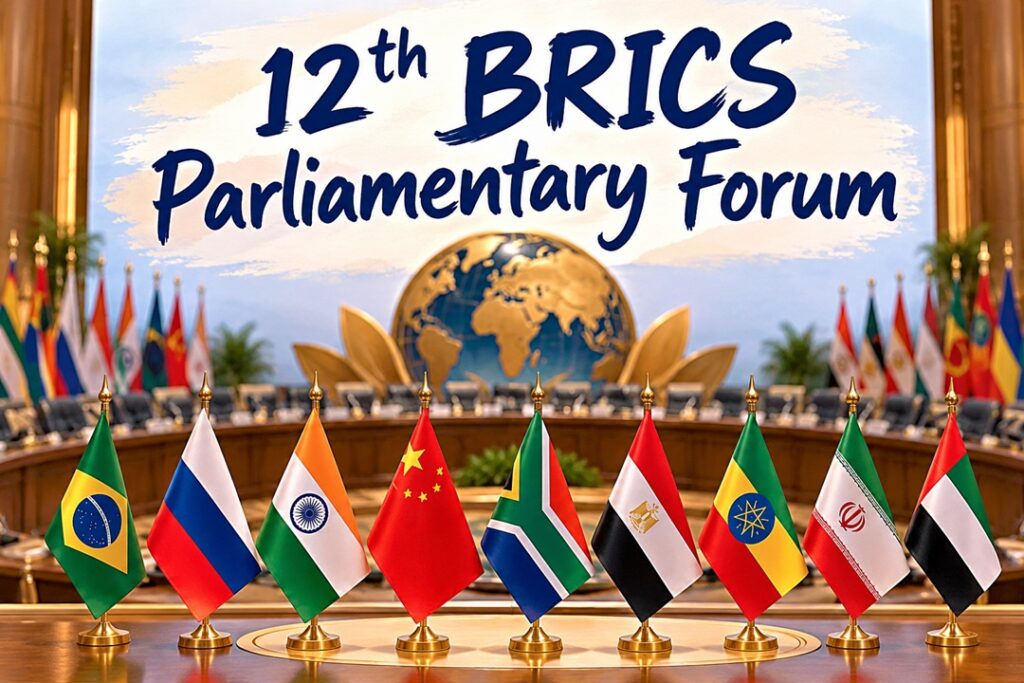
India is hosting the 12th BRICS Parliamentary Forum in New Delhi on October 26–27, 2026, building on the outcomes of the 18th BRICS Leaders’ Summit held in September 2026. The forum aims to strengthen parliamentary cooperation, advance reforms in global institutions and translate collective commitments into people-centric national policies.
What is the BRICS Parliamentary Forum?
The BRICS Parliamentary Forum is a platform for legislators from BRICS member countries to discuss common developmental challenges and strengthen cooperation through parliamentary dialogue.
- Institutional role: It connects intergovernmental agreements with domestic legislation, public expenditure and policy implementation.
- Democratic representation: It enables parliamentarians to bring citizens’ concerns into international discussions.
- Key priorities: Reforming global governance, promoting sustainable development, encouraging technological cooperation and addressing emerging economic challenges.
Major Themes of the 2026 Forum
The deliberations focus on two broad areas:
- Reforming global governance: Making international institutions more representative of contemporary geopolitical realities and the interests of developing countries.
- Sustainable and inclusive development: Addressing climate change, supply-chain vulnerabilities and the challenges posed by artificial intelligence while ensuring equitable access to development opportunities.
India’s BRICS chairship is guided by four pillars: Resilience, Innovation, Cooperation and Sustainability, with human-centred development as an overarching principle.
BRICS: Global Significance and Strategic Weight
The expanded BRICS grouping has acquired considerable demographic, economic and strategic importance.
- Demographic significance: Represents approximately 50% of the global population.
- Economic influence: Accounts for over 40% of global GDP in purchasing power parity (PPP) terms and around 26% of global trade.
- Energy security: Brings together major energy producers, including Russia, Saudi Arabia, the UAE and Iran, alongside major consumers such as India and China.
- Climate transition: Provides a platform to discuss development pathways that balance industrialisation, poverty reduction and energy access with lower carbon emissions.
This growing influence creates opportunities for the Global South to shape international economic and political rules more effectively.
Why is the BRICS Parliamentary Forum Important?
1. Converting Diplomatic Commitments into Domestic Action
Parliamentarians can scrutinise government commitments and support the legislation, budgetary allocations and regulatory reforms required to implement them.
2. Strengthening the Voice of the Global South
The forum provides a collective platform to advocate reforms in institutions such as the United Nations Security Council, International Monetary Fund and World Bank, where existing representation does not fully reflect contemporary global realities.
3. Promoting Economic Resilience
Legislative cooperation can facilitate local-currency settlements, interoperable digital payment systems and diversified supply chains, reducing exposure to external financial and economic shocks.
4. Encouraging Cooperation Across Political Systems
BRICS members have different political institutions and national priorities. Parliamentary dialogue can help identify areas of common interest without requiring uniformity in domestic governance models.
5. Making Multilateral Diplomacy More People-Centric
Discussions among lawmakers can incorporate concerns relating to employment, inflation, energy affordability, inequality and climate justice into international cooperation.
Role of Parliaments in Building a Sustainable Future
Legislative Oversight and Accountability
Parliaments can monitor public expenditure, evaluate development programmes and hold governments accountable for climate commitments, social inclusion and progress towards the Sustainable Development Goals (SDGs).
Strengthening Participatory Governance
Supportive laws can empower local governments, Farmer Producer Organisations (FPOs), cooperatives and community institutions, making development more decentralised and responsive to citizens.
Enabling Low-Carbon Economic Growth
Legislatures can establish clear regulatory frameworks for renewable energy, energy efficiency, green infrastructure and sustainable industries, allowing developing countries to pursue growth without repeating carbon-intensive development models.
Responsible Governance of Emerging Technologies
Appropriate legislation is necessary to protect data privacy, strengthen cybersecurity and address algorithmic discrimination, digital monopolies and the misuse of artificial intelligence.
Protecting Intergenerational Equity
Parliamentary decisions on natural resources, biodiversity and public finances must balance present development needs with the rights and welfare of future generations.
Challenges Facing BRICS Parliamentary Cooperation
1. Political and Ideological Differences
BRICS members have diverse political systems, constitutional arrangements and strategic priorities. These differences can make agreement on common standards, institutional reforms and governance principles difficult.
2. Geopolitical Rivalries Within the Group
Bilateral disputes and strategic competition can undermine collective action.
For instance, India–China border tensions and trade imbalances may complicate cooperation on regional security and economic issues.
3. Unequal Economic Interdependence
Concentration of critical technologies, manufacturing capabilities and strategic resources in particular member countries can create vulnerabilities within the grouping. China’s dominant position in several critical-mineral processing and rare-earth supply chains illustrates the importance of diversification.
4. Limited Enforcement Mechanisms
Parliamentary discussions and recommendations are generally non-binding. Their impact depends on whether individual governments and legislatures subsequently incorporate them into domestic laws, policies and budgetary decisions.
5. Divergent Development Priorities
Members differ in their levels of economic development, energy dependence and technological capacity. A common framework must therefore accommodate different national circumstances without diluting shared objectives.
Way Forward
– Institutionalise parliamentary cooperation: Establish regular inter-parliamentary working groups on climate finance, critical minerals, digital governance and sustainable industrial development, supported by measurable follow-up mechanisms.
– Strengthen digital connectivity: Explore interoperability between national digital public infrastructure and real-time payment systems to reduce transaction costs and improve cross-border financial inclusion.
– Diversify strategic supply chains: Develop cooperation on energy, fertilisers, food security and critical minerals to reduce excessive dependence on individual suppliers.
– Promote equitable climate frameworks: Encourage climate-finance access, affordable green technologies and development-sensitive sustainability metrics that recognise differences in historical emissions and per-capita resource use.
– Improve domestic implementation: Require parliamentary committees to review the progress of relevant BRICS commitments, identify implementation gaps and promote transparency in public spending.
– Expand people-to-people cooperation: Strengthen collaboration among universities, research institutions, local governments, cooperatives and women-led enterprises to ensure that international partnerships generate tangible benefits for citizens.
Conclusion
The 12th BRICS Parliamentary Forum offers an opportunity to make multilateral cooperation more representative, accountable and responsive to the needs of developing societies. However, its effectiveness will depend on the ability of member countries to manage geopolitical differences and convert parliamentary dialogue into measurable domestic outcomes. A stronger BRICS requires not merely a greater collective economic weight, but institutions that deliver equitable growth, technological progress and sustainable development for their people.
Source : Sansad TV