
Project 18A: Advancing India’s Indigenous Naval Warfare Capabilities
Context
India’s growing maritime security concerns in the Indo-Pacific, particularly China’s expanding naval presence in the Indian Ocean Region, have highlighted the need for more advanced naval platforms. Project 18A aims to develop next-generation stealth guided-missile destroyers to strengthen India’s maritime defence, combat capabilities and strategic deterrence.
What is Project 18A?
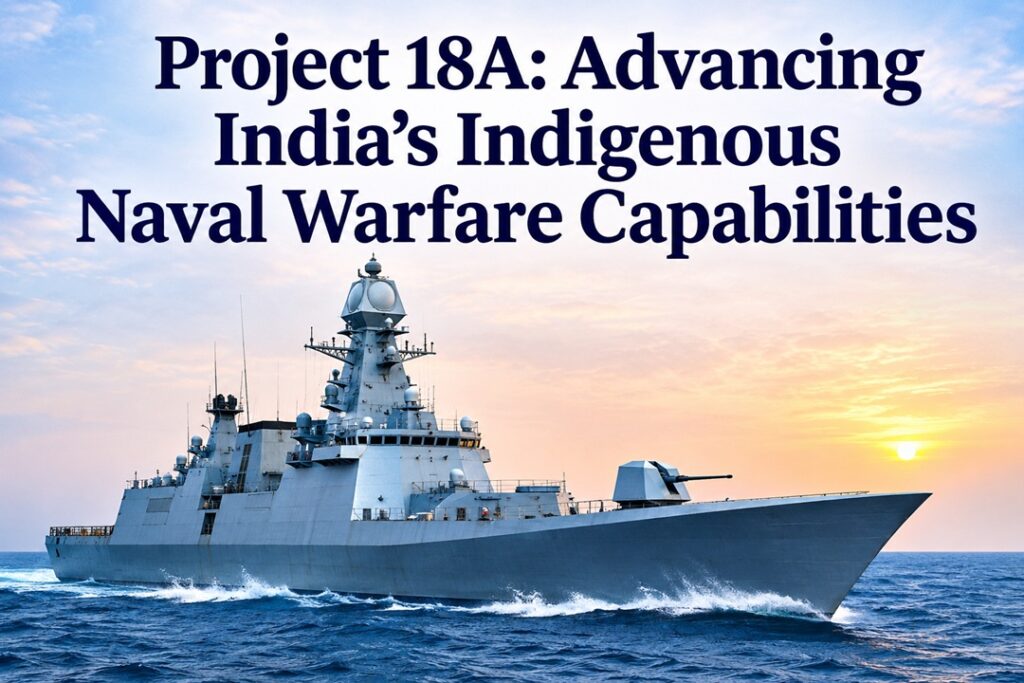
Project 18A is an indigenous warship development programme intended to produce larger, stealthier and technologically advanced guided-missile destroyers for the Indian Navy.
- Approval: The Defence Acquisition Council (DAC), chaired by the Defence Minister, has accorded in-principle approval.
- Design: The Navy’s in-house Warship Design Bureau (WDB) will undertake the warship design.
- Displacement: The proposed destroyers are expected to displace over 10,000 tonnes, compared with approximately 7,400 tonnes for the Visakhapatnam class.
- Indigenous Content: The programme aims to achieve up to 75% indigenous content.
- Shipbuilding: Both public and private sector shipyards are expected to participate through competitive processes.
Evolution of Indigenous Destroyer Development
| Programme | Warship Class |
|---|---|
| Project 15 | Delhi Class |
| Project 15A | Kolkata Class |
| Project 15B | Visakhapatnam Class |
| Project 18A | Next-generation destroyers |
Why Does India Need Next-Generation Destroyers?
1. Changing Maritime Security Environment
- Chinese Naval Expansion: Increasing Chinese naval deployments, submarine operations and research activities in the Indian Ocean have intensified regional strategic competition.
- Emerging Warfare Technologies: Hypersonic weapons, unmanned platforms and long-range precision missiles are changing the nature of naval warfare.
- Indo-Pacific Security: India needs stronger naval capabilities to protect its strategic interests and maintain regional stability.
2. Protection of Maritime Interests
- Securing Sea Lanes: Safeguards vital international shipping routes through which a significant share of India’s trade passes.
- Indian Ocean Presence: Enhances India’s ability to maintain a sustained naval presence across the Indian Ocean Region.
- Power Projection: Enables the Navy to operate effectively beyond coastal waters and support India’s wider maritime commitments.
3. Limitations of Existing Platforms
- Existing destroyers face limitations in accommodating larger inventories of advanced missiles and future weapons.
- Increasingly sophisticated threats require better radar systems, surveillance networks and electronic warfare capabilities.
- Larger platforms offer greater operational flexibility and space for integrating emerging defence technologies.
Major Weapons and Technological Capabilities
1. Advanced Missile Systems
- BrahMos: Expected to provide supersonic anti-ship and land-attack capabilities.
- Long-Range Cruise Missiles: Can enhance precision-strike capabilities against distant targets.
- Surface-to-Air Missiles: Strengthen protection against hostile aircraft and incoming missiles.
2. Advanced Detection and Defence Systems
- Modern Radar Systems: Improve the detection and tracking of aerial and maritime threats.
- Integrated Combat Management: Connects sensors, communication networks and weapons for coordinated operations.
- Electronic Warfare: Enhances the ability to identify, disrupt and counter hostile electronic systems.
- Multi-Layered Defence: Aims to improve protection against complex threats, including ballistic missiles, hypersonic weapons and coordinated drone attacks.
3. Multi-Dimensional Operational Capabilities
- Carrier Battle Group Protection: Provides air and missile defence for aircraft carrier formations.
- Anti-Submarine Warfare: Strengthens the ability to detect and neutralise hostile submarines.
- Offensive Operations: Supports precision attacks against enemy naval assets and land-based targets.
Significance of Project 18A for India
- Strengthening Maritime Security: Improves India’s capacity to safeguard strategic waterways, shipping routes and maritime assets.
- Developing a Blue-Water Navy: Enhances the ability to conduct sustained operations across distant maritime regions.
- Strategic Deterrence: Strengthens India’s capacity to respond to potential threats and discourage hostile maritime actions.
- Defence Self-Reliance: Encourages indigenous warship design, advanced manufacturing and domestic technology development.
- Technological Innovation: Promotes the development of sophisticated sensors, missile systems, electronic warfare equipment and combat-management technologies.
- Economic Benefits: Creates opportunities for domestic shipyards, defence enterprises, component manufacturers and skilled employment.
- Strategic Influence: Reinforces India’s position as an important maritime security provider in the Indo-Pacific.
Challenges in Implementing Project 18A
- Technological Complexity: Integrating sophisticated weapons, sensors, propulsion systems and electronic warfare equipment requires substantial technical expertise.
- Financial Constraints: Large warship programmes involve significant capital expenditure and the risk of cost escalation.
- Import Dependence: Continued reliance on foreign suppliers for certain specialised components could affect self-reliance.
- Construction Delays: Design modifications, procurement difficulties and infrastructure limitations may slow implementation.
- Industrial Coordination: Synchronising the efforts of the Navy, shipyards, DRDO and private manufacturers remains essential.
- Technology Obsolescence: Rapid advances in naval warfare require the platforms to remain adaptable throughout their operational life.
Way Forward
- Deepen Indigenous Manufacturing: Prioritise domestic development of propulsion systems, advanced radars, missile technologies and electronic components.
- Strengthen Public-Private Partnerships: Encourage private shipyards and domestic defence industries to participate in complex warship construction.
- Expand Research and Development: Promote collaboration among DRDO, academic institutions, research laboratories and defence manufacturers.
- Adopt Modular Design: Ensure that future upgrades, unmanned systems and emerging weapons can be integrated without major structural modifications.
- Improve Project Execution: Establish clear procurement milestones, effective monitoring mechanisms and coordinated planning to minimise delays.
- Enhance Technology Absorption: Reduce dependence on imported critical technologies through sustained investment in indigenous innovation.
Conclusion
Project 18A represents a significant step in India’s transition towards a technologically advanced and self-reliant blue-water navy. By combining indigenous shipbuilding with sophisticated weapons and surveillance systems, the programme can strengthen maritime deterrence, protect national interests and reinforce India’s strategic presence in the Indo-Pacific.
Source : The Hindu