
India’s Educational Progress and the Persistent Rural Gender Gap
Context
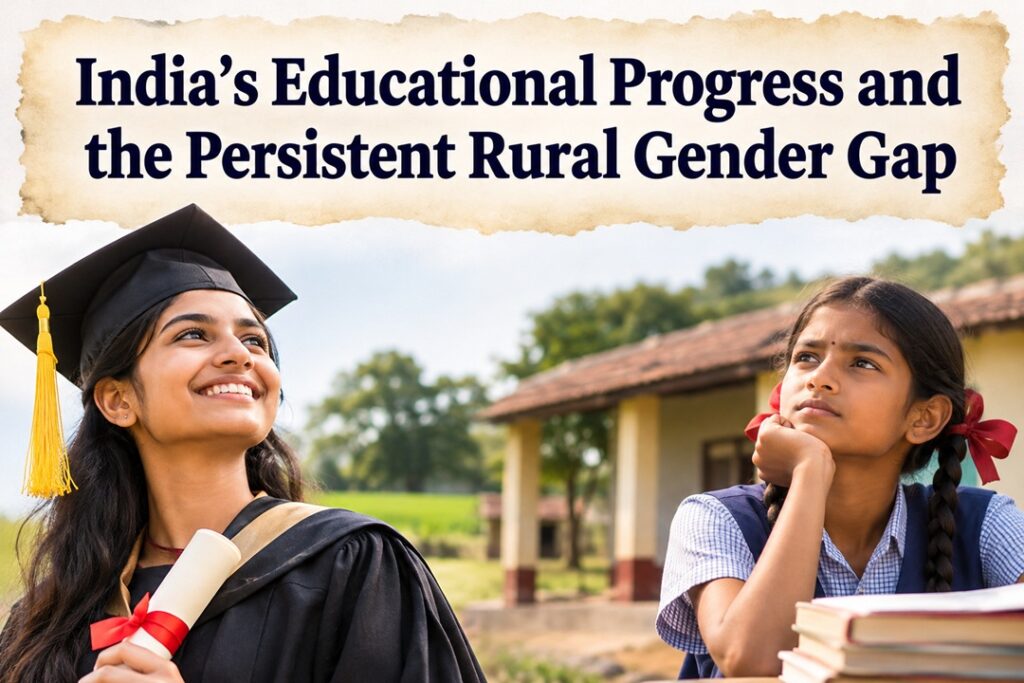
UNESCO’s 2026 Global Education Monitoring (GEM) Report highlights a significant transformation in India’s education landscape, with women surpassing men in higher education enrolment. However, substantial rural-urban inequalities persist, particularly in upper secondary school completion, leaving rural girls at a disadvantage.
About the Global Education Monitoring (GEM) Report 2026
- Nature: An independent flagship annual report published by UNESCO to monitor global progress towards Sustainable Development Goal 4 (SDG 4), which aims to ensure inclusive and equitable quality education for all.
- Mandate: It operates under the Education 2030 Incheon Declaration and Framework for Action.
- Focus: Examines educational access, participation, completion, equity and financing across countries.
Major Global Findings
- Increasing Out-of-School Population: The number of out-of-school children and youth reached 273 million in 2024, marking the seventh consecutive year of increase, excluding 13 million children in conflict-affected countries.
- Expansion of Educational Access: Since 2000, enrolment has grown by 30% in primary and secondary education, 45% in pre-primary education and 161% in tertiary education.
- Slow Improvement in Secondary Completion: Upper secondary completion increased from 37% in 2000 to 61% in 2024. However, reaching 95% completion at the current pace could take until 2105.
- Improved Educational Progression: Grade repetition declined by 62% in primary education and 38% in lower secondary education since 2000.
- Inequitable Financing: Fewer than 10% of countries have strongly equity-oriented education financing systems, reflecting inadequate redistribution towards disadvantaged learners.
- Gaps in Early Childhood Education: Although 75% of five-year-olds attend school, 27% enter primary education prematurely, while only 60% complete one year of pre-primary education.
India’s Performance: Progress and Emerging Gender Contrasts
- Female Dominance in Higher Education: Women’s Gross Enrolment Ratio (GER) reached 31.2%, exceeding men’s 28.9%, with a Gender Parity Index (GPI) of 1.08.
- Sustained Growth in Female Participation: Women’s higher education enrolment increased by 42.2%, from 1.57 crore in 2014–15 to 2.24 crore in 2023–24.
- Persistent Rural Gender Inequality: India’s upper secondary GPI stands at 0.89 nationally, but falls sharply to 0.59 in rural areas, while urban areas have achieved gender parity.
- Improved School Retention: The secondary dropout rate declined to 7%, while the retention rate reached 51.9%.
- Greater Female Participation in Schooling: Girls constitute 48.4% of total school enrolment.
- Recognition of Rapid Progress: UNESCO categorises India as a fast-progress country, having reduced its initial gender disparity in upper secondary completion by at least 65% since 2000.
Factors Contributing to India’s Educational Progress
1. Nutritional Support and School Feeding Programmes
- Mid-day meals and other school feeding initiatives have improved school participation, particularly among disadvantaged communities.
- Example: Free school meals in India generated nearly twice the positive impact on primary enrolment for girls compared to boys in disadvantaged rural communities.
2. Gender-Sensitive School Infrastructure
- Improved access to drinking water, sanitation and separate toilets has helped address barriers affecting adolescent girls.
- Example: Gender-segregated toilets in rural schools have contributed to improved enrolment and retention among adolescent girls.
3. Community-Based Empowerment Initiatives
- Girls’ clubs, mentorship programmes and life-skills education encourage continued schooling and support transitions to higher grades.
- Example: Community-based girls’ clubs in Karnataka have supported secondary school completion through peer networks, academic assistance and empowerment activities.
4. National-Level Educational Interventions
- Coordinated initiatives to expand school access, promote girls’ education and strengthen retention have helped reduce historical gender disparities.
- Example: India has bridged more than 65% of its initial gender gap in upper secondary completion since 2000.
Major Challenges to Educational Equity
1. Persistent Rural-Urban Gender Divide
- Rural girls encounter multiple barriers when transitioning from secondary to upper secondary education.
- Example: A rural upper secondary completion parity index of 0.59 indicates that only 59 girls complete this stage for every 100 boys.
- Long travel distances, safety concerns, household responsibilities and limited access to nearby schools contribute to this disparity.
2. Delayed School Progression
- Grade repetition, overage enrolment and delayed transitions prevent children from completing education within the expected timeframe.
- Example: In low-income countries, the difference between timely and eventual lower secondary completion has widened to nine percentage points.
3. Inequitable Distribution of Education Funding
- Public education expenditure does not always adequately prioritise rural schools and socio-economically disadvantaged communities.
- Example: In half the countries using targeted school equity grants, these grants account for less than 0.5% of total education budgets.
4. Inadequate Disaggregated Educational Data
- Insufficient data on geographical location, household wealth and social background makes it difficult to identify and address educational inequalities.
- Example: One in three countries does not report educational disparities based on urban-rural location, while one in two fails to report differences across wealth quintiles.
5. Overemphasis on Enrolment Rather Than Completion
- Rising enrolment figures do not necessarily translate into sustained attendance, learning outcomes or successful graduation.
- Gross Enrolment Ratios can conceal inequalities in age-appropriate progression and actual educational attainment.
UNESCO’s Recommendations
- Integrate National Education Targets into Budgets: Establish realistic national benchmarks and incorporate them into government planning and budgetary allocations.
- Adopt Multi-Sectoral Interventions: Combine school infrastructure, nutrition, social protection, transportation and institutional reforms rather than depending on isolated interventions.
- Prioritise Equity-Based Financing: Direct greater financial resources towards rural schools, disadvantaged districts and marginalised households through targeted grants and social transfers.
- Strengthen Educational Monitoring: Move beyond enrolment-based indicators towards completion, attainment and learning outcomes.
- Improve Data Disaggregation: Integrate administrative records with household surveys to identify inequalities based on gender, income and geographical location.
Way Forward
- Strengthen Rural Secondary Infrastructure: Establish accessible secondary and senior secondary schools, improve transportation facilities and ensure safe commuting for adolescent girls.
- Expand Financial Assistance: Provide targeted scholarships, conditional cash transfers and educational support to girls from economically weaker households.
- Address Socio-Cultural Barriers: Promote community awareness, parental engagement and interventions to reduce early marriage and excessive domestic responsibilities.
- Improve Digital Inclusion: Expand affordable internet connectivity, digital learning facilities and access to educational resources in rural areas.
- Ensure Outcome-Based Monitoring: Track gender-disaggregated indicators covering attendance, transition rates, completion and learning outcomes.
- Promote Cooperative Governance: Strengthen coordination between central and state governments, local bodies, schools and communities to address region-specific educational barriers.
Conclusion
UNESCO’s 2026 GEM Report demonstrates that India has made considerable progress in expanding women’s participation in higher education. However, the persistence of rural gender disparities in upper secondary completion highlights the difference between educational access and substantive equality. Achieving SDG 4 requires moving beyond universal enrolment towards equitable educational outcomes through targeted public financing, gender-sensitive infrastructure, social protection and locally responsive interventions. Ultimately, educational progress must ensure that every girl, irrespective of her geographical or socio-economic background, can complete quality education and access opportunities for empowerment.
Source : UNESCO