
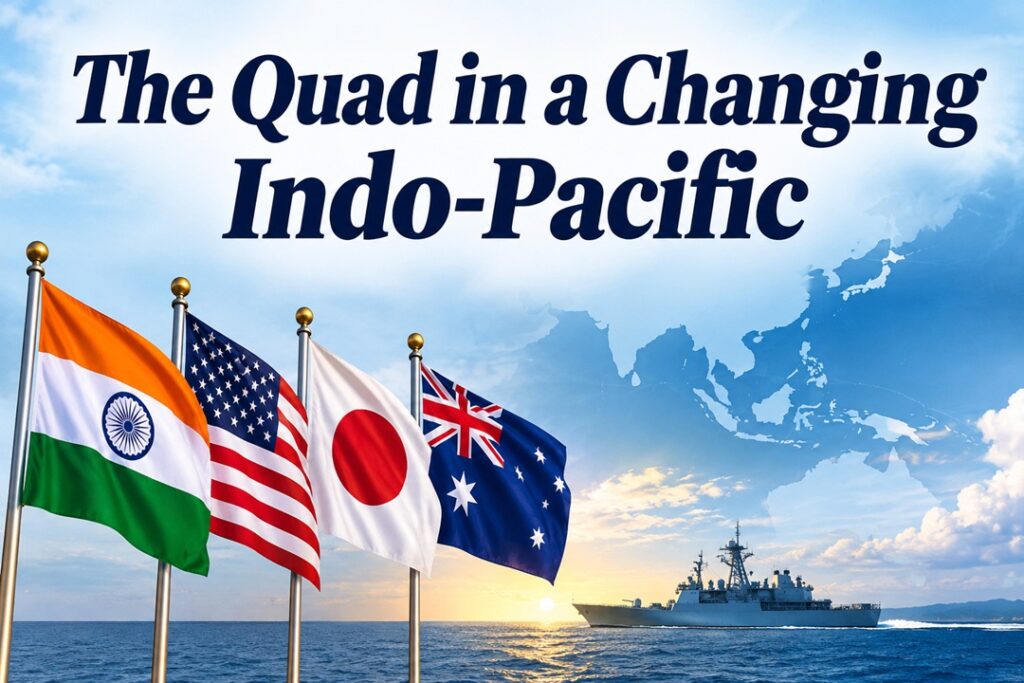
The Quad in a Changing Indo-Pacific: Challenges to Strategic Unity
Context
Leaders of the Quadrilateral Security Dialogue (Quad), comprising India, Australia, Japan and the United States, are expected to meet in Manila in November 2026 alongside the 49th ASEAN Summit. The meeting comes amid geopolitical uncertainty, bilateral trade tensions and questions over the United States’ long-term commitment to the Indo-Pacific.
What is the Quad?
The Quad is an informal strategic partnership among four maritime democracies aimed at maintaining a free, open, inclusive and resilient Indo-Pacific region.
- Institutional Structure: It does not have a permanent secretariat, legally binding treaty or standing military command. Its functioning relies on leaders’ summits, ministerial consultations and issue-based working groups.
- Core Objectives: Strengthening maritime security, protecting freedom of navigation, improving regional connectivity, ensuring resilient supply chains and promoting a rules-based international order.
Evolution of the Quad
- 2004 – Humanitarian Cooperation: The partnership originated through coordinated disaster-relief operations following the Indian Ocean tsunami.
- 2007 – Initial Dialogue: The four countries explored strategic cooperation, although the initiative subsequently lost momentum.
- November 2017 – Revival: The Quad was revived in Manila during the ASEAN Summit amid growing concerns over China’s expanding influence in the Indo-Pacific.
- 2021 – Leaders’ Level Engagement: The grouping was elevated to the summit level, strengthening political coordination among its members.
- 2024 – Wilmington Summit: The leaders reaffirmed their commitment to maritime security, technology cooperation and regional stability.
- 2025–2026 – Continued Functional Engagement: Despite the absence of regular leaders’ meetings and growing geopolitical disagreements, ministerial consultations and practical cooperation continued.
How Has the Quad Maintained Cooperation Amid Political Differences?
Despite differences over trade, tariffs and strategic priorities, the four countries have sustained cooperation through several functional initiatives.
1. Continued Diplomatic Engagement
Quad Foreign Ministers held five meetings during 2025–2026, including engagements in Washington, New Delhi, Manila and Atlanta. These consultations helped maintain diplomatic coordination and prepare the ground for the forthcoming leaders’ summit.
2. Strengthening Maritime Domain Awareness
The Indo-Pacific Maritime Surveillance Collaboration (IPMSC), launched at the May 2026 New Delhi Foreign Ministers’ Meeting, seeks to integrate satellite, aerial and surface-based monitoring systems.
- It builds upon the existing Indo-Pacific Partnership for Maritime Domain Awareness (IPMDA).
- It aims to develop a near-real-time Common Operating Picture (COP) to improve maritime information-sharing and identify suspicious activities.
3. Securing Critical Minerals and Supply Chains
The Quad Critical Minerals Initiative Framework seeks to diversify critical mineral supply chains and reduce excessive dependence on individual sources.
Members are also supporting undersea cable connectivity across Pacific Island countries and cooperation on Open RAN-based 5G and 6G telecommunications standards.
4. Supporting ASEAN Centrality
In July 2026, the Quad issued a dedicated joint statement on cooperation with ASEAN. It sought to align its maritime, artificial intelligence and infrastructure initiatives with the ASEAN Outlook on the Indo-Pacific (AOIP).
Major Challenges Facing the Quad
1. Uncertainty Over American Strategic Commitment
The United States’ increasing attention towards the Russia-Ukraine conflict, European security and instability in West Asia has raised concerns about the consistency of its Indo-Pacific engagement.
- The review of the AUKUS security partnership has generated uncertainty among regional allies.
- Unilateral tariff measures have also created friction with traditional partners.
2. Differences in Strategic Priorities
Although all four countries support a rules-based maritime order, their threat perceptions and approaches towards China are not identical.
- India must balance maritime security with continental security challenges along the Line of Actual Control (LAC).
- Japan and the United States place greater emphasis on developments in the East China Sea and Taiwan Strait.
- India’s multi-alignment approach also differs from the alliance-based security arrangements followed by the United States and Japan.
3. Emergence of Alternative Minilateral Groupings
Uncertainty surrounding the Quad has encouraged countries to strengthen other strategic arrangements to diversify their security partnerships.
Examples include:
- Japan-Australia-India (JAI) trilateral cooperation.
- Japan’s One Cooperative Effort Among Nations (OCEAN) framework.
- Greater strategic engagement by European powers, particularly France, in the Indo-Pacific.
Such arrangements can complement the Quad but may also create overlapping priorities and fragmented coordination.
4. ASEAN’s Concerns Regarding Regional Autonomy
Several Southeast Asian countries remain cautious about the Quad’s expanding strategic role.
- They do not want to be compelled to choose between the United States and China.
- There are concerns that the Quad could overshadow ASEAN-led regional institutions.
- While individual ASEAN members welcome cooperation in maritime security and infrastructure, they remain reluctant to formally endorse the Quad as a regional security framework.
Strategic Significance of the Manila Summit
1. Strengthening the Indo-Pacific Maritime Order
Hosting the summit in the Philippines, which faces persistent maritime disputes and coercive activities in the South China Sea, carries considerable strategic significance. It reinforces opposition to unilateral attempts to change the regional status quo.
2. Reaffirming ASEAN Centrality
Holding the summit alongside the ASEAN Summit provides an opportunity to demonstrate that the Quad intends to complement, rather than replace, ASEAN-led regional institutions.
3. Renewing American Strategic Engagement
The meeting offers President Donald Trump an important opportunity to communicate his administration’s Indo-Pacific priorities and reassure regional partners regarding American commitments to maritime security and regional deterrence.
4. Restoring High-Level Political Momentum
The summit can bridge the gap between continued working-level cooperation and political disagreements among member countries, ensuring that the grouping retains strategic relevance.
Way Forward
- Prioritise Practical Regional Deliverables: Strengthen cooperation in maritime surveillance, critical minerals, digital infrastructure, trusted AI and disaster management rather than allowing the Quad to become an exclusively geopolitical platform.
- Address Trade and Economic Differences: Resolve tariff disputes and supply-chain disagreements among members to prevent economic tensions from weakening strategic trust.
- Strengthen ASEAN Engagement: Implement joint projects under the ASEAN Outlook on the Indo-Pacific, particularly in clean energy, disaster resilience, infrastructure and maritime cooperation.
- Improve Coordination Among Minilaterals: Develop stronger linkages between the Quad, JAI and bilateral partnerships such as India-Philippines defence cooperation to avoid duplication and improve regional security coordination.
- Maintain Strategic Flexibility: Respect the different national priorities of member countries while identifying common interests that can sustain long-term cooperation.
- Ensure Consistent Political Commitment: Regular leaders’ meetings and ministerial consultations are essential to prevent changes in domestic political priorities from disrupting the partnership.
Conclusion
The Quad’s future depends not merely on its ability to respond to China’s growing influence but also on its capacity to maintain unity despite divergent national interests. The Manila Summit provides an opportunity to restore political momentum and strengthen regional confidence in the partnership. By prioritising practical cooperation, resolving bilateral differences and respecting ASEAN centrality, the Quad can emerge as a credible and constructive pillar of Indo-Pacific stability.
Source : The Hindu