
Anthropogenic Noise Pollution: An Emerging Threat to Wildlife and Biodiversity
Context
A study published in Science, analysing over 200 experiments involving 177 species across six continents, found that human-generated noise significantly alters wildlife characteristics. It reported a 138% increase in mortality and a 27% decline in overall fitness, highlighting noise pollution as an overlooked threat to biodiversity.
Understanding Anthropogenic Noise Pollution
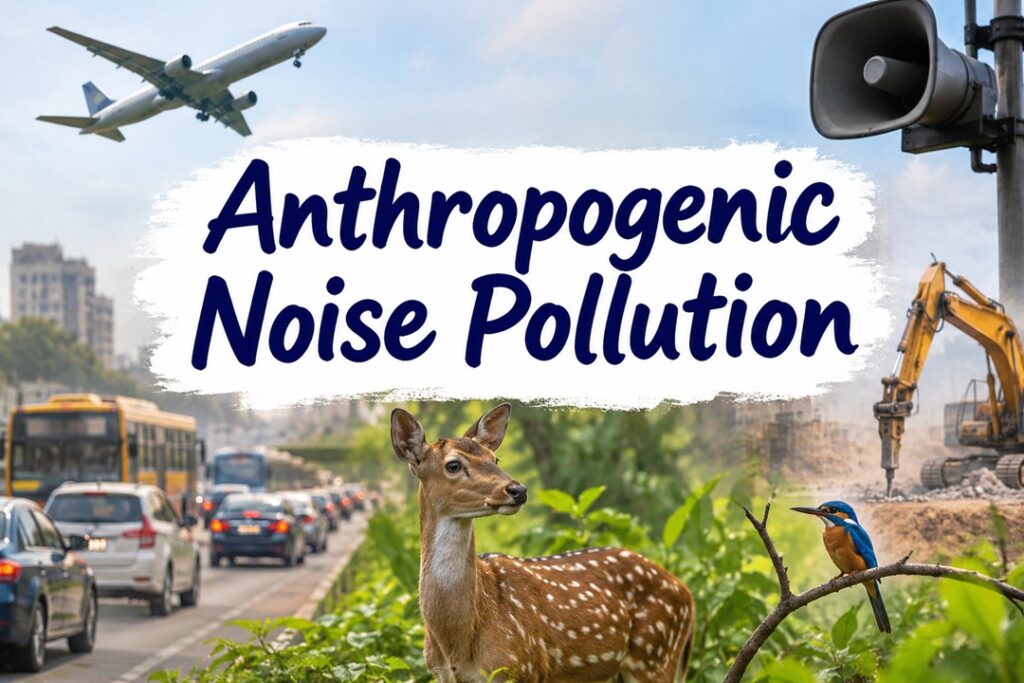
Anthropogenic noise pollution refers to excessive or disruptive sounds produced by human activities that disturb the natural acoustic environment and interfere with the survival and functioning of wildlife.
- Major Sources: Road traffic, industrial operations, shipping, offshore infrastructure, petroleum exploration and military sonar activities.
- Anthropocene Connection: As human activities increasingly shape planetary systems, noise has emerged as an additional form of environmental disturbance affecting terrestrial and aquatic ecosystems.
How Does Noise Pollution Affect Wildlife?
1. Alteration in Behavioural Patterns
- Wildlife modifies its feeding, movement, sheltering and predator-avoidance behaviour in response to continuous noise exposure.
- Predators experience approximately 25% lower hunting success despite increasing their hunting efforts by over 150%.
- Underwater noise makes it difficult for marine predators, such as killer whales, to detect and locate prey.
2. Physiological and Developmental Stress
- Persistent noise activates stress responses and increases the release of stress hormones.
- It can cause cellular damage and impair immunity, cognitive functioning, reflexes and internal physiological balance.
- Exposure can also interfere with reproductive processes and mate selection.
3. Disruption of Reproduction and Parental Care
- Noise exposure influences parental behaviour differently across species.
- Some bird species increase parental investment to compensate for environmental disturbances, potentially improving offspring weight.
- Other species reduce parental care, negatively affecting the survival of their young.
4. Declining Survival and Ecological Fitness
- Noise contributes to both direct mortality and indirect biological stress.
- The study identified a 138% rise in mortality and a 27% decline in overall fitness among the wildlife examined.
- These effects can weaken populations and reduce their capacity to adapt to environmental changes.
Why Are Marine Ecosystems Particularly Vulnerable?
Sound plays a fundamental role in aquatic ecosystems because it travels faster and farther in water than in air.
- Dependence on Acoustic Communication: Whales, fish and several marine invertebrates use sound for navigation, communication, locating food and understanding their surroundings.
- Growing Underwater Noise: Shipping, offshore construction, oil and gas exploration and military sonar generate human-induced underwater sounds, collectively referred to as anthrophony.
- Disruption of Ecological Interactions: Excessive underwater noise interferes with communication, predator detection, prey identification and other essential biological processes.
Consequently, increasing acoustic disturbances can affect the survival and ecological relationships of marine organisms, even without physically damaging their habitats.
Winners and Losers in the Changing Acoustic Environment
- Unequal Species Responses: Noise does not affect all species uniformly. Some organisms adapt to noisy conditions, while others experience significant behavioural and physiological stress.
- Acoustic Traps: Certain predators exploit situations where enclosed habitats amplify sound, potentially forcing prey into more exposed locations.
- Altered Predator–Prey Relationships: Changes in communication and sound perception can modify hunting efficiency and predator avoidance.
- Ecosystem Imbalance: These differential responses may alter species interactions, food webs and broader ecosystem dynamics.
Challenges in Controlling Noise Pollution
- Limited Visibility: Unlike conventional pollutants, noise pollution is not always physically visible, making its ecological consequences less apparent.
- Inadequate Regulatory Attention: Existing environmental and biodiversity conservation frameworks often give insufficient importance to natural soundscapes.
- Expanding Economic Activities: Growing maritime transport, industrialisation, infrastructure development and offshore exploration are increasing acoustic disturbances.
- Species-Specific Responses: Wildlife exhibits different levels of sensitivity and adaptation, making uniform mitigation standards difficult to implement.
- Monitoring Difficulties: Assessing long-term acoustic changes across diverse terrestrial and marine habitats requires specialised scientific monitoring.
Way Forward
- Recognising Acoustic Ecology: Integrate the protection of natural soundscapes into biodiversity conservation policies and environmental regulations.
- Establishing Acoustic Refuges: Identify and protect low-noise areas where wildlife can communicate, reproduce, feed and migrate without excessive disturbance.
- Promoting Quieter Technologies: Encourage noise-reduction technologies in shipping, industrial machinery, offshore construction and transportation.
- Strengthening Environmental Assessments: Incorporate terrestrial and underwater noise pollution into Environmental Impact Assessments (EIA) for infrastructure and industrial projects.
- Scientific Research and Monitoring: Develop long-term acoustic monitoring systems and species-specific noise exposure standards.
- International Cooperation: Promote coordinated action to address underwater noise, particularly in international shipping routes and shared marine ecosystems.
Conclusion
Anthropogenic noise is an increasingly important yet frequently overlooked driver of biodiversity loss. Conservation strategies must extend beyond protecting land, water and physical habitats to safeguarding the natural acoustic environments on which wildlife depends. Protecting the soundscape is therefore essential for maintaining ecological interactions, ecosystem stability and long-term biodiversity conservation.
Source : The Hindu