
The Berlin Conference (1884–85): Foundations of Africa’s Colonial Partition
Context
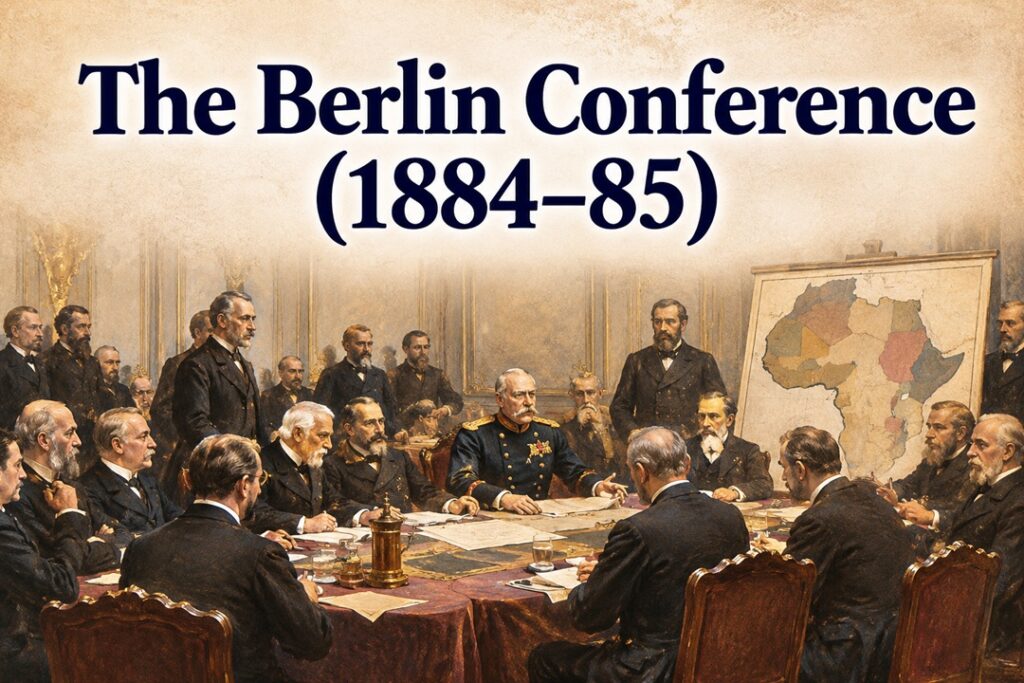
November 15, 2026, marks the 142nd anniversary of the Berlin West Africa Conference (1884–85), organised under German Chancellor Otto von Bismarck. The conference sought to regulate competing European colonial ambitions in Africa and established rules that facilitated the subsequent colonisation of the continent.
What Was the Berlin Conference?
The Berlin Conference was an international diplomatic meeting held in Berlin from November 15, 1884, to February 26, 1885. It concluded with the General Act of Berlin, which established a framework for regulating European territorial claims, commercial activities and navigation in Africa.
- Participants: Fourteen Western powers participated, including Britain, France, Germany, Portugal, Belgium, Spain, Italy, the United States and others.
- Exclusion of Africans: No African representatives were invited, despite the conference determining the future of their territories and populations.
Why Did European Powers Convene the Conference?
- Competition for Colonial Dominance: Germany and France sought to challenge Britain’s growing influence in Africa, particularly after its occupation of Egypt in 1882.
- Control over Congo Trade Routes: European powers opposed the Anglo-Portuguese Treaty of 1883, which recognised Portuguese claims over the mouth of the Congo River and threatened their commercial interests.
- Leopold II’s Territorial Ambitions: Belgium’s King Leopold II had expanded his influence in Central Africa through the International Association of the Congo, creating competing territorial claims.
- Avoiding European Conflicts: Growing colonial competition among Britain, France, Germany and Portugal raised the possibility of armed confrontation. The conference aimed to establish common rules to manage these rivalries.
Major Provisions of the General Act of Berlin
- Effective Occupation: European powers were required to demonstrate actual administrative and military control over a territory to establish valid colonial claims, rather than relying on symbolic declarations.
- Free Trade in the Congo Basin: The convention opened the Congo Basin to commercial activities by all participating powers without discriminatory trade restrictions.
- Freedom of Navigation: It guaranteed commercial navigation along the Congo and Niger rivers, facilitating European access to the African interior.
- Neutrality of the Congo Basin: The agreement provided for the neutrality of the Congo Basin during conflicts involving European powers.
- Suppression of Slave Trade: Participating countries committed themselves to combating the slave trade and protecting indigenous populations, although these commitments were frequently contradicted by colonial practices.
Did the Berlin Conference Directly Partition Africa?
The conference is often associated with the division of Africa, but its role requires historical clarification.
- No Direct Territorial Division: The General Act did not formally distribute African territories among European countries through a map-based division, although it recognised Leopold II’s claims over the Congo Free State.
- Institutionalising Colonial Expansion: The principle of effective occupation encouraged European powers to establish physical control over territories through military expeditions, treaties and administrative structures.
- Acceleration of the Scramble for Africa: The conference intensified competition for territorial acquisition, commonly known as the Scramble for Africa.
- Extent of Colonisation: By 1913, almost the entire African continent had come under European colonial control, with Ethiopia and Liberia remaining independent.
Long-Term Consequences of the Berlin Conference for Africa
- Arbitrary Political Boundaries: Colonial powers subsequently established borders without adequately considering existing ethnic, linguistic and cultural identities, dividing communities and creating territorial disputes.
- Economic Exploitation: Colonial economies were structured around extracting minerals, agricultural commodities and other natural resources for European industries rather than promoting African economic integration.
- Institutionalised Violence: Colonial expansion facilitated widespread exploitation, forced labour and human rights abuses, particularly under Leopold II’s administration in the Congo Free State.
- Political Instability: Artificial borders and colonial administrative arrangements contributed to post-independence conflicts, separatist movements and governance challenges.
- Weak Regional Integration: Colonial transport and trade networks primarily connected resource-producing regions with European markets, limiting economic linkages between African countries.
Way Forward
- Strengthen African Regional Cooperation: Institutions such as the African Union should promote peaceful resolution of border disputes and deeper regional integration.
- Promote Economic Self-Reliance: African countries should move beyond raw-material exports by developing domestic industries, value chains and regional markets.
- Address Historical Injustices: Greater attention should be given to colonial exploitation, restitution, cultural preservation and the protection of indigenous communities.
- Reform Global Governance: African countries should receive greater representation in international institutions to ensure that global decisions reflect their interests and sovereignty.
Conclusion
The Berlin Conference did not directly draw the modern political map of Africa, but it established the diplomatic and legal foundations that accelerated European colonial expansion. By prioritising European commercial interests and political competition over African sovereignty, it facilitated the continent’s widespread colonisation. Its legacy of artificial boundaries, economic dependency and political instability highlights the long-term consequences of excluding indigenous populations from decisions concerning their own future.
Source : The Indian Express