
Quad Manila Summit 2026: Strengthening Indo-Pacific Cooperation and India’s Strategic Role
Context
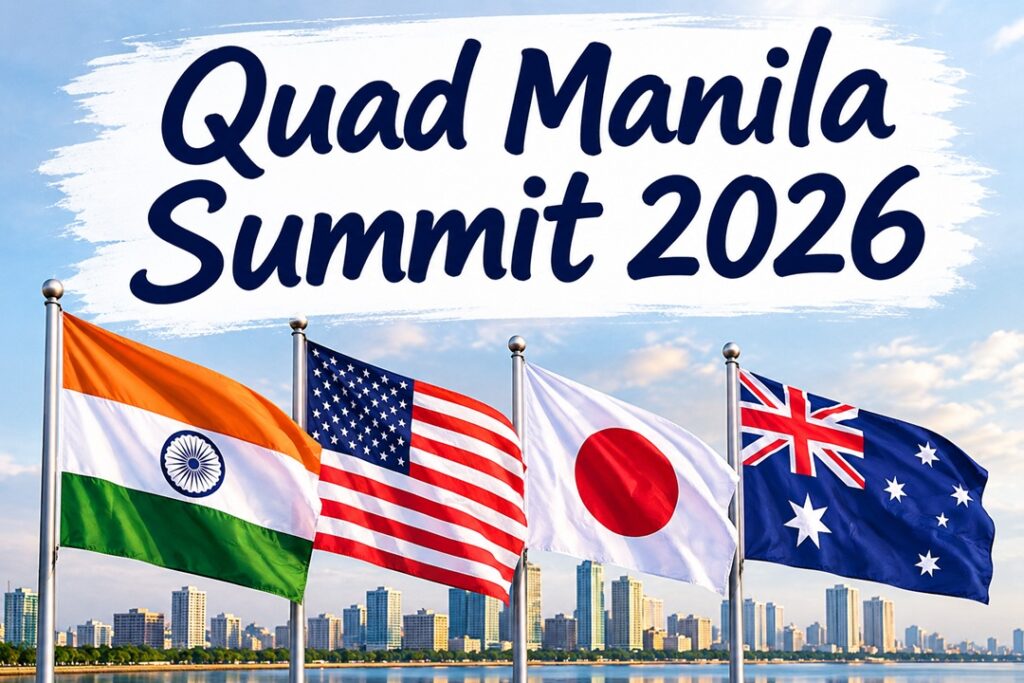
Leaders of the Quadrilateral Security Dialogue (Quad), comprising India, the United States, Japan and Australia, convened in Manila, Philippines, on November 17, 2026. The summit marked the first time a non-member country hosted a Quad Leaders’ Summit, highlighting the grouping’s growing engagement with Southeast Asia and its commitment to a Free and Open Indo-Pacific.
About the Quad Grouping
The Quad is a strategic partnership among four maritime democracies aimed at promoting a free, open, inclusive and rules-based Indo-Pacific. Revived in 2017, it has expanded its cooperation beyond maritime security to include infrastructure, technology, economic resilience, cybersecurity and regional connectivity.
The 2026 Manila Summit was held alongside regional ASEAN and East Asia Summit engagements, marking nearly a decade of the Quad’s revival and ten years of Japan’s Free and Open Indo-Pacific vision.
Major Outcomes of the Manila Summit
1. Opposition to Coercive Practices: The leaders opposed unilateral attempts to alter the regional status quo through force or coercion. They also expressed concern over arbitrary export restrictions and the use of supply chains as instruments of geopolitical pressure.
2. Quad Business Leaders’ Forum: India will host the inaugural Quad Business Leaders’ Forum in Mumbai in early 2027. The initiative seeks to strengthen private-sector partnerships, promote investment and develop resilient regional supply chains.
3. Strengthening Maritime Security: The summit advanced maritime domain awareness cooperation and announced the first Quad-context joint maritime patrol exercise for 2027, involving P-8 and P-3C surveillance aircraft.
4. Artificial Intelligence Cooperation: The Quad AI Accelerator was operationalised to facilitate funding, technical assistance and the deployment of trustworthy AI solutions across Indo-Pacific countries.
5. Resilient Undersea Connectivity: Leaders welcomed new undersea communication cable projects in the Indian Ocean. Australia also announced an expanded contribution towards submarine electricity cable connectivity, supporting regional energy security.
6. Cybersecurity and Counterterrorism: The members agreed to strengthen cooperation against cyber threats, cross-border terrorism and violent extremism through coordinated regional frameworks.
7. Reaffirming ASEAN Centrality: The summit reiterated support for ASEAN unity and its central role in shaping the regional security and economic architecture.
Challenges Facing the Quad
1. Vulnerability of Critical Supply Chains
- Concentration of strategic resources and manufacturing capacities in a few countries exposes Quad members to economic coercion and supply disruptions.
- For instance, China’s export restrictions on critical minerals and heavy infrastructure equipment, including Tunnel Boring Machines (TBMs), have affected India’s infrastructure and metro-rail projects.
2. Divergent Strategic Priorities
- Differences in geopolitical interests and diplomatic priorities can affect the consistency of Quad cooperation.
- India’s need to balance maritime commitments with border security along the Line of Actual Control (LAC), strategic autonomy and energy security illustrates this challenge.
- Similarly, changing US diplomatic priorities towards major-power relations and conflicts in Europe and West Asia could weaken sustained attention towards the Indo-Pacific.
3. Institutional Limitations
- The Quad does not have a permanent secretariat or legally binding treaty framework.
- Consequently, implementation of summit-level commitments depends heavily on political willingness, intergovernmental coordination and individual national capacities.
- Delays in developing alternative regional economic arrangements following setbacks to initiatives such as the Indo-Pacific Economic Framework (IPEF) highlight the difficulty of translating strategic ambitions into practical outcomes.
4. Balancing ASEAN Sensitivities
- Several Southeast Asian countries support the Quad’s development initiatives but remain cautious about becoming involved in major-power rivalry.
- India’s simultaneous engagement with ASEAN through initiatives such as free e-visas for ASEAN tourists and seafarer safety cooperation reflects the importance of maintaining an inclusive and non-confrontational regional approach.
Strategic Significance of the Manila Summit
1. Revitalising Political Commitment
The summit restored leader-level engagement after a two-year gap since the 2024 Wilmington Summit. It demonstrated the grouping’s ability to maintain continuity despite political and leadership changes among member countries.
2. Strengthening ASEAN’s Regional Role
Holding the summit in Manila, a country directly affected by South China Sea tensions, demonstrated support for Southeast Asian sovereignty. It also reinforced the message that the Quad complements rather than replaces ASEAN-led regional institutions.
3. Moving Towards Practical Maritime Cooperation
The proposed joint maritime patrol exercise represents a shift from information-sharing and maritime surveillance towards greater operational coordination. This could improve interoperability and collective responses to maritime security challenges.
4. Enhancing India’s Geo-economic Influence
India’s selection as host of the first Quad Business Leaders’ Forum in Mumbai strengthens its position as a regional destination for investment, technology partnerships and supply-chain diversification.
5. Addressing Emerging Security Threats
Cooperation on artificial intelligence, cybersecurity, terrorism and critical infrastructure protection expands the Quad’s relevance beyond conventional military security to emerging non-traditional threats.
Way Forward
- Strengthen Institutional Coordination: Establish dedicated coordination mechanisms and measurable implementation timelines to ensure that summit commitments translate into tangible outcomes.
- Diversify Critical Supply Chains: Develop alternative sources of critical minerals, semiconductors, energy resources and essential industrial equipment to reduce strategic dependencies.
- Prioritise ASEAN Engagement: Ensure that Quad initiatives remain transparent, inclusive and responsive to Southeast Asian development and security priorities.
- Expand Maritime Cooperation: Strengthen information-sharing, joint exercises, humanitarian assistance and disaster response capabilities while respecting international law, particularly UNCLOS.
- Promote Technology Partnerships: Accelerate cooperation in trusted AI, digital infrastructure, cybersecurity and emerging technologies while protecting data security and technological sovereignty.
- Mobilise Private Investment: Use the Mumbai Business Leaders’ Forum to develop concrete investment partnerships and deliver infrastructure projects across the Indo-Pacific.
Conclusion
The 2026 Manila Summit represents an important step in transforming the Quad from a strategic consultative grouping into a more action-oriented partnership. Its expanded focus on maritime security, economic resilience, technological cooperation and regional connectivity reflects the changing nature of Indo-Pacific challenges. For India, the grouping provides an opportunity to strengthen its maritime influence, diversify strategic partnerships and emerge as a key provider of regional public goods. However, its long-term effectiveness will depend on institutional continuity, practical implementation and sensitivity towards ASEAN’s central role in the regional order.
Source : MEA