
From Mineral Extraction to Material Security: Strengthening India’s Critical Mineral Ecosystem
Context
Experts have called for India to move beyond mineral exploration and mining towards domestic processing, refining and recycling to reduce external dependence and safeguard industrial supply chains. The ₹34,300 crore National Critical Mineral Mission (NCMM) provides an institutional framework for achieving this transition.
What is Material Security?
Material security refers to ensuring a reliable and uninterrupted supply of processed, refined and industry-ready minerals required for domestic manufacturing.
- It goes beyond possessing mineral reserves or extracting raw ores.
- It includes beneficiation, chemical refining, recycling and maintaining strategic reserves.
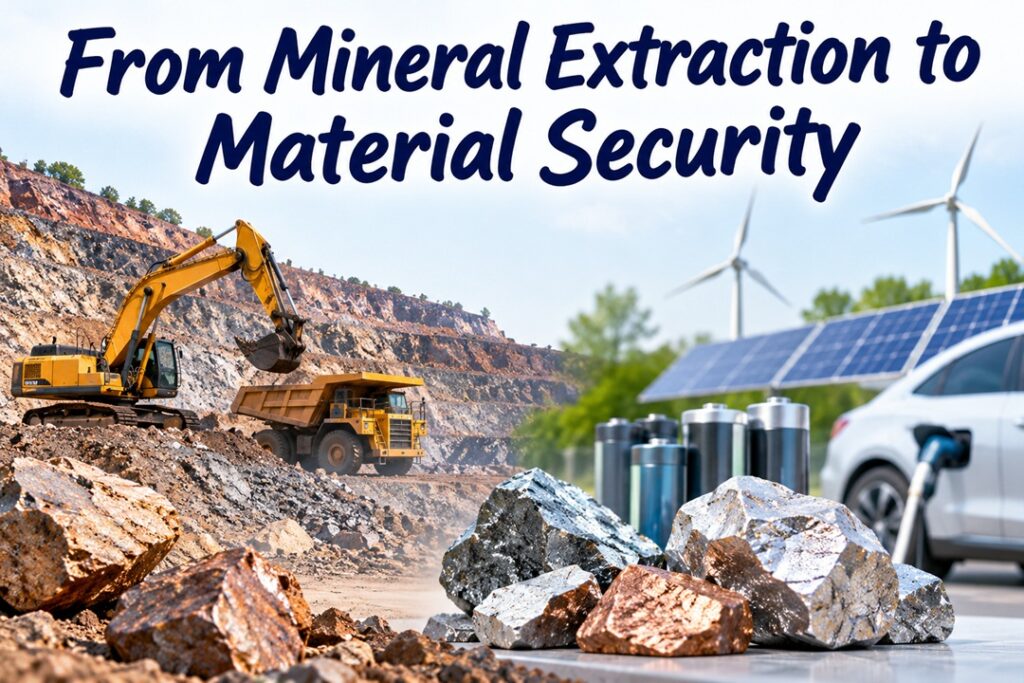
- Minerals such as lithium, cobalt, nickel and rare earth elements are essential for electric vehicles, renewable energy, electronics and advanced manufacturing.
India’s Policy Framework for Critical Mineral Security
India has introduced several initiatives to strengthen its critical mineral ecosystem:
1. National Critical Mineral Mission (NCMM): Approved in 2025 with an allocation of ₹34,300 crore over seven years, it supports exploration, mining, mineral processing, overseas acquisitions and research and development.
2. MMDR Act Amendments (2023 and 2025): These amendments strengthened the framework for critical mineral block auctions, overseas mineral acquisitions and recovery of minerals from mining waste.
3. Critical Mineral Recycling Incentive Scheme: With an outlay of ₹1,500 crore for 2025–31, the scheme encourages mineral recovery from electronic waste, discarded batteries and industrial waste, targeting 400 kilotonnes of recycled material by 2031.
4. Overseas Mineral Acquisition: Khanij Bidesh India Limited (KABIL) facilitates access to mineral resources abroad through acquisitions and international partnerships, including lithium resources in Argentina.
Why Mining and Auctions Alone Cannot Ensure Mineral Security?
India’s current approach needs to address the gap between mineral extraction and the availability of usable industrial materials.
– Processing is the Missing Link: Extracted ores require beneficiation and specialised chemical refining before they can be used in batteries, electric motors and permanent magnets. Countries such as China have gained strategic advantages through their strong mineral processing and refining capabilities.
– Long Lead Time for Domestic Mining: New mining projects require environmental approvals, land acquisition and infrastructure development. Consequently, domestic mineral production may not keep pace with the rapidly expanding requirements of EV and renewable energy industries.
– Continued Import Dependence: Despite having geological reserves, India remains heavily dependent on imports of processed lithium, cobalt, nickel and sintered rare-earth permanent magnets.
Major Challenges in Achieving Material Security
1. Inadequate Domestic Processing Infrastructure
India lacks sufficient commercial-scale hydrometallurgical and chemical refining facilities. This creates the possibility of extracting minerals domestically, exporting them for processing and subsequently importing the refined products.
2. Weak E-Waste Collection and Recycling Systems
India generated approximately 3.8 million tonnes of e-waste in 2024. However, informal collection networks, inconsistent material quality and inadequate traceability restrict the availability of reliable raw materials for organised recycling industries.
3. Changing Battery Technologies
Rapid technological developments make long-term mineral demand difficult to predict. For instance, the growing adoption of Lithium Iron Phosphate (LFP) batteries compared with Nickel Manganese Cobalt (NMC) batteries changes the relative demand for nickel and cobalt.
Therefore, excessive investment in static mineral stockpiles could create financial and strategic risks.
4. Geopolitical Concentration of Supply Chains
The concentration of mining and refining activities in a few countries exposes India to export restrictions, supply disruptions and international price fluctuations. Restrictions on critical minerals and rare-earth magnets can directly affect automobile and clean-energy manufacturing.
5. Technology and Research Constraints
Advanced mineral separation, refining and recycling require specialised technologies, skilled manpower and substantial capital investment. Limited domestic technological capabilities can delay the development of an integrated mineral industry.
Way Forward
– Develop Integrated Processing Infrastructure: Establish critical mineral processing parks near mining locations and ensure that refining facilities develop alongside mineral extraction projects.
– Strengthen Urban Mining: Integrate informal waste collectors into formal recycling networks through Extended Producer Responsibility (EPR), digital tracking and quality certification under Bureau of Indian Standards (BIS) standards.
– Create Strategic Mineral Reserves: Prioritise stockpiling refined, industrial-grade minerals rather than raw ores. Establish clear mechanisms for periodic stock rotation and emergency release.
– Adopt Outcome-Based Assessment: Evaluate the NCMM through the actual quantity of refined and recycled minerals supplied to domestic industries instead of focusing predominantly on the number of mineral blocks auctioned.
– Promote Indigenous Technology: Leverage the ₹210 crore ANRF-MAHA Research Programme and international collaborations with Australia, Japan and the European Union to develop advanced refining, mineral recovery and rare-earth processing technologies.
– Diversify International Supply Chains: Expand overseas mineral partnerships and acquisitions to reduce excessive dependence on individual countries and improve supply-chain resilience.
Conclusion
India’s critical mineral strategy must evolve from securing mineral deposits to ensuring the availability of processed and industry-ready materials. While the National Critical Mineral Mission and mining reforms provide an important institutional foundation, their success will depend on building domestic refining capabilities, strengthening recycling networks and developing strategic reserves. An integrated approach to exploration, processing and circular resource management is essential for securing India’s clean energy transition, electric mobility and long-term manufacturing competitiveness.
Source : The Hindu