
Tackling India’s Air Pollution Through a Citizen-Led Clean Air Movement
Context
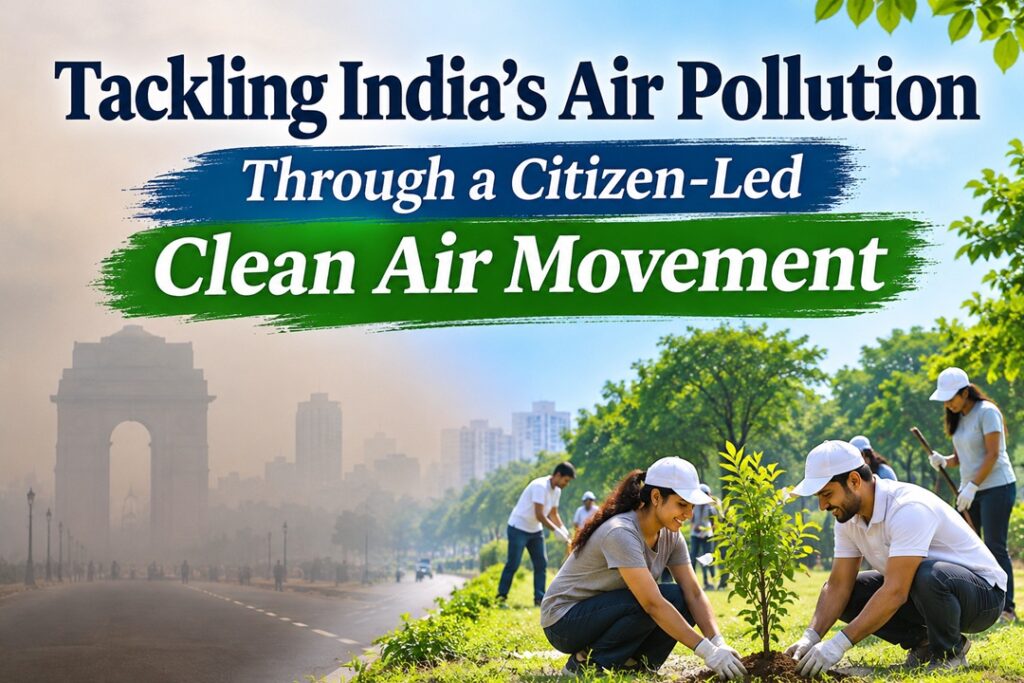
Following the post-Deepavali deterioration in air quality, with Delhi-NCR recording an AQI of nearly 400 and authorities imposing Stage III restrictions under the Graded Response Action Plan (GRAP), experts have called for a sustained, citizen-driven anti-pollution campaign inspired by the behavioural transformation achieved through the Swachh Bharat Mission.
Understanding India’s Air Pollution Crisis
Air pollution in India has evolved into a persistent public health and environmental challenge. It results from multiple sources, including vehicular emissions, industrial pollution, construction dust, agricultural residue burning and open waste disposal. These sources become particularly dangerous during winter when unfavourable meteorological conditions trap pollutants near the ground.
Magnitude and Health Consequences
- Dangerously High Pollution: Particulate matter concentrations in several Indian cities remain significantly above WHO-recommended limits, with pollution levels in parts of Delhi-NCR reaching an AQI of 400, affecting nearly 80 million residents.
- Reduced Life Expectancy: According to the Energy Policy Institute at the University of Chicago (EPIC) 2025 report, air pollution reduces India’s average life expectancy by approximately five years.
- Global Pollution Burden: India remains among the world’s most polluted countries, highlighting the need for stronger preventive public health measures.
Government Measures to Control Air Pollution
- Graded Response Action Plan (GRAP): The Commission for Air Quality Management (CAQM) escalated GRAP restrictions from Stage I to Stage III within 15 days, including construction bans, stricter vehicle pollution checks and inspections of agricultural stubble-burning locations.
- Real-Time Pollution Monitoring: The deployment of PAVAN-I3C (Integrated Command and Control Centre) aims to strengthen industrial and traffic pollution surveillance.
- Emission Reduction Targets: Delhi and neighbouring NCR states have been directed to reduce annual pollution levels by 15–20%.
Despite these interventions, recurring pollution episodes indicate that regulatory enforcement must be complemented by long-term behavioural transformation.
Why Is a Citizen-Led Movement Necessary?
1. Limitations of Emergency-Based Enforcement
Temporary construction bans, vehicle restrictions and penalties can reduce pollution during severe episodes but cannot independently address its underlying causes. Such interventions often produce short-term compliance without establishing environmentally responsible habits.
2. Lessons from the Swachh Bharat Mission
The Swachh Bharat Mission (SBM) demonstrated how sustained communication and community participation can transform public behaviour.
- It helped change sanitation practices among approximately 600 million people who previously practised open defecation.
- Between 2015 and 2019, rural India received an estimated 2,500–3,300 targeted communication messages per person.
- Strong political leadership, local participation and continuous awareness campaigns helped establish sanitation as a collective responsibility.
A similar behavioural mobilisation strategy can make clean air a shared public priority.
3. Community Participation: The Indore Experience
Indore’s achievement as one of India’s cleanest cities demonstrates the importance of combining public infrastructure with citizen ownership. More than 35 lakh citizens have participated in its waste-management and zero-waste initiatives, showing how collective responsibility can support lasting environmental improvements.
4. Alignment with Mission LiFE
India’s Lifestyle for Environment (LiFE) initiative encourages individuals to adopt sustainable consumption and production practices. Its behavioural approach, alongside initiatives such as Ek Ped Maa Ke Naam, can strengthen public participation in pollution reduction and environmental conservation.
The wider adoption of lifestyle-based interventions has the potential to reduce annual global carbon dioxide emissions by approximately 2 billion tonnes by 2030.
Major Challenges in Building a Clean Air Movement
1. Resistance to Lifestyle Changes
- Many citizens continue to prefer private vehicles despite expanding public transport networks.
- Voluntary measures such as carpooling, waste segregation and avoiding open biomass burning remain inconsistently followed.
- The contradiction between demanding clean air and engaging in polluting activities weakens collective action.
2. Seasonal and Reactive Public Communication
- Awareness campaigns frequently intensify only when pollution reaches dangerous levels.
- Last-minute vehicle restrictions and regulatory announcements create confusion and inconvenience.
- Inadequate advance communication can result in traffic congestion and non-compliance, particularly at Delhi’s entry points.
3. Excessive Dependence on Temporary Technological Solutions
- Measures such as anti-smog guns, water sprinkling and artificial rain experiments may offer limited or temporary relief.
- Excessive dependence on these interventions can divert resources from structural emission reduction, cleaner mobility and public awareness.
4. Weak Connection Between Environmental Responsibility and Personal Benefits
- General appeals for environmental protection may not sufficiently motivate behavioural change.
- Citizens need to understand how cleaner choices directly improve their health, reduce household expenditure and enhance quality of life.
5. Infrastructure and Institutional Gaps
- Inadequate last-mile connectivity discourages people from shifting to public transport.
- Limited waste-processing and crop-residue management facilities make environmentally responsible practices difficult.
- Fragmented coordination among neighbouring states complicates regional pollution management.
Way Forward
1. Institutionalise Year-Round Awareness Campaigns
- Shift from emergency-based communication to continuous multimedia campaigns on vehicle emissions, waste management, firecracker use and public health consequences.
- Promote the economic and environmental benefits of electric vehicles (EVs), CNG and public transport.
- Use local languages and community-specific communication strategies.
2. Strengthen Grassroots Environmental Participation
- Organise regular awareness programmes through schools, colleges, Resident Welfare Associations (RWAs), farmer cooperatives, transport unions and industrial establishments.
- Involve State Pollution Control Boards in community-level training and environmental education.
- Encourage citizen groups to monitor local pollution sources and report violations.
3. Combine Infrastructure with Behavioural Responsibility
- Improve affordable public transport and last-mile connectivity.
- Establish effective segregated waste collection and scientific waste-processing facilities.
- Expand access to crop-residue management machinery and alternatives to open-field burning.
- Make sustainable choices convenient and accessible rather than relying exclusively on penalties.
4. Mobilise Political Leadership and Local Champions
- Involve elected representatives, community leaders, educational institutions and public figures in promoting clean-air practices.
- Recognise neighbourhoods and institutions that achieve measurable pollution-reduction outcomes.
- Develop a mass movement similar to Swachh Bharat, making clean air a continuous public campaign.
5. Strengthen Regional Coordination and Accountability
- Improve coordination between Delhi and neighbouring states to address transboundary pollution.
- Establish measurable annual pollution-reduction targets and transparent public reporting.
- Combine CAQM enforcement with local-level monitoring and community participation.
Conclusion
India’s recurring air pollution crisis cannot be resolved through seasonal restrictions and emergency interventions alone. The experience of the Swachh Bharat Mission demonstrates that sustained communication, political commitment and community ownership can transform public behaviour at scale. By integrating Mission LiFE principles with stronger infrastructure, institutional accountability and citizen participation, India must transform clean air from a seasonal government priority into a year-round people’s movement. Such collective action is essential for protecting public health and achieving the vision of Viksit Bharat.
Source : The Hindu