
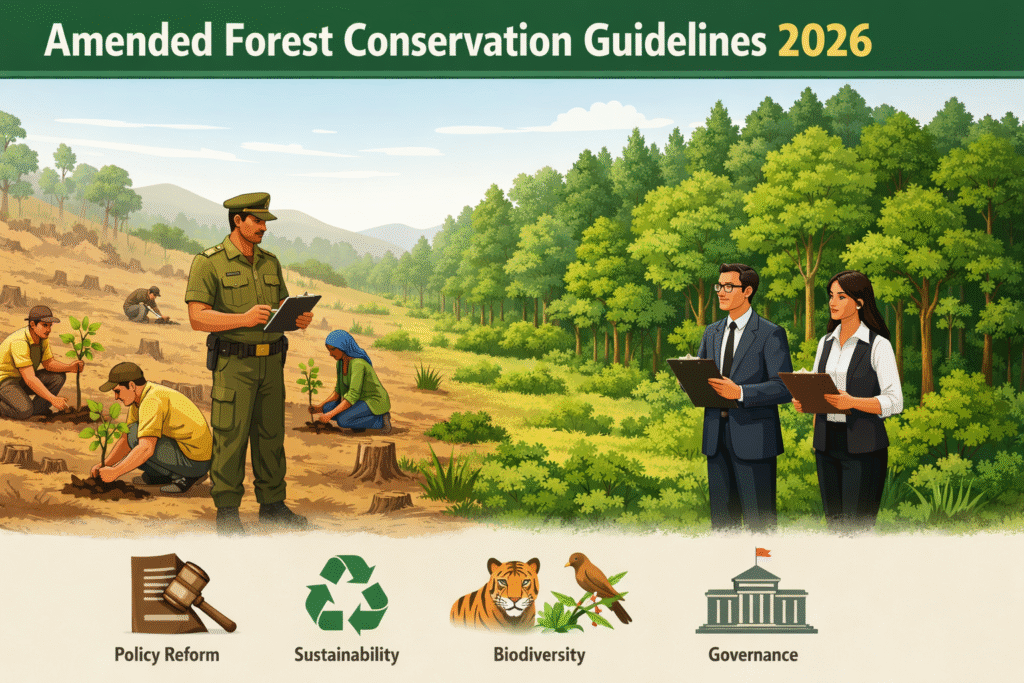
Context: In January 2026, the Ministry of Environment, Forest and Climate Change (MoEFCC) amended guidelines under the Van (Sanrakshan Evam Samvardhan) Adhiniyam, 1980 to allow non-government participation in restoring degraded forest land.
Nature of Amendment: Revises the 2023 guidelines under the Act to treat certain plantation and afforestation activities on forest land as forestry activities, not non-forest use, when carried out as per approved plans.
Key Provisions:
Reclassification of Plantations: Plantation and afforestation on forest land are recognised as forestry activities under state supervision.
Compensatory Afforestation Exemption: Such projects are exempted from Compensatory Afforestation, as no formal forest diversion is involved.
NPV Waiver: Net Present Value charges are no longer required for plantation and restoration activities on forest land.
Non-government Participation: Private and non-government entities can be engaged by states for restoration and plantation work.
Plan-based Approval: Activities must strictly follow approved Working Plans or Management Plans of State Forest Departments.
State-level Flexibility: States may frame case-specific revenue-sharing and utilisation mechanisms.
Retention of Government Control: Ownership and management of forest land remain with the government.
Rationale for the Amendment:
Extent of Degradation: ISFR 2023 reports about 2.08 lakh sq. km of forests under open and scrub categories.
Green Cover Target: Achieving the 33 percent forest and tree cover goal requires resources beyond public funding.
Rising Imports: Paper and paperboard imports nearly doubled between 2020–21 and 2024–25.
Fiscal Constraints: Limited government finances necessitate private and non-government investment.
Concerns and Challenges:
Monoculture Risk: Commercial plantations may replace native forests, reducing biodiversity.
Dilution of Safeguards: Removal of CA and NPV weakens ecological cost internalisation.
Community Impact: Plantation-centric models may undermine rights under the Forest Rights Act.
Regulatory Ambiguity: Blurring of lines between restoration and commercial exploitation.
Conclusion: The 2026 amendments aim to accelerate restoration of degraded forests by mobilising non-government resources. However, without strict safeguards, biodiversity protection and community rights may be compromised. A science-based, rights-oriented and transparent framework is essential to ensure that restoration strengthens India’s natural forests rather than merely expanding plantations.
Source : DH