
Artificial Intelligence as a Catalyst for Rural Transformation in India
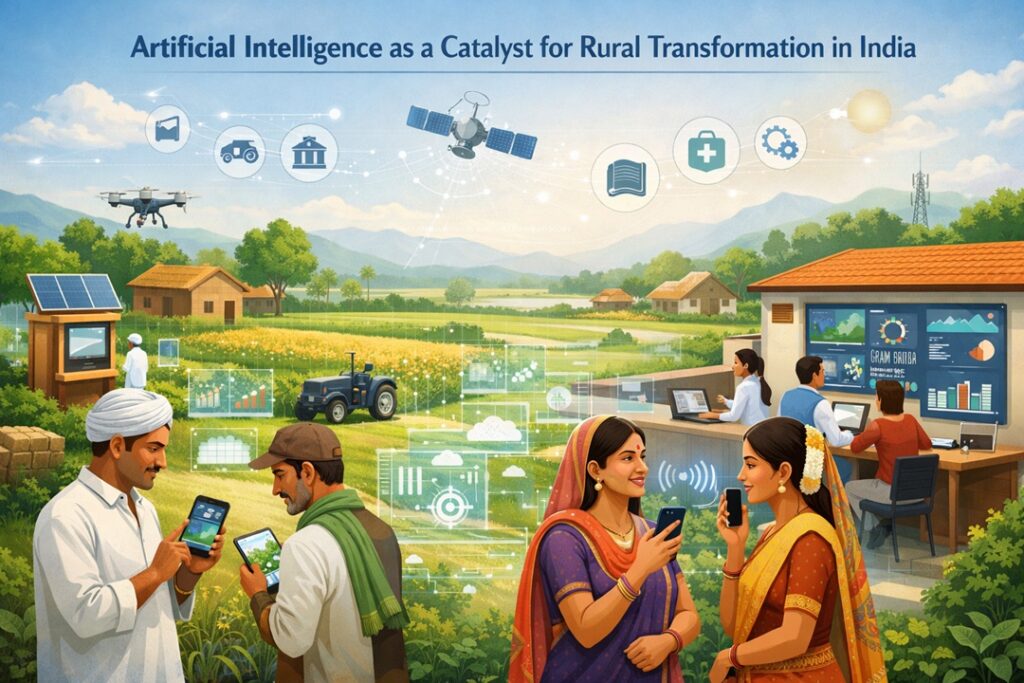
Context
The India–AI Impact Summit 2026 positioned Artificial Intelligence as a foundational enabler of Viksit Bharat@2047, signalling India’s transition from experimental AI pilots to scalable, nationwide deployment in rural administration, welfare delivery, and livelihood generation. The rollout of BharatGen, along with the India AI Governance Guidelines, has institutionalised a framework for responsible, inclusive, and multilingual AI grounded in Indian socio-economic realities.
AI as an Enabler of Rural Transformation
Core Idea:
In rural India, AI operates as a development-centric digital tool capable of undertaking cognitive functions such as climate-risk assessment, crop diagnostics, and speech-to-text translation. When integrated with Digital Public Infrastructure (DPI), AI serves as a public utility by extending governance and service delivery to regions constrained by weak physical infrastructure.
Developmental Potential Across Rural Sectors
Climate-Smart Farming & Yield Optimisation:
AI-driven models assist farmers through predictive insights on weather variability, pest infestation, and soil conditions, improving farm resilience.
Illustration: The AI-enabled National Pest Surveillance System processes satellite and field data to deliver timely advisories to farmers in Karnataka and other states.
Voice-Based Public Service Delivery:
Natural Language Processing (NLP) allows citizens to access government schemes through speech interfaces, overcoming literacy and language barriers.
Illustration: BHASHINI enables voice-based access to PM-Kisan and other services across 14+ Indian languages.
Last-Mile Healthcare Support:
AI-based chatbots and decision-support systems augment healthcare delivery in underserved regions.
Illustration: The Suman Sakhi WhatsApp chatbot in Madhya Pradesh provides maternal and neonatal health guidance to rural families.
Automation in Local Self-Governance:
AI tools improve the quality and transparency of Panchayat-level documentation and decision-making.
Illustration: SabhaSaar converts Gram Sabha audio recordings into structured minutes, benefiting over 2.5 lakh Panchayats.
Monitoring of Rural Assets:
Geospatial AI enhances accountability in public works by tracking asset creation and maintenance.
Illustration: BhuPRAHARI uses satellite imagery to assess MGNREGA assets such as Amrit Sarovars.
Policy Measures and Institutional Support
IndiaAI Mission: ₹10,372 crore national initiative to provide affordable compute infrastructure, datasets, and innovation support.
BharatGen (2025): A government-backed multimodal LLM supporting 22 Indian languages, reinforcing India’s sovereign AI ecosystem.
Adi Vaani Platform: AI-driven initiative focused on tribal communities for service access and preservation of indigenous oral knowledge.
YUVAI Programme: Capacity-building initiative training students (Classes 8–12) to apply AI solutions to grassroots challenges.
eGramSwaraj & Gram Manchitra: Integrated digital platforms for Panchayat planning, budgeting, and spatial asset management.
Structural and Ethical Constraints
Connectivity Gaps: Inadequate power supply and broadband coverage hinder AI deployment in remote regions.
Skill and Awareness Deficit: Low levels of digital and AI literacy restrict meaningful adoption and increase exposure to misinformation.
Contextual Data Limitations: Global datasets fail to capture India’s linguistic and agro-ecological diversity.
Fiscal Barriers: High upfront costs deter Panchayat-level adoption of AI tools.
Privacy Concerns: Expanding use of biometric data raises risks of surveillance and exclusion.
Strategic Path Forward
Satellite-Based Digital Access through LEO networks
India-Centric Data Ecosystem via AI Data Labs
Explainable AI (XAI) in welfare delivery
Grassroots Skill Building under PMGDISHA
Strengthening Indigenous Models like BharatGen
Closing Perspective
Artificial Intelligence has the potential to evolve into a public infrastructure for inclusion rather than remaining an urban-centric technology. By embedding AI within ethical frameworks, local languages, and grassroots governance, India can ensure that digital transformation translates into tangible socio-economic gains for rural communities.
Source : PIB