
Attacks on UAE Energy Infrastructure & Strategic Role of Fujairah Port
Context
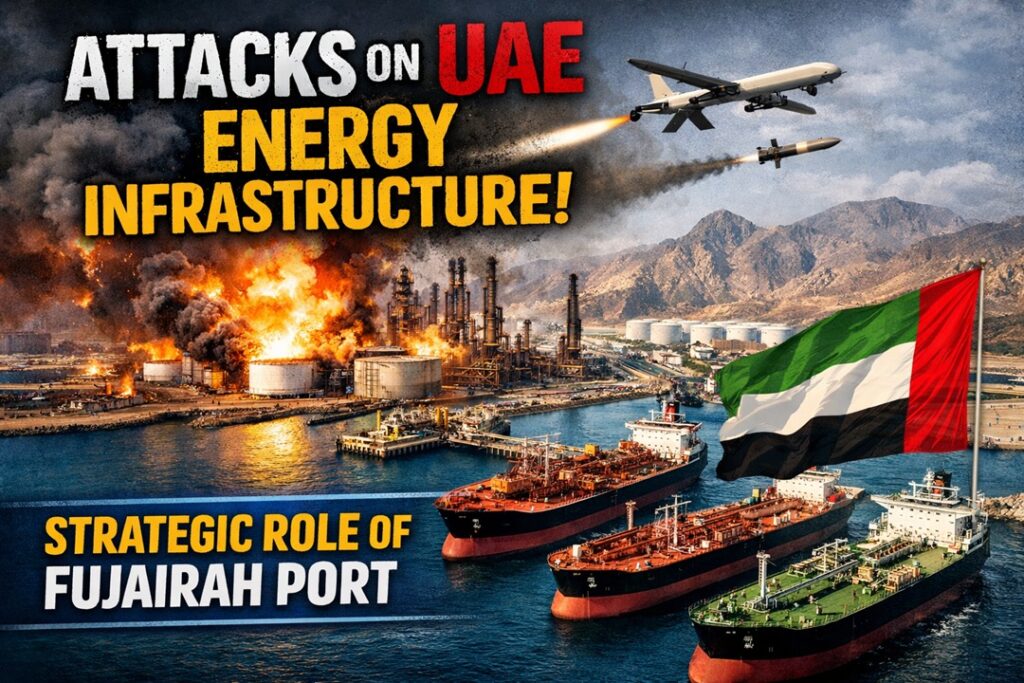
Recent drone and missile strikes near Fujairah and the Shah gas field in the UAE have disrupted oil loading and gas operations, highlighting vulnerabilities in regional energy infrastructure.
Port of Fujairah
Overview:
A major deep-water, multipurpose port and one of the world’s leading oil storage and bunkering hubs, serving as a key export outlet for UAE hydrocarbons.
Location:
Situated in Fujairah Emirate on the eastern coast of the United Arab Emirates.
Sea Access:
Directly opens into the Gulf of Oman and Arabian Sea, bypassing the Strait of Hormuz.
Historical Background:
Developed in the late 1970s and operational since the early 1980s; expanded into a global oil logistics hub over time.
Key Features
- Connected to Abu Dhabi oil fields via the Abu Dhabi Crude Oil Pipeline (ADCOP), enabling exports without passing Hormuz.
- Large oil storage capacity, making it one of the biggest global storage hubs.
- Among the top global bunkering centres supplying fuel to ships.
- Advanced port infrastructure with modern terminals and extensive berthing facilities.
- Handles significant maritime traffic annually with high anchorage capacity.
Industrial Ecosystem
Hosts the Fujairah Oil Industry Zone (FOIZ) and several international oil companies, forming an integrated energy and logistics hub.
Strategic Significance
- Provides an alternative export route outside the Strait of Hormuz chokepoint.
- Enhances UAE’s energy security and resilience.
- Acts as a key node linking Middle Eastern energy supplies to global markets.
Source : DD News