
BharatNet & National Broadband Mission 2.0
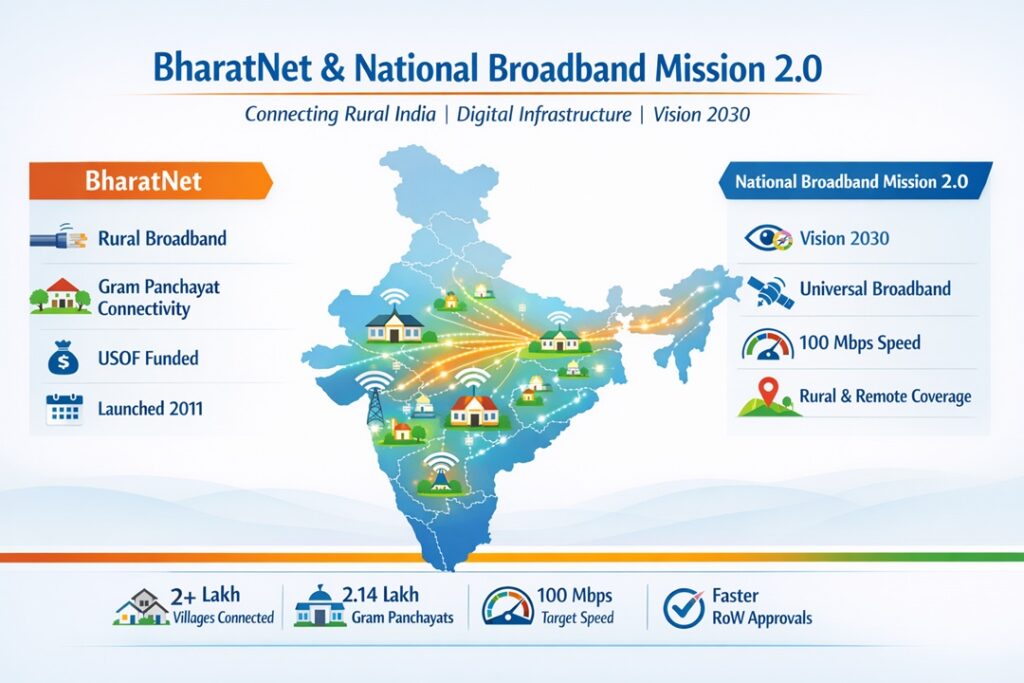
Context
The Union Minister for Communications recently presented an update on the implementation status of BharatNet, progress in rural digital infrastructure, and long-term goals under National Broadband Mission (NBM) 2.0 aimed at achieving universal connectivity by 2030.
Overview of BharatNet
- Core Objective: To eliminate digital inequality by ensuring reliable high-speed broadband access in rural regions.
- Priority Areas: Village-level institutions, particularly Gram Panchayats.
- Inception: October 2011.
- Administrative Ministry: Ministry of Communications.
Execution Framework
- Governance Model: Joint Centre–State initiative.
- State Role: Provision of free Right of Way (RoW) for network deployment.
- Right of Way (RoW): Statutory authorization that allows public agencies to install and maintain telecom and digital infrastructure on land or property.
Operational Components
- Financial Support: Universal Service Obligation Fund (USOF).
- Technology Stack: Optical Fibre Cable (OFC), satellite links, radio-based connectivity, fibre over power lines, and public Wi-Fi hotspots.
- Implementation Mode: Nationwide village coverage with Public–Private Partnership (PPP) execution in 16 States.
Implementation Status (September 2025)
- Connected Gram Panchayats: Over 2.14 lakh under Phase I and Phase II.
- Village Reach: More than 2 lakh villages connected.
- Last-Mile Access: Over 1 lakh Wi-Fi hotspots made operational.
Strategic Importance
- Inclusive Digital Access: Narrows the rural–urban connectivity gap.
- Public Service Enablement: Facilitates digital governance, telemedicine, online education, agri-advisory services, and DBT-based welfare delivery.
- National Digital Backbone: Acts as a foundational pillar for Digital India and technology-led growth.
Fast Facts: National Broadband Mission (NBM) 2.0 – Vision 2030
- Purpose: Establish a comprehensive framework for nationwide broadband availability by 2030.
- Launch Year: April 2025.
- Focus: High-speed, affordable, and meaningful internet access for all regions, including remote and underserved areas.
Targets and Present Performance
| Indicator | 2030 Goal | Present Level |
|---|---|---|
| Village Optical Fibre Coverage | 2.7 lakh villages with 95% uptime | 42,000 villages (Dec 2025) |
| Connectivity of Key Institutions (schools, anganwadis, panchayats) | 90% | 68.8% |
| Average Fixed Broadband Speed | 100 Mbps | 61.55 Mbps |
| RoW Clearance Timeline | Streamlined approvals | Reduced from 455 days to 30.4 days |
| Fibre Asset Mapping (PM GatiShakti) | 100% coverage | 94% |
| Rural Internet Density | 60 users per 100 population | 47.16 per 100 population |
Source : PIB