
Bureau of Indian Standards: Institutional Evolution and Contemporary Reforms
Context
The 79th Foundation Day of the Bureau of Indian Standards (BIS) was celebrated, highlighting its shift from a regulatory to a facilitative approach in line with ease of doing business and strengthening a national quality culture.
Institutional Profile
Nature and Role
• India’s National Standards Body
• Ensures standardisation, certification, hallmarking, and quality assurance
• Focus on consumer protection and global competitiveness
Establishment and Location
• Established in 1987
• Operational from 1 April 1987
• Headquarters at New Delhi
Evolution and Legal Framework
Historical Background
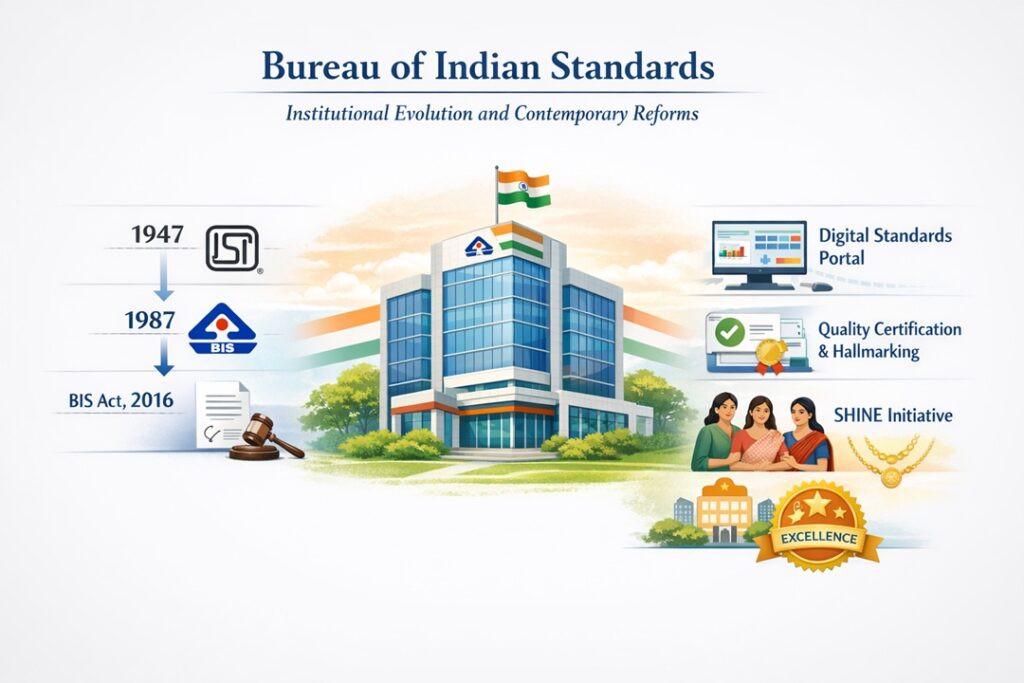
• 1947: Indian Standards Institution ISI established
• Origin linked to 1946 memorandum
• 1952–56: Launch of ISI Certification Marks Scheme
Legal Framework
• 1987: ISI transformed into BIS
• BIS Act, 2016 strengthened mandate and global alignment
Key Functions and Mandate
Standards and Certification
• Over 23,300 Indian Standards across sectors
• Product certification including fast-track licensing
Regulatory and Quality Assurance
• Compulsory Registration Scheme
• Foreign Manufacturers Certification Scheme
• Hallmarking of precious metals
Capacity and Infrastructure
• Laboratory services and recognition
• Consumer awareness and training programmes
Recent Reforms and Initiatives
Digital and Process Reforms
• BIS Standardisation Portal in beta launch
• End-to-end digital lifecycle from proposal to publication
• Enhanced transparency and reduced timelines
Inclusive and Excellence Initiatives
• SHINE initiative for women-centric capacity building through SHGs and NGOs
• Women positioned as community quality ambassadors
• BIS–SAKSHAM scheme for annual institutional excellence recognition
Conclusion
BIS’s evolution into a facilitative, technology-driven, and inclusive institution strengthens ease of doing business, enhances consumer trust, and reinforces India’s role in global standard-setting and quality-led growth.
Source : PIB