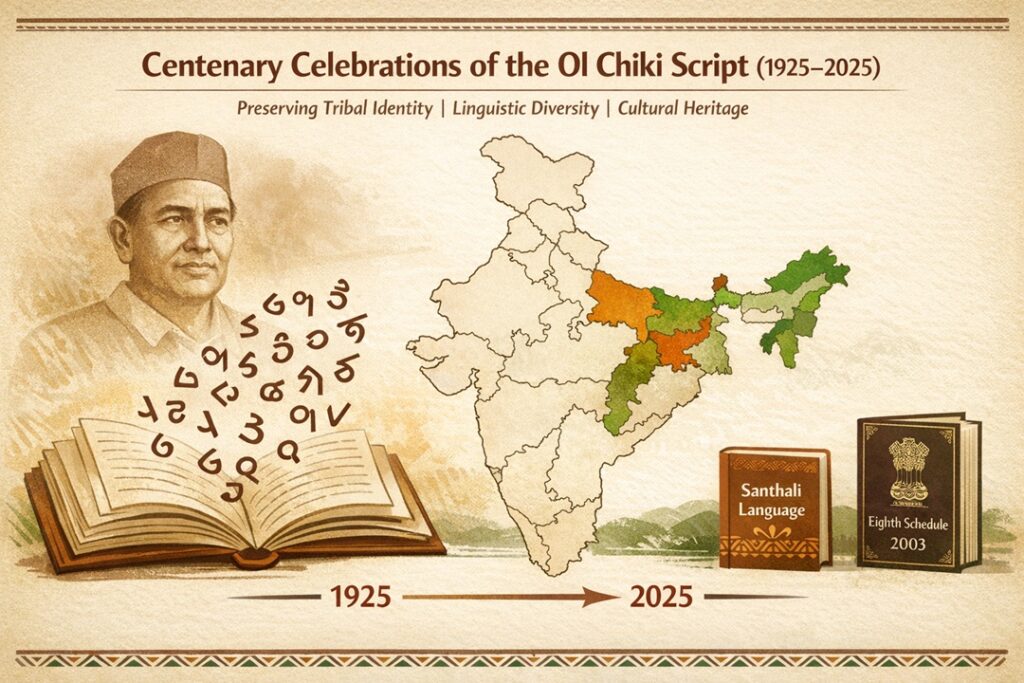
Centenary Celebrations of the Ol Chiki Script
Context
The Union Ministry of Culture is set to inaugurate the 100-year commemoration (1925–2025) of the Ol Chiki script on 16 February 2026 in New Delhi.
Script and Language Significance
Ol Chiki functions as the standardized writing system for Santhali, one of India’s major tribal languages. It was consciously developed as an independent script to mirror Santhali’s natural sound structure, rather than relying on adapted scripts such as Devanagari or Roman.
Historical Development
The script was devised in 1925 by Pandit Raghunath Murmu with the aim of safeguarding Santhali linguistic and cultural identity. His literary work High Serena (1936) played a key role in promoting the script. He is respectfully remembered as Guru Gomke (Great Teacher) within the Santhal community.
Geographical Spread and Linguistic Roots
Speech Community: Santhali speakers
Language Group: Austroasiatic family (Munda branch)
Major Regions: Jharkhand, Odisha, West Bengal, Assam, and Bihar
Structural and Linguistic Features
Alphabet System: Comprises 30 distinct characters
Sound Mapping: One character corresponds to one sound
Phonological Depth: Effectively captures glottal stops and indigenous phonetic elements
Ease of Use: Absence of conjunct letters
Design Origin: Fully indigenous, independent of Brahmi-derived or Roman scripts
Legal and Constitutional Recognition
Santhali was accorded constitutional recognition through its inclusion in the Eighth Schedule via the 92nd Constitutional Amendment Act, 2003. Further, in December 2025, the Constitution of India was translated into Santhali using the Ol Chiki script, enhancing linguistic inclusion and democratic accessibility.
Source : PIB