
Changing Cyclone Patterns in the North Indian Ocean
Context
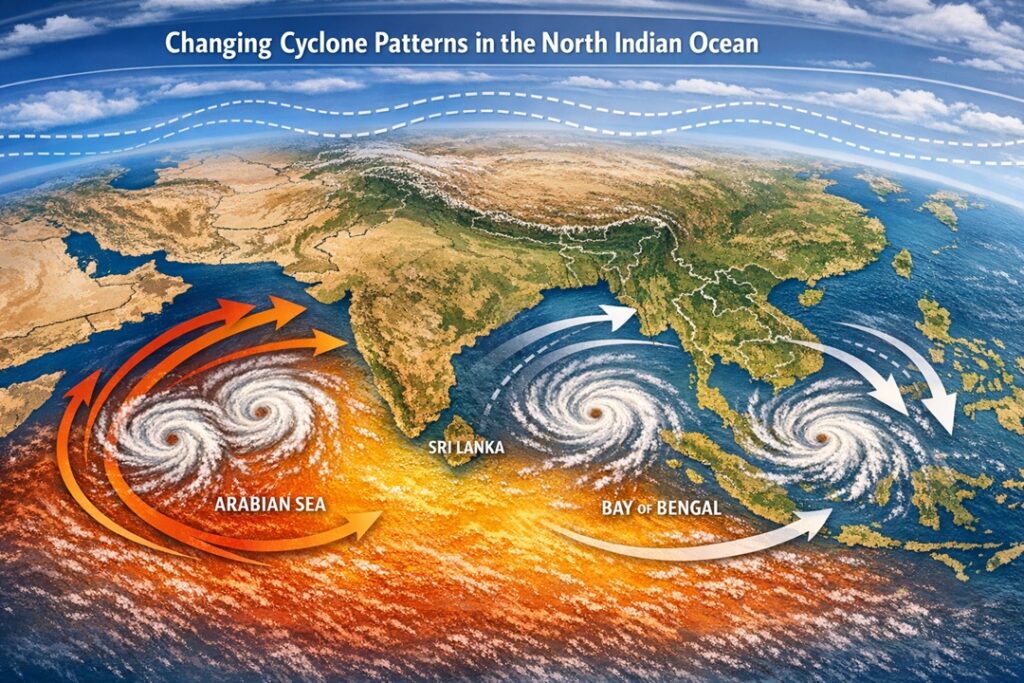
Cyclonic disturbances over the North Indian Ocean including the Arabian Sea and Bay of Bengal have undergone major changes in frequency, intensity, spatial distribution and seasonality, influencing India’s disaster risk profile.
Types of Cyclonic Disturbances
Tropical Cyclones
Low-pressure systems forming over warm oceans above 26.5°C
Energy derived from latent heat release during condensation
Generally move east to west
Cause intense damage over smaller areas
Extra-tropical Cyclones
Form in mid-latitudes between 30° and 60°
Energy derived from horizontal temperature gradients
Move west to east under westerly jet streams
Affect larger regions with diverse weather patterns
Long-term Frequency Trends
Early 20th Century Pattern
Average annual disturbances below 10 during 1900–1920
Mid-20th Century Peak
Activity increased to above 15 by the 1930s
Stability maintained till the 1970s
Late 20th Century Decline
Sharp fall during the 1980s–2000s
Lowest average of around 8 disturbances
Recent Revival
Gradual increase since the 2010s
Levels still below historical peaks
Regional Shift in Cyclone Origin
Bay of Bengal Trend
Once the primary cyclone hub
Experienced a sharp decline in disturbances
Arabian Sea Trend
Cyclone formation increasing steadily
Indicates westward shift of cyclone risk
Intensity and Severity Changes
Overall Pattern
Fewer cyclones but greater intensity
Bay of Bengal
Higher proportion reaching severe categories since the 1970s
Arabian Sea
Faster ocean warming leading to stronger and less unpredictable cyclones
Seasonality Changes
Earlier Pattern
Cyclone activity concentrated in July–September
Current Pattern
Shift towards October–December formation
Dominance of post-monsoon cyclones
Implications for India
Positive Implications
Lower overall cyclone frequency reduces aggregate exposure
Reduced Bay of Bengal activity benefits eastern coastal states
Later-season cyclones support monsoon crop maturity
Negative Implications
Increased risk along the western coast
Higher damage potential due to severe cyclones
Greater likelihood of compound flooding events
Extended risk period for fishing communities
Conclusion
The North Indian Ocean is experiencing fewer but stronger cyclones, a westward shift in activity, and delayed seasonality. These changes demand region-specific disaster preparedness, improved forecasting systems and climate-resilient coastal infrastructure to reduce future risks.
Source : The Hindu