
Cheetah Reproduction Milestone at Kuno National Park
Context
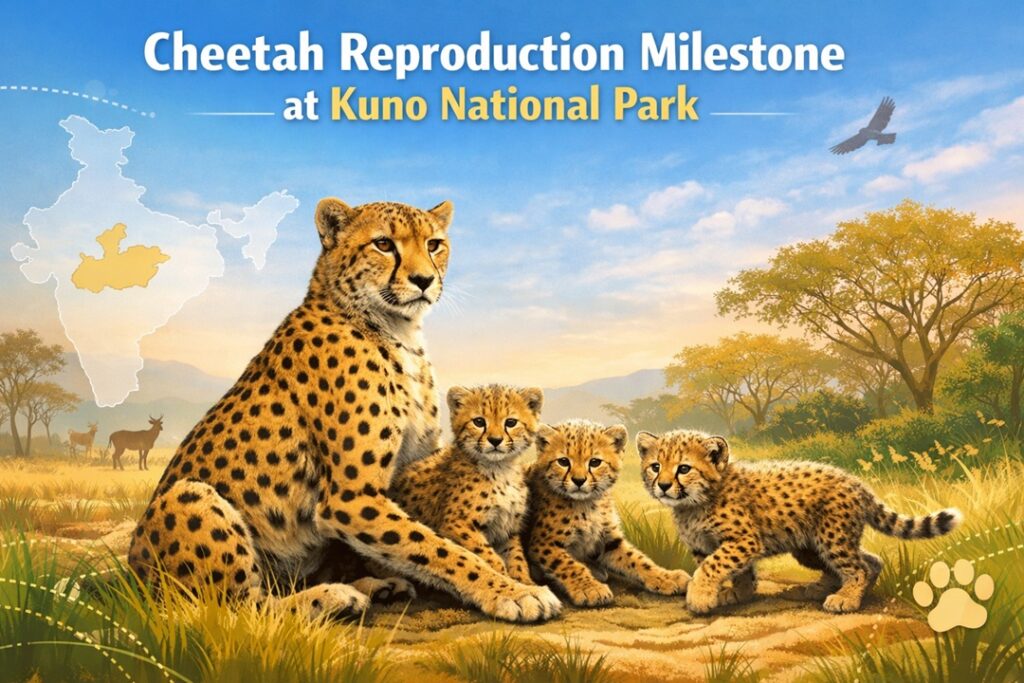
A female cheetah translocated from South Africa recently gave birth to three cubs inside Kuno National Park, raising India’s total cheetah population to 38. The event highlights progress under India’s cheetah restoration efforts.
Kuno National Park: Location & Status
- Geographical Position: Situated in Sheopur district of Madhya Pradesh under the Kuno Wildlife Division
- Physiographic Setting: Part of the Central Indian Vindhyan landscape
- Legal Evolution:
- Notified as a Wildlife Sanctuary in 1981
- Upgraded to National Park status in December 2018
Habitat & Vegetation Profile
- Tropical dry deciduous forests (north and south Indian types)
- Dry savannah grasslands and scrub ecosystems
- Riverine forests along perennial watercourses
Major Tree Species: Kardhai, Salai, Khair
Hydrology & River System
- Kuno River serves as the primary water source
- Forms part of the Chambal River basin
Faunal Composition
- Herbivores: Chital, Sambar, Nilgai, Chinkara, Blackbuck, Gaur, Four-horned antelope
- Carnivores: Leopard, Dhole, Indian wolf, Striped hyena, Jackal, Jungle cat
- Other Mammals: Sloth bear, Civets, Mongooses, Indian fox, Porcupine, Indian hare, Langur, Rhesus macaque
Cultural & Historical Features
- Houses forts such as Palpur, Amet, and Maitoni associated with former princely states
India’s Cheetah Restoration Programme
- Programme Type: First-ever intercontinental reintroduction of a large wild carnivore
- Commencement: September 2022 with cheetahs brought from Namibia
- Objective: Build a self-sustaining, free-ranging cheetah population through phased induction
- Implementing Authority: National Tiger Conservation Authority (NTCA), Ministry of Environment, Forest and Climate Change
- Technical Partner: Cheetah Conservation Fund (CCF)
Cheetah Subspecies Overview
Asiatic Cheetah
- Scientific Name: Acinonyx jubatus venaticus
- Historical Range: West Asia to the Indian subcontinent
- IUCN Status: Critically Endangered
- Status in India: Declared extinct in 1952
African Cheetah
- Scientific Name: Acinonyx jubatus jubatus
- Native Range: Eastern and Southern Africa
- Habitat Preference: Open grasslands and lightly wooded areas
- IUCN Status: Vulnerable
Source : The Hindu