
Child Trafficking in India : Constitutional Mandate, Judicial Vigilance, and Governance Response
Context
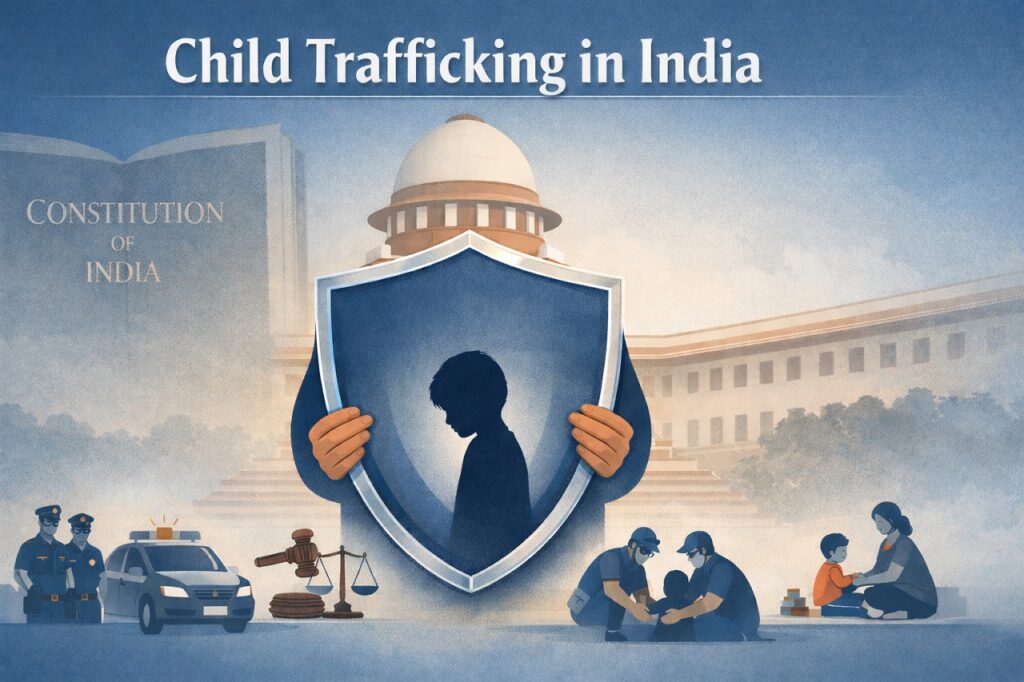
Child trafficking continues to pose a grave challenge to India’s constitutional ethos and human rights obligations. In K. P. Kiran Kumar v. State (2025), the Supreme Court of India reaffirmed the seriousness of the offence and laid down strict judicial principles to curb trafficking, holding that such acts constitute a direct violation of a child’s right to life, dignity, and bodily integrity under Article 21 of the Constitution.
Understanding Child Trafficking
Child trafficking refers to the recruitment, transportation, transfer, harbouring, or receipt of a child for the purpose of exploitation.
Under the Palermo Protocol, 2000, exploitation includes sexual exploitation, forced labour, slavery-like practices, servitude, and forced removal of organs. India signed the Protocol in 2002 and ratified it in May 2011, aligning its domestic legal framework with international anti-trafficking standards.
At the national level, Section 143 of the Bharatiya Nyaya Sanhita (BNS), 2023 defines trafficking as exploitation achieved through threat, force, coercion, abduction, fraud, deception, abuse of power, or inducement, including monetary benefits.
The scope of exploitation under Indian law covers physical and sexual exploitation, slavery or servitude, bonded labour, and forced organ removal.
Supreme Court’s Interpretation in K. P. Kiran Kumar v. State
Case Background
In 2010, a minor girl was rescued from a rented premises in Peenya, Bengaluru, during a police raid conducted with the assistance of NGO workers.
Judicial Determination (2025)
The Supreme Court upheld the conviction of the accused under the Immoral Traffic (Prevention) Act, 1956, emphasising that offences involving child trafficking demand a victim-centric and constitutionally informed judicial approach.
Key Judicial Observations
The Court stressed that testimony of minor victims must be assessed with sensitivity, acknowledging their emotional and psychological vulnerability.
It recognised that trafficking networks function through organised and layered criminal structures, which often prevents victims from providing precise or consistent narratives.
The Court clarified that delays, silence, or lack of precision in a child’s testimony do not weaken credibility, as trauma significantly affects memory and articulation.
Most importantly, the Court reaffirmed that trafficking strikes at the core of constitutional morality, violating dignity, autonomy, and the right to life.
Current Scenario of Child Trafficking in India
As per the National Crime Records Bureau, around 3,098 children below 18 years were rescued in 2022.
Between April 2024 and March 2025, more than 53,000 children were rescued across India from child labour, trafficking, and kidnapping.
Regional Patterns
Data from 2018 to 2022 reveals a consistent pattern of children being trafficked for commercial sexual exploitation, forced labour, and begging, with West Bengal, Assam, and Bihar reporting relatively higher incidence.
Conviction Deficit
Despite large-scale rescue efforts, the conviction rate remained alarmingly low at 4.8 percent, pointing to weaknesses in investigation, prosecution, and witness protection.
Performance of Special Courts
In 2025, 80,320 new POCSO cases were registered, while 87,754 cases were disposed of, resulting in a 109 percent disposal rate, marking the first instance where disposals exceeded registrations.
Constitutional and Statutory Safeguards
Articles 23 and 24 of the Constitution prohibit trafficking, forced labour, and employment of children in hazardous occupations.
Article 39 (e) and (f) directs the State to safeguard children from exploitation and ensure conditions for healthy physical and moral development.
Sections 98 and 99 of the BNS, 2023 criminalise the selling and buying of minors.
The Immoral Traffic (Prevention) Act, 1956 focuses on preventing trafficking for sexual exploitation.
The Juvenile Justice (Care and Protection of Children) Act, 2015 provides a comprehensive framework for care, protection, rehabilitation, and reintegration of trafficked children.
The Criminal Law (Amendment) Act, 2013 expanded the definition of trafficking to include sexual exploitation, slavery, servitude, forced labour, and organ removal, irrespective of consent.
The POCSO Act, 2012, being gender-neutral, prescribes stringent punishment for sexual offences against children, including life imprisonment and, in extreme cases, the death penalty.
To ensure speedy justice, nearly 400 fast-track courts have been established exclusively for POCSO cases.
Evolution of Judicial Response
In Vishal Jeet v. Union of India (1990), the Supreme Court identified trafficking and child prostitution as grave socio-economic evils requiring preventive and rehabilitative measures.
In M. C. Mehta v. State of Tamil Nadu (1996), the Court issued directions to prohibit child labour in hazardous industries.
In Bachpan Bachao Andolan v. Union of India (2011), the Court laid down comprehensive directions to address widespread child trafficking and ensure rehabilitation of rescued children.
Administrative and Policy Interventions
Anti-Human Trafficking Units (AHTUs) operate as specialised police units across districts to investigate trafficking offences.
The Child Protection Services (CPS) scheme provides shelter, education, counselling, and rehabilitation to rescued children.
The UJJAWALA Scheme focuses on prevention, rescue, rehabilitation, reintegration, and repatriation of trafficked women and children.
The Integrated Child Protection Scheme (ICPS) strengthens institutional care, foster care, and adoption mechanisms.
District Magistrates and Sub-Divisional Magistrates are empowered to order rescue operations, provide interim medical care and counselling, and dismantle trafficking hubs.
Under Operation AAHT, 1,048 victims were rescued and 257 traffickers apprehended in 2023.
Under Operation Nanhe Farishtey, 3,973 girl children were rescued in 2023.
Risk Factors and Emerging Threats
Children from economically and socially marginalised communities remain at heightened risk due to poverty and lack of institutional safeguards.
Persistent failures of family, society, and state institutions continue to expose children to exploitation.
Push factors such as poverty, unemployment, distress migration, disasters, and family disintegration deepen vulnerability.
The digital ecosystem, particularly social media and online platforms, has emerged as a new recruitment space through fake job offers and modelling opportunities.
Way Forward
The State must strengthen institutional mechanisms to ensure effective protection of children’s social, economic, and legal rights.
There is an urgent need for robust enforcement, improved investigation, and higher conviction rates to create strong deterrence.
Enhanced Union–State coordination is essential, as trafficking networks operate across state boundaries while policing remains a State subject.
Source : The Hindu