
Circular Agriculture and India’s Waste-to-Wealth Transition
Context
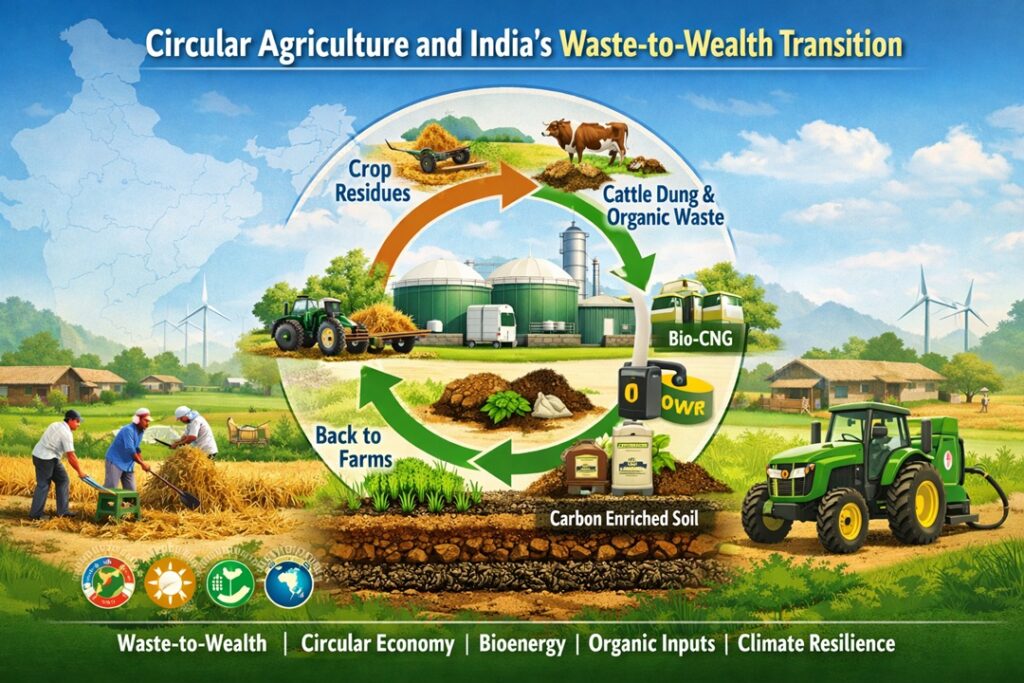
The Union Government has recently reviewed the performance of the Waste-to-Wealth initiative, highlighting that the GOBARdhan programme has expanded to over half of India’s districts, marking steady progress towards a circular and sustainable agricultural economy.
Conceptual Framework: Circularity in Agriculture
What does it mean?
Circular agriculture refers to a closed-loop production system that optimises resource use and minimises waste generation. Unlike linear models of extraction and disposal, it applies the 6R principle to repurpose agricultural residues, livestock waste, and food discards into productive outputs such as Compressed Biogas (CBG), organic manure, bio-energy, and soil enhancers.
Key Indicators and Statistics
- Biomass Availability: India produces nearly 350 million tonnes of agricultural residues annually.
- Renewable Energy Scope: Crop waste holds the capacity to generate over 18 GW of renewable power each year.
- Economic Outlook: India’s circular economy is projected to evolve into a trillion-dollar sector, supporting 10 million jobs by 2050.
- Food Loss Trends: While 1.3 billion tonnes of food is wasted globally, India witnesses nearly 60% of wastage at the consumer household level.
- Scheme Performance: As of January 2026, 979 functional biogas plants are operational under the GOBARdhan framework.
Why Circular Agriculture Matters
Revitalising Soil Productivity:
Recycling organic inputs restores soil fertility and lowers chemical fertiliser dependence.
Illustration: Application of digested slurry from biogas plants, as recommended by ICAR, is aiding carbon restoration in intensively farmed soils.
Reducing Climate Footprint:
Methane capture from biodegradable waste significantly cuts greenhouse gas emissions.
Illustration: The Unified GOBARdhan Portal monitors CBG generation, directly contributing to India’s Net-Zero emission pathway.
Diversifying Rural Incomes:
Waste monetisation creates alternative income avenues for farmers.
Illustration: In Punjab and Haryana, farmers now earn by supplying crop residues for off-field management rather than resorting to stubble burning.
Enhancing Water Sustainability:
Recycling treated wastewater conserves freshwater resources.
Illustration: The Jal Shakti Abhiyan promotes reuse of greywater for village plantations and nutrition gardens.
Efficient Resource Utilisation:
Circular agriculture aligns with SDG-2 and SDG-12, ensuring sustainability across food systems.
Illustration: Biochar incorporation improves soil moisture retention while enabling long-term carbon sequestration.
Policy Measures and Programmatic Support
- GOBARdhan Programme: Promotes conversion of organic waste into CBG and bio-fertilisers.
- Crop Residue Management Strategy: Machinery subsidies and over 42,000 Custom Hiring Centres to reduce residue burning.
- Agriculture Infrastructure Fund: ₹66,310 crore sanctioned for post-harvest and organic input infrastructure.
- Animal Husbandry Infrastructure Development Fund: ₹15,000 crore allocation for scientific handling of animal by-products.
- Swachh Bharat Mission (Grameen) 2.0 & Jal Jeevan Mission: Strengthen rural solid–liquid waste management to achieve ODF Plus status.
Implementation Constraints
Capital Intensity:
Biogas plants and residue-handling equipment demand high initial investment.
Operational and Supply Chain Issues:
Transporting bulky biomass from fragmented farms remains cost-intensive.
Technology Readiness:
Advanced solutions like engineered biochar systems are still under development.
Behavioural Challenges:
Traditional residue-burning practices persist despite incentives.
Market Viability Issues:
Organic and waste-derived inputs struggle to compete with subsidised chemical fertilisers.
Strategic Way Forward
- Carbon Market Integration: Enable farmers to earn through carbon credits linked to biochar and biogas usage.
- Institutional Strengthening: Position FPOs as nodal agencies for managing residue machinery and bio-energy clusters.
- Innovation-led Solutions: Accelerate R&D in microbial decomposition and advanced biomass conversion.
- Regulatory Support: Ensure pricing and distribution parity for organic fertilisers.
- Behavioural Change Campaigns: Expand Jan Andolan for community-driven waste segregation.
Closing Perspective
Adopting circular agriculture is essential for achieving food security, climate resilience, and rural prosperity. By scaling initiatives such as GOBARdhan, AIF, and CRM, India is converting agricultural waste into a strategic economic resource, laying the foundation for a sustainable and inclusive Viksit Bharat by 2047.
Source : PIB