
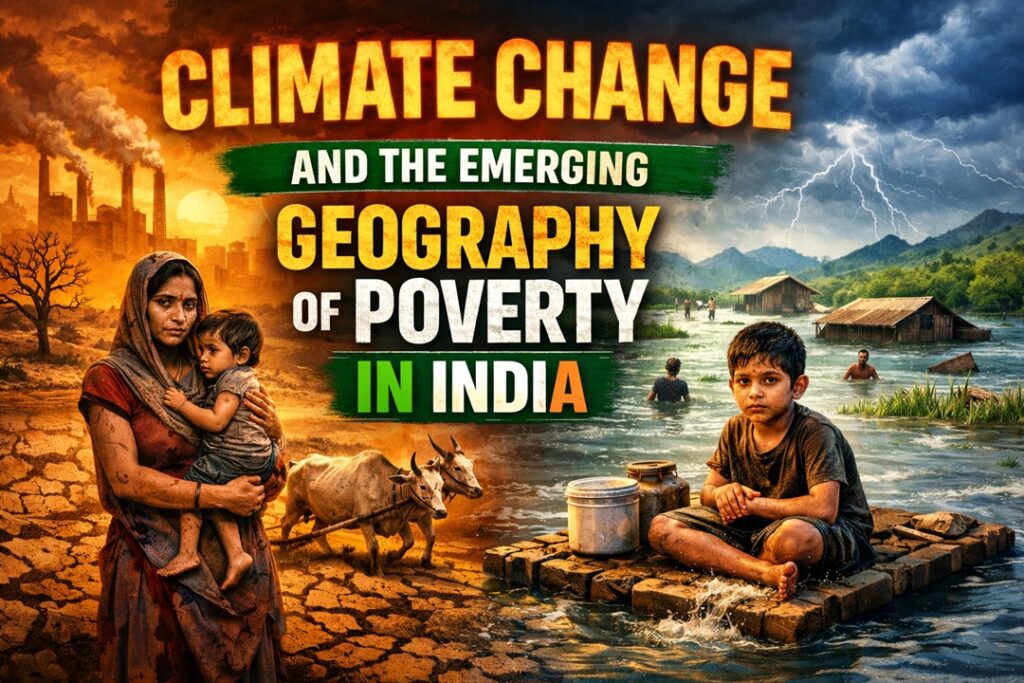
Climate Change and the Emerging Geography of Poverty in India
Context
A recent study by the National Institute of Science Education and Research (NISER) highlights how climate variability is increasingly reshaping poverty patterns across India, linking environmental stress with economic vulnerability.
Key Findings of the Report
Poverty Trends in Transition – India has achieved considerable reduction in poverty levels over time, with both headcount ratio and intensity declining. However, these improvements remain unstable and reversible.
Climate as a Risk Multiplier – Climate variability has emerged as a new driver of vulnerability, particularly for communities dependent on agriculture and natural resources.
Environmental Pressures Intensify Inequality – Factors such as unpredictable rainfall, rising temperatures, floods, and droughts interact with socio-economic disparities, worsening poverty conditions.
Reversal Threat – Households that have moved out of poverty remain highly susceptible to falling back due to recurring climate shocks.
Evidence Base – The study, covering 593 districts across 21 states, establishes that poverty is increasingly climate-linked rather than purely economic, demanding localized policy approaches.
Climatic Drivers of Poverty
Temperature Fluctuations – Variability in maximum temperature is identified as the most influential factor. Heat stress reduces farm productivity, labour efficiency, and health outcomes.
Floods and Rainfall Irregularities – Flood-prone regions face repeated damage to crops and infrastructure, while erratic rainfall disrupts cropping cycles and creates water stress.
Analytical Framework – The study employs a logistic regression model integrating climatic, social, and economic variables to assess poverty vulnerability.
The “Drought-Agriculture Nexus”
Compound Vulnerability – Districts that are both drought-prone and agriculture-dependent are 83% more likely to remain poor.
Cycle of Distress – Repeated crop failures, unstable incomes, and rising indebtedness trap farmers in a vicious cycle.
Structural Concern – Limited non-farm opportunities restrict income diversification, reinforcing rural poverty.
Social Inequality Dimensions
Tribal Vulnerability – Districts with higher Scheduled Tribe (ST) populations show elevated poverty risks.
Geographical Exposure – These communities often inhabit ecologically fragile zones like forests and drought-prone areas.
Marginalisation Factors – Limited infrastructure, poor access to markets, and dependence on natural resources heighten climate sensitivity.
Economic Structure and Resilience
Role of Diversification – Regions with a stronger tertiary sector (services, trade, IT) exhibit lower poverty levels.
Reduced Climate Dependence – Diversified economies are less reliant on agriculture, thereby reducing exposure to climate shocks.
Institutional Strength – Better infrastructure, education, and healthcare systems enhance adaptive capacity.
Regional Patterns and Policy Gaps
High Poverty Regions – Eastern states such as Chhattisgarh, Odisha, Jharkhand, Bihar, and West Bengal show higher vulnerability due to agricultural dependence.
Relatively Better Regions – States like Kerala, Karnataka, Tamil Nadu, Gujarat, and Maharashtra perform better due to diversified economies.
Policy Limitations – National frameworks like the National Action Plan on Climate Change (NAPCC) and State Action Plans face implementation gaps at the district level.
Way Forward
Climate-Smart Agriculture – Promote drought-resistant crops, efficient irrigation (drip/sprinkler), and adaptive farming practices.
Livelihood Diversification – Expand rural non-farm employment, enhance skill development, and support MSMEs.
Disaster Preparedness – Strengthen early warning systems, climate-resilient infrastructure, and community-based disaster management.
Targeted Inclusion – Focus on STs and marginalized groups through better access to credit, markets, and institutional support.
Integrated Governance – Align climate policy with poverty alleviation through district-level, context-specific planning and multi-stakeholder collaboration.
Future Outlook
Climate-Poverty Nexus – The study highlights that climate change is redefining poverty geography in India.
Developmental Risk – Increasing climate shocks may reverse gains and deepen inequality.
SDG Linkages – Achieving goals like poverty eradication, zero hunger, and climate action under the United Nations Sustainable Development Goals (SDGs) depends on integrating climate resilience.
Strategic Imperative – A region-specific, multi-dimensional approach focusing on diversification, institutional capacity, and vulnerable communities is essential for inclusive growth.
Source : Business Standard