
Concerns over Electoral Integrity and Institutional Independence in India
Context
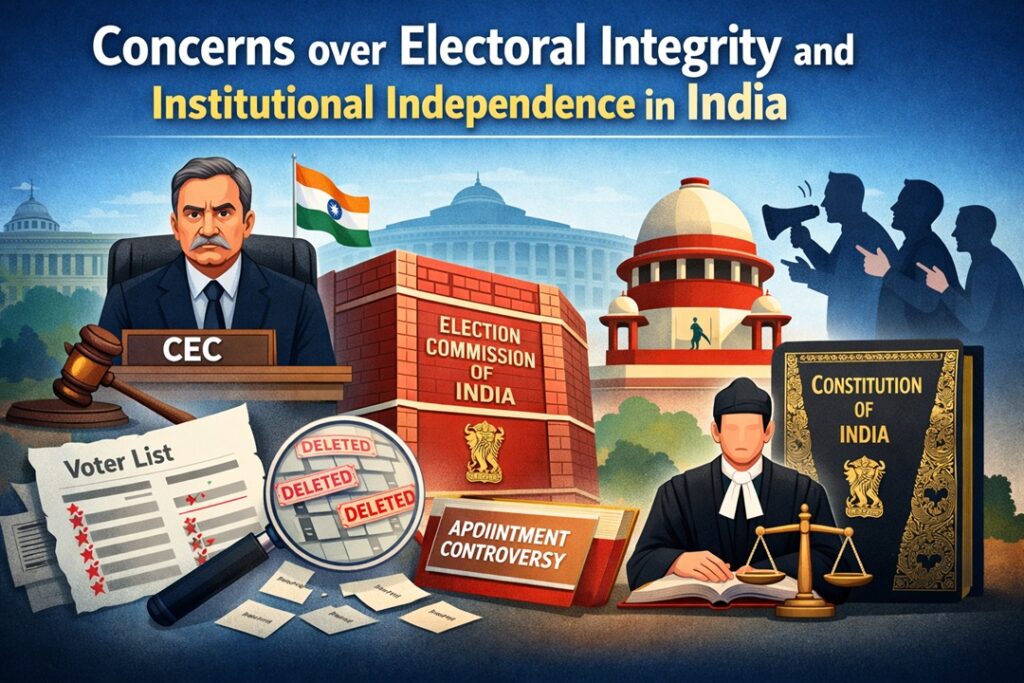
Recent developments have intensified debates over the neutrality and credibility of India’s electoral machinery. These concerns culminated in a political move by Opposition parties proposing the removal of the Chief Election Commissioner (CEC), citing alleged institutional bias and procedural irregularities.
Contemporary Developments and Concerns
Electoral Roll Revision – In mid-2025, the Election Commission of India initiated a Special Intensive Revision (SIR) of electoral rolls in Bihar.
Scale of Deletions – Nearly 65 lakh voter names were removed during the exercise.
Judicial Scrutiny – The deletions were challenged before the Supreme Court on grounds of procedural arbitrariness.
Charges Raised – Allegations of electoral roll manipulation and “vote suppression” surfaced during the revision process.
Democratic Implications – Critics argue that such actions threaten the constitutional guarantee of universal adult suffrage under Article 326.
Constitutional Architecture of Election Administration
Foundational Provision – The Election Commission derives its authority from Article 324 of the Constitution.
Functional Mandate – It exercises supervision, direction, and control over elections to constitutional offices and legislatures.
Institutional Composition – The Commission includes:
• Chief Election Commissioner
• Other Election Commissioners
• Regional Commissioners (if required)
Structural Evolution –
• Initially a single-member body.
• Became multi-member in 1989.
• Permanently institutionalised as a multi-member commission in 1993.
Judicial Endorsement – Upheld by the Supreme Court in T. N. Seshan vs Union of India (1995).
Leadership and Internal Functioning
Chairpersonship – Under Article 324(3), the CEC functions as the Chairperson of the Commission.
Decision-Making Logic – The model balances administrative leadership with collective decision-making to prevent concentration of power.
Tenure Framework – As per the 2023 Act, the CEC serves for six years or until 65 years of age.
Service Protection – Article 324(5) ensures that service conditions cannot be altered to the disadvantage of the CEC.
Debate on Appointment Mechanism
Statutory Shift – The 2023 Appointment Act replaced the earlier 1991 framework governing appointments.
Selection Panel –
• Prime Minister
• Union Cabinet Minister
• Leader of Opposition in Lok Sabha
Point of Contention –
• The Supreme Court in Anoop Baranwal (2023) recommended inclusion of the Chief Justice of India.
• Legislative exclusion of the CJI raised concerns over executive dominance.
Pending Litigation –
• Challenged in Jaya Thakur vs Union of India (2024).
• Matter scheduled for further hearing in 2026.
Safeguards in Removal Procedure
Removal of CEC –
• Governed by Article 324(5).
• Same procedure as removal of a Supreme Court judge under Article 124(4).
• Grounds limited to proven misbehaviour or incapacity.
Other Commissioners –
• Removed by the President based on the CEC’s recommendation.
• Vineet Narain (1997) restricted unilateral advisory power of the CEC.
Statutory and Procedural Framework
Election Laws –
• Representation of the People Acts, 1950 & 1951.
Inquiry Mechanism –
• Judges (Inquiry) Act, 1968.
• Section 11 of the 2023 Act.
Parliamentary Threshold –
• Lok Sabha: 100 MPs.
• Rajya Sabha: 50 MPs.
Inquiry Committee Composition –
• Supreme Court Judge / Chief Justice of India
• Chief Justice of a High Court
• Eminent Jurist
Due Process Guarantees –
• Framing of specific charges.
• Right to be heard.
• Mandatory medical examination in incapacity cases.
Political Overtones
Legislative Arithmetic – The Opposition’s motion faces numerical constraints in Parliament.
Government Position – Allegations of bias have been officially denied.
Institutional Credibility – Persistent politicisation risks eroding public trust in constitutional authorities.
Democratic Prudence – Legitimate criticism must be distinguished from institutional delegitimisation.
Broader Democratic Implications
Core Principle – India’s constitutional democracy rests on free, fair, and credible elections.
Balancing Act – Sustaining electoral integrity requires harmony between executive authority and institutional autonomy.
Way Forward – Reinforcing transparency, judicial oversight, and constitutional morality remains essential.
Source : The Hindu