
Constitution (130th Amendment) Bill: Accountability vs Liberty
Context
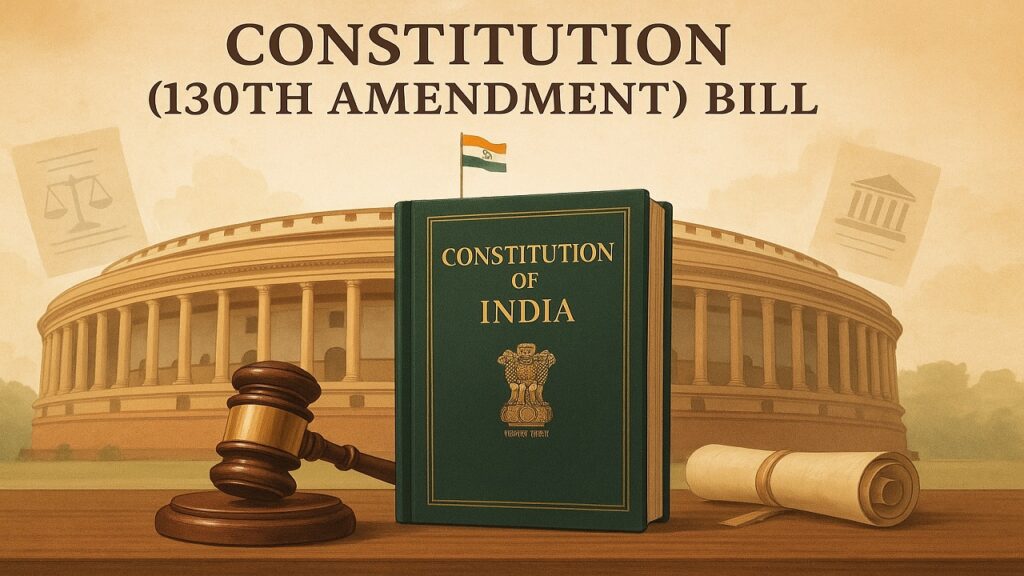
Recently, the Central Government introduced the Constitution (One Hundred and Thirtieth Amendment) Bill in Parliament.
The Bill seeks to establish a framework for the removal of Ministers, Prime Ministers, and Chief Ministers in cases where they are arrested and detained in custody for serious offences.
It aims to strengthen political accountability, ensure ethical governance, and maintain public trust in constitutional offices.
About the Bill
1. Removal of Ministers:
- If a Minister is arrested and detained for 30 consecutive days for an offence punishable with imprisonment up to 5 years or more,
- He shall be removed from office by the President on the advice of the Prime Minister by the 31st day of custody.
- If no advice is tendered, he shall automatically cease to hold office.
- For State Ministers, a similar provision applies — the Governor acts on the advice of the Chief Minister.
2. Removal of Prime Minister or Chief Minister:
- If the Prime Minister or Chief Minister is arrested and detained for 30 consecutive days,
- They must resign by the 31st day, or
- Shall cease to hold office automatically thereafter.
3. Constitutional Amendments Proposed:
The Bill seeks to amend the following Articles:
- Article 75 – Union Council of Ministers
- Article 164 – State Council of Ministers
- Article 239AA – Special provisions relating to the National Capital Territory of Delhi
Issues and Concerns Raised by the Opposition
1. Discretionary Arrests and Detentions:
- The Opposition has warned that the discretionary powers of police and courts regarding arrests and detentions could lead to political misuse.
- The lack of procedural safeguards may enable the targeting of Opposition leaders through fabricated cases.
2. Arrest Discretion under BNSS:
- The Bharatiya Nagarik Suraksha Sanhita (BNSS) allows police officers not to arrest automatically for offences punishable up to 7 years.
- Thus, the discretion in arresting Ministers creates ambiguity and potential misuse.
3. Judicial Precedents Supporting Discretion in Arrests:
- Deenan vs Jayalalitha (1989): Arrest powers are discretionary, not mandatory.
- Joginder Kumar vs State of U.P. (1994): Arrest must be justified, not automatic.
- Amarawati vs State of U.P. (2004): Police are not bound to arrest in every cognisable offence.
- Satender Kumar Antil vs CBI (2022): Agencies must comply with Sections 41 and 41A CrPC before arrest.
Potential for Misuse
1. Arrest as a Political Tool:
- The National Police Commission (1977) observed that about 60% of arrests were unnecessary or unjustified.
- There is concern that arrest provisions could be used politically to disqualify Ministers belonging to Opposition parties.
2. Misuse of Detention and Bail Process:
- Since the removal condition is based on 30 consecutive days of detention, the grant or denial of bail becomes decisive.
- Although the Supreme Court upholds that “bail is the rule, jail is the exception,” bail is often denied due to subjective considerations like the seriousness of offence.
3. Problems under Special Statutes:
- Laws such as PMLA, NDPS, and UAPA impose twin conditions for bail:
- The accused must prove innocence, and
- Assure that no offence will be committed while on bail.
- These conditions reverse the burden of proof, making it extremely difficult for Ministers to secure bail within 30 days.
- For example, in the Manish Sisodia case, bail was granted only after 17 months of incarceration under PMLA.
4. Judicial Subjectivity:
- The decision to grant or deny bail often depends on the judge’s interpretation of liberty under Article 21, leading to inconsistency and subjectivity.
Constitutional and Legal Concerns
1. Default Bail Overlap:
- The Bill does not consider default bail provisions under Section 167(2) CrPC (Section 187 BNSS), which allows bail if investigations exceed 60 to 90 days.
- Thus, the 30-day disqualification period appears arbitrary and inconsistent with existing legal timeframes.
2. Hobson’s Choice for Ministers:
- The Bill places Ministers in a dilemma:
- Continue in office and risk removal, or
- Resign and lose duties, even if later granted bail.
- This creates a conflict between political responsibility and legal rights.
Judicial and Institutional Safeguards
- The Arnesh Kumar vs State of Bihar (2014) judgment mandates that the police must record reasons and evidence before making arrests.
- Yet, many High Courts have observed non-compliance with these directions.
- Without strict enforcement of these judicial safeguards, the new amendment may deepen misuse rather than prevent it.
Conclusion
The Constitution (One Hundred and Thirtieth Amendment) Bill, 2025 seeks to reinforce accountability and integrity among Ministers by introducing clear provisions for removal in cases of arrest and detention.
However, the lack of procedural safeguards, possibility of political misuse, and legal inconsistencies pose significant challenges to its fairness and constitutionality.
To strike a balance between ethical governance and individual liberty, there must be stronger judicial oversight, objective arrest guidelines, and clear safeguards against political abuse.
Only then can the Bill serve its intended purpose of upholding probity in public life without undermining democratic freedoms.
Source : The Hindu