
Cooperative-Led Healthcare Financing in India
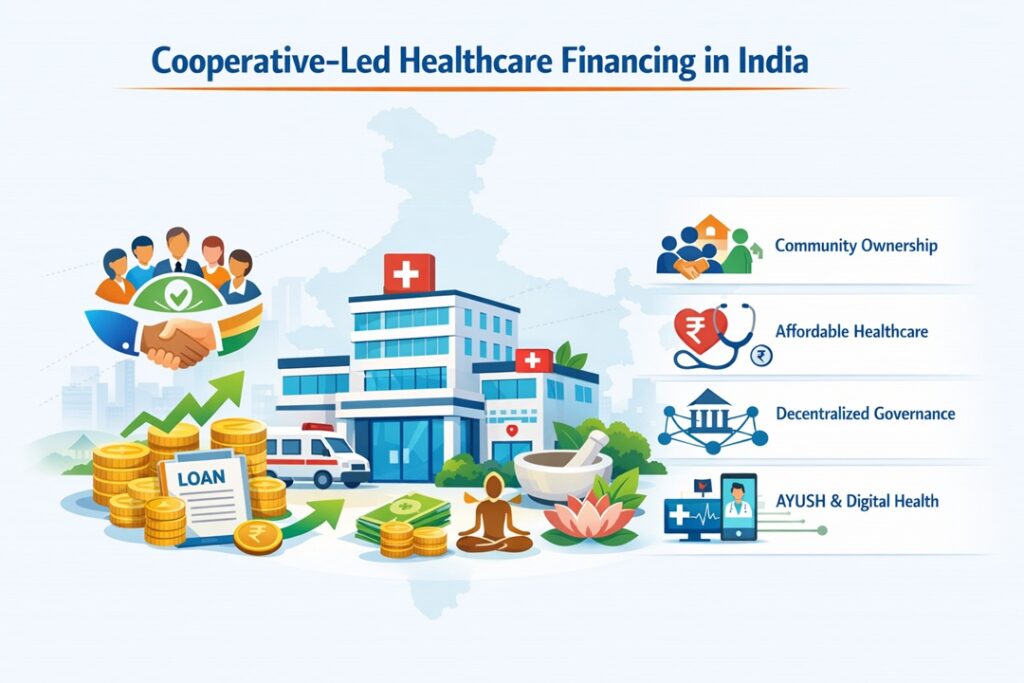
Context
The Government of India, through a parliamentary response, highlighted progress in operationalising a cooperative-based healthcare financing mechanism and clarified its institutional funding framework.
Cooperative Health Infrastructure Support Scheme
Scheme Overview: A specialised financial assistance initiative of the National Cooperative Development Corporation (NCDC) designed to enable cooperative societies to create, upgrade, and manage healthcare facilities across the country.
Year of Operationalisation: 2020, in consonance with the National Health Policy, 2017.
Nodal Authority: NCDC
Administrative Supervision: Ministry of Cooperation
Core Objectives
Accessible Healthcare Delivery: To expand affordable and community-driven health services through cooperative institutions.
Integration of Traditional Medicine: To encourage participation of AYUSH systems and digital health platforms in India’s public healthcare ecosystem.
Operational Framework
Eligible Entities: Cooperative societies registered under State or Multi-State Cooperative Societies Acts with health-related objectives embedded in their bye-laws.
Scope of Assistance: Financial support for hospital infrastructure, technology upgradation, AYUSH facilities, telemedicine services, health insurance initiatives, and working capital needs.
Credit Support: Long-term loans with flexible repayment periods of up to 8 years, including an initial moratorium of 1–2 years, linked to project viability.
Gender-Sensitive Incentives: Interest rate concession for cooperatives with majority women membership, subject to repayment discipline.
Funding Channels & Safeguards: Assistance extended either through State Governments or directly by NCDC, covering up to 90% of project costs, backed by prescribed security arrangements.
Policy Relevance
Decentralised Health Governance: Reinforces the role of cooperative institutions in delivering healthcare at the grassroots level.
Community Accountability: Promotes participatory management and local ownership of healthcare services.
Support to Integrative Medicine: Strengthens infrastructure for traditional medicine systems, contributing to a pluralistic healthcare model in India.
Source : PIB