
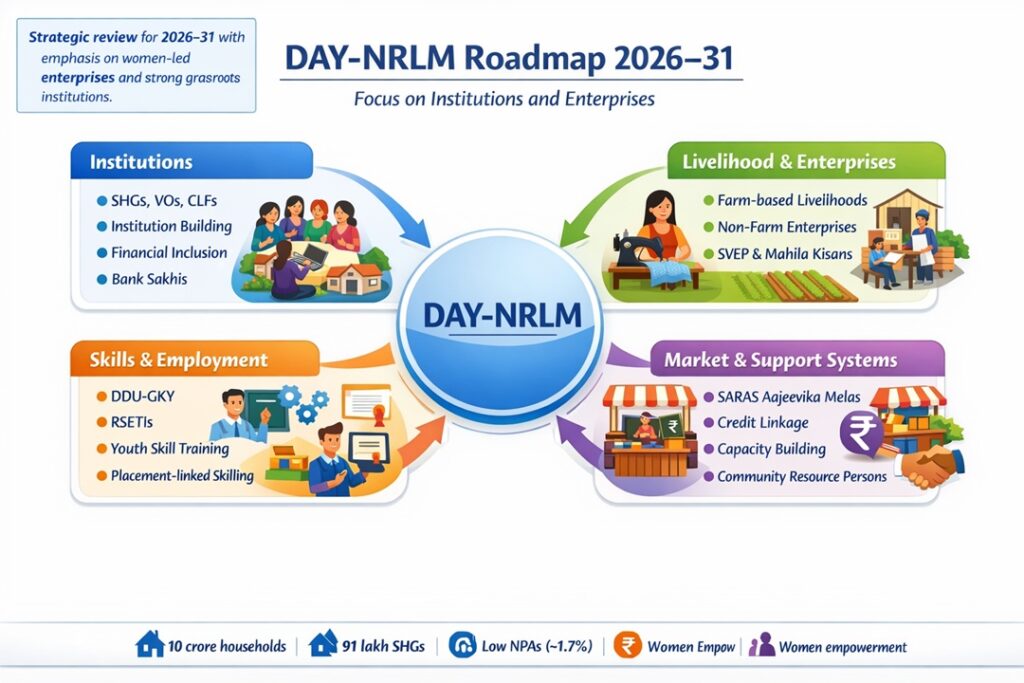
DAY-NRLM Roadmap 2026–31: Focus on Institutions and Enterprises
Context
The Deendayal Antyodaya Yojana–National Rural Livelihoods Mission (DAY-NRLM) has been taken up for a strategic review for the period 2026–27 to 2030–31, with a renewed focus on scaling women-led rural enterprises and strengthening grassroots institutions.
Scheme Profile – A centrally sponsored flagship initiative aimed at reducing rural poverty and enhancing livelihoods through the Self-Help Group (SHG)–based community mobilisation approach.
Year of Introduction – 2016.
Former Designation – National Rural Livelihoods Mission (NRLM).
Administrative Authority – Ministry of Rural Development.
Operational Framework – Executed by State Rural Livelihoods Missions in partnership with SHGs, Village Organisations (VOs) and Cluster-Level Federations (CLFs).
Territorial Reach – Implemented across all States and Union Territories except Delhi and Chandigarh.
Scale of Outreach – Nearly 10 crore rural poor households organised into around 91 lakh SHGs nationwide.
Core Aims
- Income Generation – Foster sustainable livelihoods and women-centric entrepreneurship.
- Access to Finance – Integrate beneficiaries with formal banking and credit systems.
- Livelihood Expansion – Encourage diversification and convergence with public services and entitlements.
- Women’s Agency – Strengthen social participation and leadership of rural women.
Target Groups
- Rural women from poor households.
- Members of SHGs.
- Rural youth covered under skilling initiatives.
Beneficiary Selection
Households identified as NRLM Target Households (NTH) through Participatory Identification of Poor (PIP) rather than BPL enumeration.
Associated Programmes
- Deen Dayal Upadhyaya Grameen Kaushalya Yojana (DDU-GKY).
- Rural Self Employment Training Institutes (RSETIs).
Programme Pillars
- Institutional Strengthening & Financial Access – SHG nurturing, collateral-free credit, interest subvention, banking outreach via Bank Sakhis.
- Enterprise Promotion – Support to farm-based activities through Mahila Kisans; non-farm sectors like handicrafts and food processing; Start-up Village Entrepreneurship Programme (SVEP).
- Community Cadre Support – Krishi Sakhi, Pashu Sakhi and Bank Sakhi for sector-specific services.
- Skills & Wage Employment – DDU-GKY for placement-linked training (15–35 years); RSETIs for entrepreneurial skills (18–50 years).
- Market Linkages & Capacity Enhancement – SARAS Aajeevika Melas and training support from NIRDPR.
Financing Arrangement – Cost-sharing between the Union and State Governments.
Impact Assessment
- NPAs maintained at about 1.7% despite large credit volumes.
- Marked improvement in women’s economic security and community leadership.
- Robust base created for future growth in entrepreneurship, market integration and innovative financing.
Source : PIB