
DHRUVA: India’s UPI-like Digital Addressing System
Context
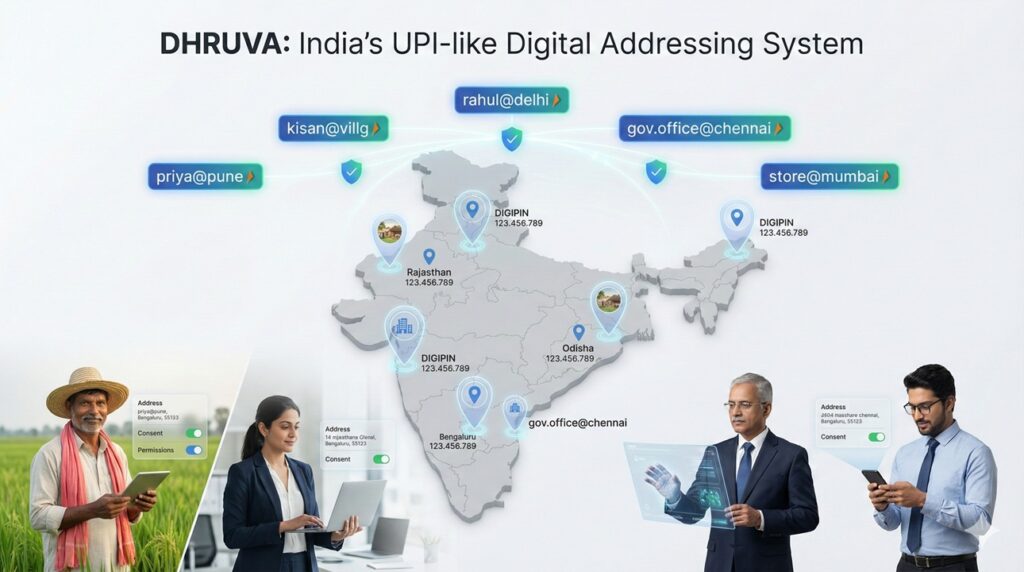
The Department of Posts has released a draft amendment proposing DHRUVA, a digital addressing system enabling virtual address labels such as name@entity, similar to UPI handles.
About dhruva
DHRUVA is a national Digital Address Digital Public Infrastructure that standardises and virtualises physical addresses using UPI-like digital labels.
It is built on the DIGIPIN system, providing geocoded precision and interoperability across platforms.
The draft policy was introduced by the Department of Posts in 2025.
Aim of dhruva
To create a unified, secure, interoperable, and user-controlled digital address ecosystem.
To treat address-data as core public infrastructure comparable to Aadhaar, UPI, DigiLocker.
To enable Address-as-a-Service (AaaS) for government agencies, citizens, and businesses.
Key features of dhruva
UPI-like Virtual Labels Users receive virtual address handles such as name@entity, acting as proxies for physical addresses.
Consent-Based Access Address sharing occurs only through time-bound, purpose-specific consent, ensuring strong privacy safeguards.
DIGIPIN Backbone DIGIPIN is a 10-character alphanumeric geocode mapping every 14 sq m of India, creating nearly 228 billion unique pins. It improves accuracy in rural and hard-to-map regions.
Address-as-a-Service (AaaS) Provides secure APIs to integrate address data with government systems, fintech platforms, logistics networks, and e-commerce services.
Institutional Architecture A Section 8 not-for-profit entity (NPCI-like) will govern the system.
Address Service Providers (ASPs) issue address labels, while Address Information Agents (AIAs) manage consent workflows.
Interoperability and Adoption The system is voluntary and encourages participation from e-commerce, gig platforms, financial services, and logistics firms.
Conclusion
DHRUVA can modernise India’s address infrastructure by improving precision, privacy, and interoperability. Its adoption can enhance service delivery, strengthen logistics, and support India’s broader Digital Public Infrastructure ecosystem.
Source : The Hindu