
Digital Overuse as an Emerging Public Health Challenge in India
Context
The Economic Survey 2025–26 cautions that the expanding footprint of digital overuse and screen-dependent behaviour is emerging as a silent public health crisis and a structural risk to India’s future labour productivity.
Understanding the Phenomenon
Conceptualisation: Digital dependency denotes a behavioural pattern of uncontrollable and excessive interaction with online platforms and smart devices that interferes with normal psychological functioning and daily activities.
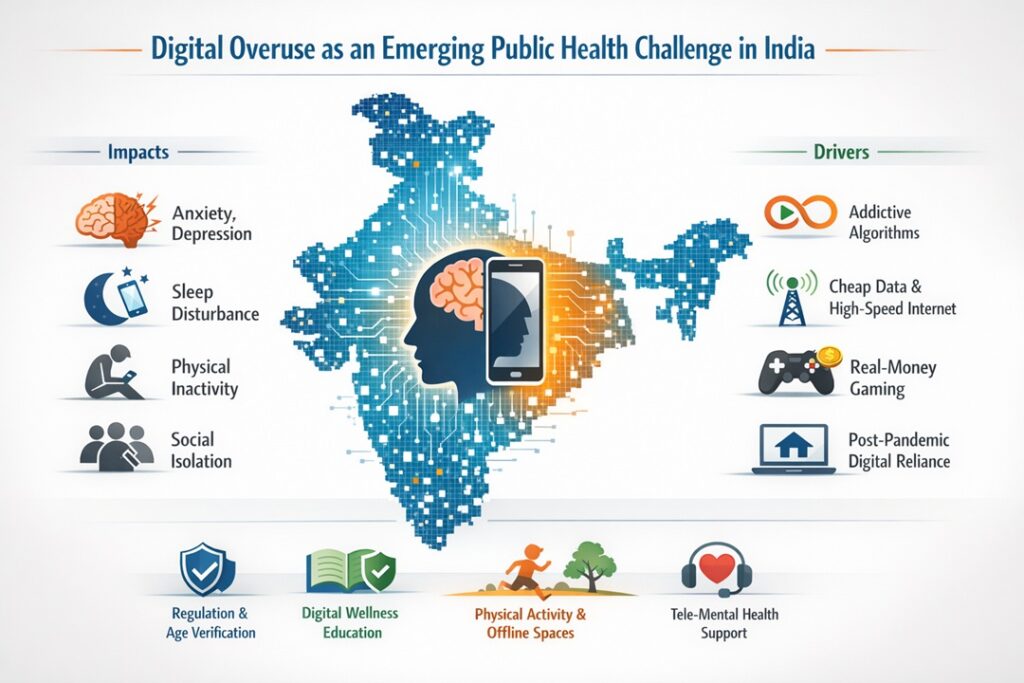
Psychological Consequences: Rising incidence of stress, depressive symptoms, emotional dysregulation, and diminished self-worth, often reinforced by online comparison and virtual harassment.
Somatic Consequences: Disturbed sleep cycles, reduced physical movement, eye fatigue, and posture-related musculoskeletal disorders.
Neuro-social Effects: Declining concentration capacity, weakened memory retention, and gradual thinning of offline social relationships.
Evidence from Economic Survey 2025–26
Connectivity Saturation: Internet user base expanded nearly fourfold between 2014 and 2024, with youth forming the largest connected cohort.
Escalating Screen Time: Aggregate smartphone usage crossed approximately one lakh crore hours in 2024.
Skewed Usage Patterns: A greater proportion of adolescents use smartphones for entertainment and social networking than for learning purposes.
Vulnerable Population Segment: Adolescents and young adults (15–24 years) show the highest susceptibility to online gaming and social media disorders.
Digital-Led Growth: The digital sector’s dominant share in national income contrasts with growing behavioural health stress.
Changing Disease Profile: Traditional mortality indicators improve, but lifestyle-driven mental disorders expand rapidly.
Structural Drivers
Engagement-Maximising Architecture: Platform interfaces engineered around continuous content feeds and instant rewards.
Post-Pandemic Behavioural Shift: Sustained reliance on digital spaces following prolonged lockdowns.
High-Speed, Low-Cost Internet: Affordable data and 5G networks intensify high-definition streaming and interactive gaming.
Financialised Gaming Models: Monetisation strategies built around micro-transactions and rewards.
Urban Social Fragmentation: Shrinking community interaction and recreational avenues.
Implementation Bottlenecks
Measurement Gaps: Absence of regularly updated national-level prevalence statistics.
Enforcement Weakness: Difficulty in ensuring age-appropriate access controls.
Regulatory Pushback: Commercial resistance from large technology platforms.
Cultural Acceptance: Excessive screen exposure perceived as normal modern behaviour.
Service Shortfall: Insufficient availability of specialised digital addiction treatment services.
Strategic Response Pathways
Smart Network Design: Differentiated data allocations prioritising educational use.
Platform Accountability: Mandatory age verification and stricter compliance norms.
Preventive Education: Integration of digital wellbeing modules into schooling.
Rebuilding Offline Ecosystems: Strengthening sports, arts, and community spaces.
Strengthened Tele-Mental Health: Preventive outreach and behavioural counselling.
Conclusion
The Survey signals that India’s next phase of digital governance must prioritise healthy usage over mere universal connectivity. Embedding digital wellbeing into policy architecture is central to protecting human capital and sustaining inclusive growth.
Source : The Hindu