
Disaster Management in India: Challenges of Funding, Federalism and Preparedness
Context
The 2024 Wayanad landslides in Kerala and the subsequent Centre–State mismatch over relief allocation have renewed concerns that India’s disaster financing system is becoming increasingly centralised and discretionary, weakening cooperative federalism and slowing timely response.
Understanding India’s Disaster Response Framework
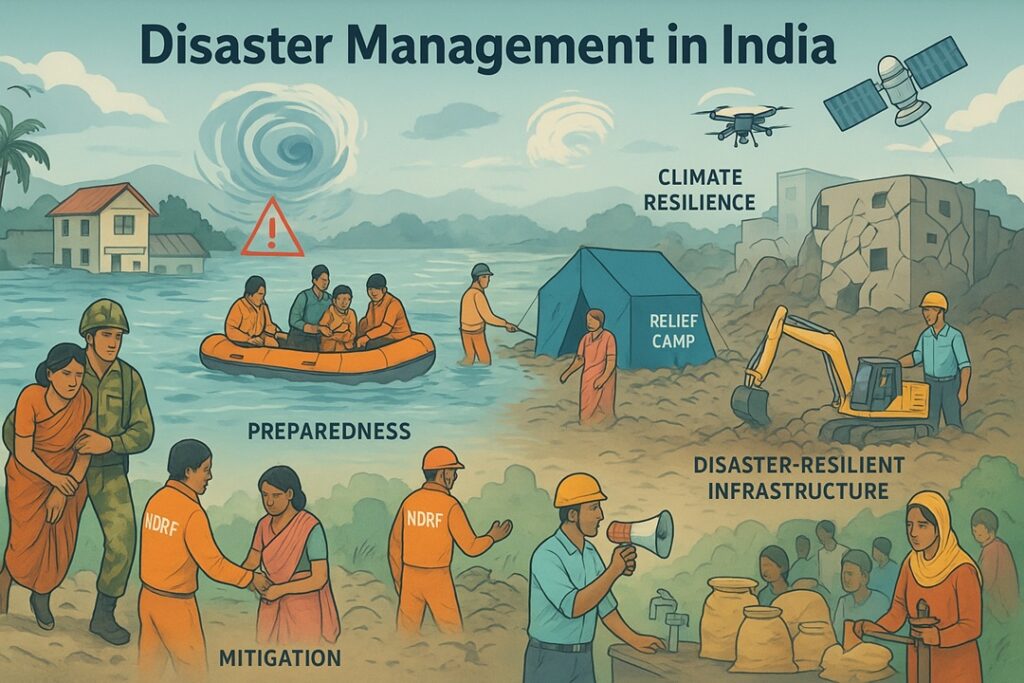
India’s disaster management system, established under the Disaster Management Act, 2005, integrates Union, State, district and local institutions to ensure prevention, preparedness, mitigation, response and recovery operations across the country.
Evolution from Relief-Centric to Preparedness-Oriented Approach
For decades, India followed a relief-centric model focused mainly on compensation after disasters. Recent policy frameworks like NPDM 2009 and NDMP 2016/2019 now emphasise preparedness, mitigation, early warning, resilience-building and long-term risk reduction.
Institutional Multi-Tier Governance Structure
The system consists of NDMA at the national level, SDMAs at the State level and DDMAs at the district level. This ensures vertically integrated decision-making from Delhi to panchayats, supported by NDRF as a specialised response force.
Adoption of a Multi-Hazard Vulnerability Perspective
India recognises its exposure to a wide range of hazards including floods, cyclones, earthquakes, landslides, droughts and industrial accidents. This broad approach enables hazard-specific planning and resource allocation.
Alignment with the Sendai Framework for Disaster Risk Reduction
India’s disaster policies align with the Sendai Framework (2015–2030), prioritising risk-informed development, inclusivity, community participation and the principle of build back better during reconstruction.
Strengthening of Institutional Capacities
India has developed a robust institutional chain comprising NDMA, NDRF, SDMAs and DDMAs. These bodies form a coordinated network capable of early warning dissemination, evacuation and emergency response.
Advancements in Cyclone Preparedness and Early Warning
States like Odisha and Andhra Pradesh have significantly reduced cyclone mortality through effective evacuation planning, resilient shelter infrastructure and accurate IMD forecasts based on satellites, Doppler radars and SMS alerts.
Growth in Disaster Training, Drills and Community Participation
Large-scale multi-hazard exercises such as Suraksha Chakra improve preparedness. Volunteer initiatives like Aapda Mitra and engagement of NGOs strengthen community-based response capacity.
Challenges of Rising Fiscal Centralisation
Increasing centralisation of disaster funds often results in funds released being significantly lower than assessed losses. Delayed and negotiated NDRF support undermines cooperative federalism and hampers timely relief.
Limitations of Outdated Relief and Compensation Norms
Current compensation norms for death, crop damage and house repair remain inadequate compared to actual reconstruction costs. These norms require periodic revision to remain effective.
Ambiguity in Declaring Severe Disasters
The absence of clear, objective criteria for classifying a severe disaster leads to discretionary decisions, affecting States’ access to enhanced central assistance.
Procedural and Bureaucratic Delays
Central team assessments, extensive documentation and multiple approval layers cause delays in sanctioning and releasing funds during emergencies when response speed is critical.
Weaknesses in Risk-Based Allocation Mechanisms
Finance Commission allocations rely heavily on population and area rather than scientific metrics like hazard exposure, ecological sensitivity or socio-economic vulnerability.
Capacity Gaps at Local Governance Levels
Many DDMAs, panchayats and urban local bodies face shortages of trained staff, GIS tools, planning capacity and enforcement powers, limiting their ability to implement resilience-building measures.
Need for Rules-Based and Trigger-Activated Financing
A shift to objective trigger mechanisms based on indicators like rainfall thresholds, per capita loss or loss–GSDP ratios can ensure predictable and timely support free of discretion.
Reforming Relief Norms and Funding Flexibility
Relief norms must be updated regularly and should allow broader support including livelihood restoration, temporary housing and basic rebuilding to ensure effective recovery.
Empowering States and Local Institutions
Strengthening SDMAs, DDMAs and urban local bodies through training, Emergency Operation Centres, and clear district-level protocols is essential for decentralised disaster governance.
Developing a National Disaster Vulnerability Index
A composite index integrating hazard exposure, ecology, population density and socio-economic vulnerability can guide transparent, scientific and priority-based fund allocation.
Mainstreaming Disaster Risk Reduction into Development Planning
Strict enforcement of building codes, zoning laws, CRZ norms and floodplain regulations is necessary. Infrastructure development must incorporate climate- and disaster-resilient designs.
Strengthening Cooperative Federalism
Regular Centre–State consultations on norms, triggers and fund allocation can reduce discretion and ensure a predictable, transparent and rules-based system.
Conclusion
India has built a strong institutional structure for disaster governance, but rising centralisation, outdated norms and procedural delays hinder its effectiveness. With climate-related disasters intensifying, a shift towards decentralised, transparent and scientifically driven disaster financing rooted in cooperative federalism is essential to safeguard lives and ensure resilient development.
Source : The Hindu