
DLTT Plan: Building Globally Competitive Textile Districts
Context
India’s textile sector is undergoing strategic restructuring to enhance global competitiveness, deepen value addition, and ensure balanced regional development amid rising export opportunities and supply chain diversification.
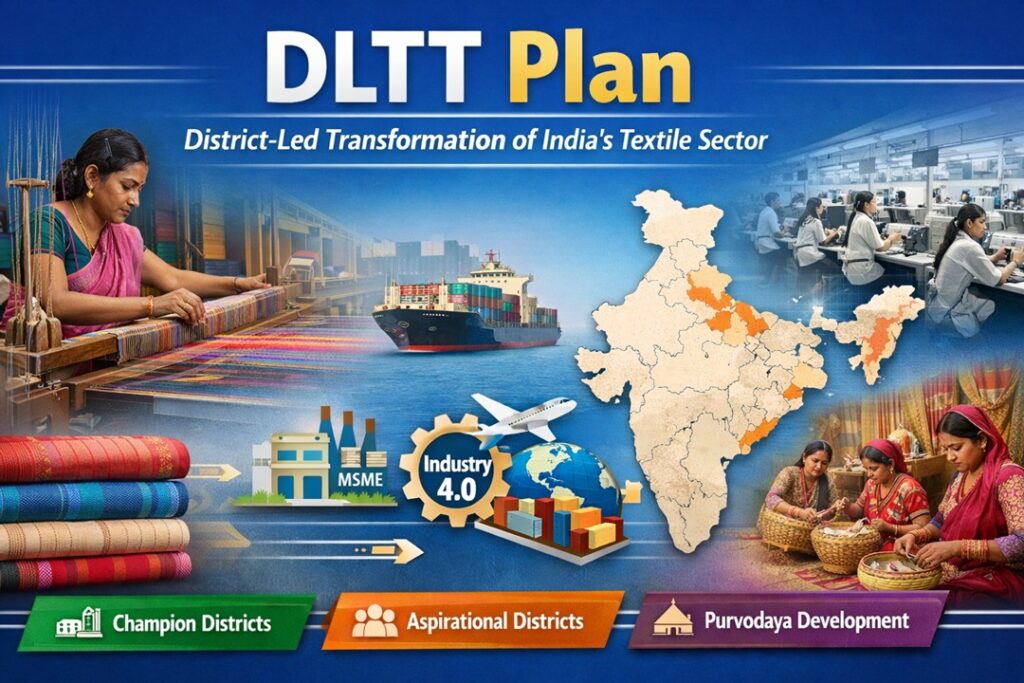
Background: The Ministry of Textiles has launched the District-Led Textiles Transformation (DLTT) Plan to develop 100 high-potential districts as Global Export Champions and transform 100 Aspirational Districts into self-reliant textile hubs.
Overview of DLTT Plan: A sector-specific, district-level transformation framework that adopts data-driven categorisation to strengthen India’s textile ecosystem—ranging from advanced export clusters to foundation-stage districts—through customised policy interventions.
Nodal Ministry: Ministry of Textiles.
Objective: To promote inclusive, sustainable, and export-oriented growth in the textile sector by decentralising implementation to districts, strengthening MSMEs, formalising the workforce, and creating globally competitive textile clusters.
Salient Features
- Data-driven district scoring: Districts assessed on export performance, MSME depth, and workforce availability.
- Dual district approach:
- Export Champion Districts (Scale & Sophistication): Mega Common Facility Centres (CFCs), Industry 4.0 adoption, advanced logistics, and direct global market linkages.
- Transformation Districts (Foundation & Formalisation): Basic skilling and certification, Raw Material Banks, and promotion of SHGs, cooperatives, and micro-enterprises.
- Purvodaya alignment: Targeted focus on Eastern and North-Eastern India through tribal belt development, improved connectivity, and GI tagging of unique handicrafts.
- Institutional convergence: Integration of government schemes, industry participation, and academic expertise to replicate and scale successful cluster models.
Importance
- Enhances India’s position in the global textile value chain and diversifies the export basket.
- Strengthens MSMEs, formalises employment, and supports women- and SHG-led enterprises.
- Drives balanced regional development in aspirational, eastern, and north-eastern districts.
Source : PIB