
Draft Pesticides Management Bill, 2025 Released for Public Consultation
Context
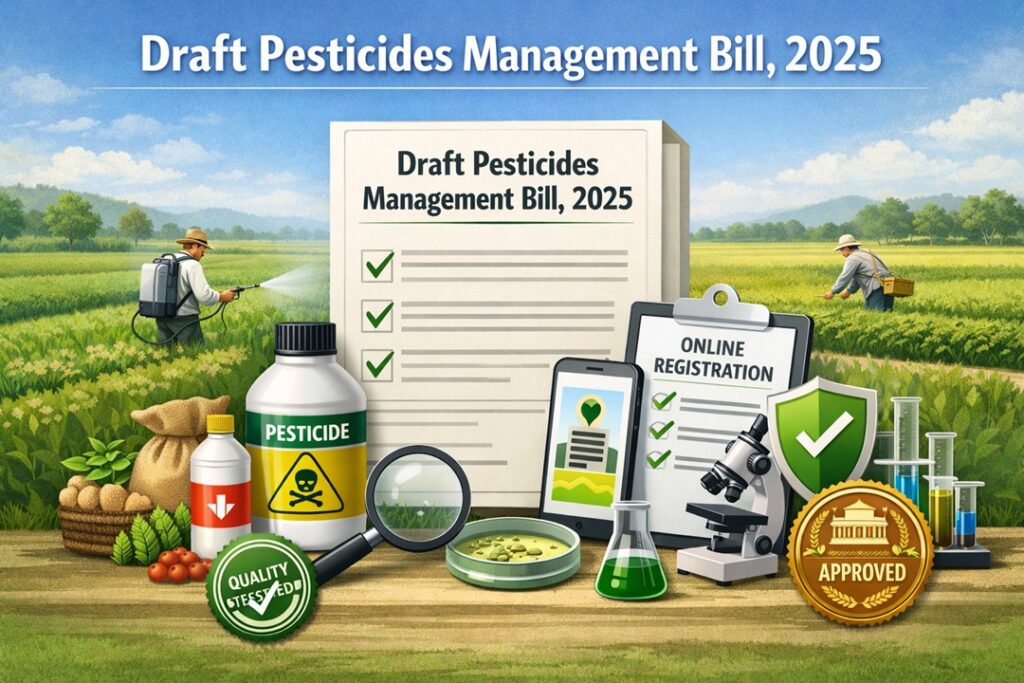
The Ministry of Agriculture & Farmers Welfare has released the Draft Pesticides Management Bill, 2025 for public and stakeholder consultation. The bill seeks to modernize pesticide regulation in India, replacing the outdated Insecticides Act, 1968.
Objective
- Modernize and replace the Insecticides Act, 1968.
- Ensure the supply of safe and quality pesticides to farmers.
- Decriminalize minor offences to promote Ease of Living and Ease of Doing Business.
Major Features
- Full-Cycle Regulation: Covers the entire life cycle of pesticides – manufacture, import, labelling, sale, transport, use, and disposal – under a unified framework.
- Central Oversight: Establishment of a Central Pesticides Board (advisory) and a Registration Committee (executive) to scrutinize and approve pesticide registrations.
- Mandatory Registration: No pesticide can be manufactured or imported without prior registration, with decisions to be made within 12–18 months.
- Digital Mechanisms: Use of digital platforms for registration, licensing, inspections, and record-keeping to simplify compliance.
- Quality Assurance: Accreditation of pesticide testing laboratories to ensure only certified products reach farmers.
- Control of Spurious Products: Stricter penalties and measures against fake, substandard, or banned pesticides, including provisions for compounding offences.
- State Role: States can prescribe enhanced penalties while balancing enforcement with local needs.
Institutional Structure
- Central Pesticides Board: Advisory body including representatives from Health, Environment, and Agriculture ministries to set safety and disposal standards.
- Registration Committee: Executive authority responsible for evaluating pesticide applications digitally, based on safety and efficacy.
- Pesticide Inspectors: Empowered to enter premises, seize stocks, and suspend sale of unsafe products for up to 60 days pending laboratory results.
Source : PIB