
Dumpsite Remediation Accelerator Programme (DRAP)
Context
The Government of India has launched the Dumpsite Remediation Accelerator Programme (DRAP) to rapidly clear legacy waste dumpsites across urban India and promote scientific solid-waste management.
Programme Profile
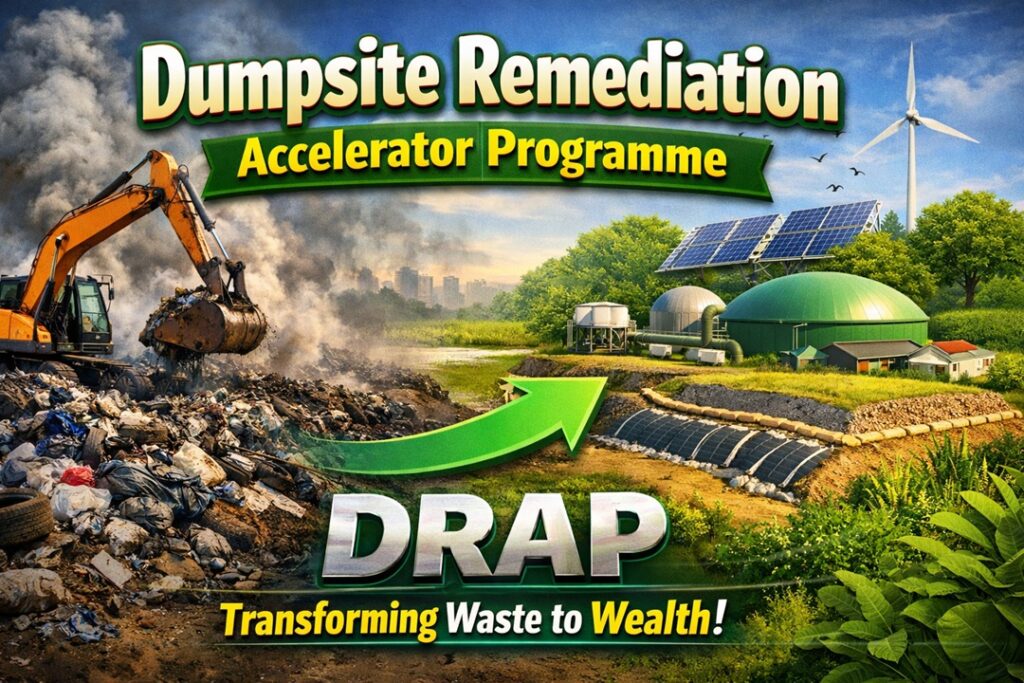
DRAP is a time-bound national mission aimed at accelerating the scientific processing and removal of legacy waste accumulated at urban dumpsites. The initiative adopts a mission-mode strategy to dismantle garbage mountains and reclaim urban land for public utilities, green spaces, and waste-processing infrastructure.
Launch & Nodal Ministry
- Introduced in November 2025.
- Implemented by the Ministry of Housing and Urban Affairs (MoHUA).
Policy Integration
- Implemented under Swachh Bharat Mission – Urban 2.0 (SBM-U 2.0).
- Supports the national objective of sustainable and scientific municipal solid-waste management.
Strategic Objectives
- Achieve complete clearance of legacy dumpsites within one year of programme adoption.
- Accelerate bio-mining and scientific processing of accumulated waste.
- Prevent the formation of new uncontrolled dumping grounds in urban areas.
- Recover valuable urban land while improving environmental and public health conditions.
Implementation Architecture
- Lakshya: Zero Dumpsites: Supports SBM-U 2.0 goal of eliminating dumpsites nationwide by September 2026.
- Targeted Site Selection: Focus on 214 high-impact dumpsites in 202 Urban Local Bodies (ULBs) where nearly 80% of legacy waste is concentrated.
- Central Financial Assistance: Government support of ₹550 per tonne for scientific remediation of legacy waste.
- 5P Governance Framework: Guided by Political leadership, Public financing, Partnerships, People’s participation, and Project management.
- Multi-stakeholder Collaboration: Engagement of PSUs, NGOs, technical experts, and infrastructure agencies for waste processing and land restoration.
- Technology-enabled Monitoring: Use of digital dashboards, GPS/RFID tracking, and daily progress reporting for transparency and real-time monitoring.
Significance for Urban Sustainability
- Reduces soil degradation, groundwater contamination, and air pollution caused by legacy waste.
- Facilitates conversion of dumpsites into parks, civic infrastructure, and productive urban land uses.
- Strengthens sustainable urban governance and public health outcomes.
Source : PIB