
Dynamic Groundwater Assessment 2024: Towards Water Security
Context
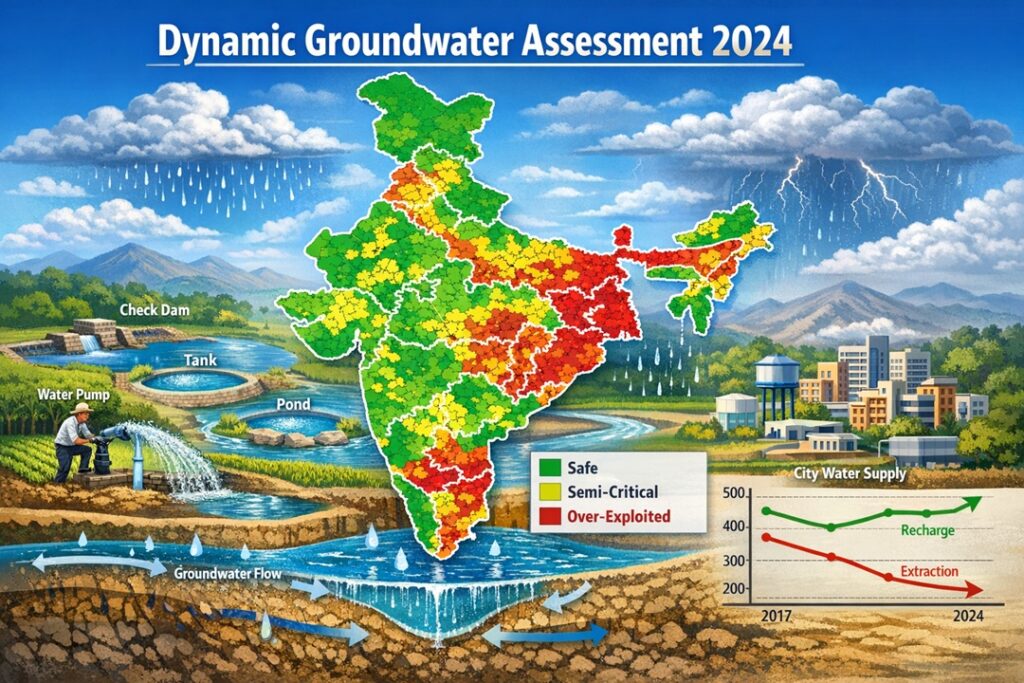
The Union Minister of Jal Shakti released the Dynamic Ground Water Resource Assessment Report 2024, highlighting an overall improvement in India’s groundwater status due to higher recharge and reduced long-term extraction compared to 2017.
Key Trends in Groundwater Resources
Improved Groundwater Recharge
Total annual groundwater recharge has increased to 446.90 BCM, driven by rainwater harvesting and water conservation structures.
Sustainable Extraction at National Level
Annual groundwater extraction stands at 245.64 BCM, with the stage of extraction at 60.47 percent, indicating relative sustainability.
Increase in Safe Assessment Units
The share of Safe units has risen to 73.4 percent, compared to 62.6 percent in 2017, reflecting better groundwater management.
Decline in Over Exploited Areas
Over exploited units have reduced from 17.24 percent in 2017 to 11.13 percent in 2024, showing partial stress reversal.
Role of Water Conservation Structures
Recharge from tanks, ponds and conservation structures has increased to 25.34 BCM, nearly double of 2017 levels.
Persistent Regional Imbalance
Critical and over exploited units remain concentrated in Punjab, Haryana, Delhi, Rajasthan, Tamil Nadu, Karnataka, Telangana and Gujarat.
Dependence on Monsoon Rainfall
Around 61 percent of recharge comes from rainfall, making groundwater highly sensitive to monsoon variability and climate change.
Causes of Groundwater Depletion
Agricultural Over Dependence
Groundwater supports nearly 62 percent of irrigation, with water intensive crops pushing many regions into over exploitation.
Seasonal Rainfall Pattern
Nearly 75 percent of annual rainfall occurs during June to September, creating mismatch between recharge and withdrawal.
Hydro Geological Constraints
About two thirds of India lies in hard rock terrain with limited groundwater storage capacity.
Distorted Energy Pricing
Free or subsidised electricity promotes excessive pumping, especially in north western and peninsular states.
Urban and Industrial Pressure
Rapid urbanisation and industrial growth have increased non agricultural groundwater extraction.
Government Initiatives
National Aquifer Mapping Programme
Scientific mapping and aquifer based management under NAQUIM and NAQUIM 2.0.
Atal Bhujal Yojana
Community led demand side management in water stressed blocks.
Master Plan for Artificial Recharge
Creation of large scale recharge structures to harness 185 BCM of monsoon runoff.
Jal Shakti Abhiyan Catch the Rain
Nationwide campaign for rainwater harvesting and conservation.
Challenges in Groundwater Management
Threat to Water Security
Groundwater supplies 85 percent of rural and 50 percent of urban drinking water.
Regional Inequality
Over exploitation is concentrated in specific regions, leading to uneven development.
Water Quality Degradation
Issues of salinity, arsenic and fluoride contamination coexist with quantity stress.
Climate Change Impact
Erratic rainfall caused a marginal fall in recharge from 449.08 BCM in 2023 to 446.90 BCM in 2024.
Fragmented Governance
Groundwater being a State subject leads to weak regulation and uneven policy implementation.
Way Forward
Aquifer Based Planning
Village level aquifer management plans focusing on critical and over exploited units.
Demand Side Reforms
Crop diversification, rational power pricing and expansion of micro irrigation.
Strengthening Artificial Recharge
Effective implementation of the Master Plan for Artificial Recharge.
Community Participation
Expansion of Atal Bhujal Yojana with behavioural change interventions.
Data Driven Governance
Regular assessments using IN GRES GIS based platform for evidence based policymaking.
Conclusion
The Ground Water Assessment 2024 shows positive national level trends, but regional stress, climate risks and governance gaps persist. Sustainable groundwater management requires aquifer based planning, community participation and climate resilient water governance to ensure long term water security for India.
Source : PIB