
Electoral Roll Revision Controversy in West Bengal
Context
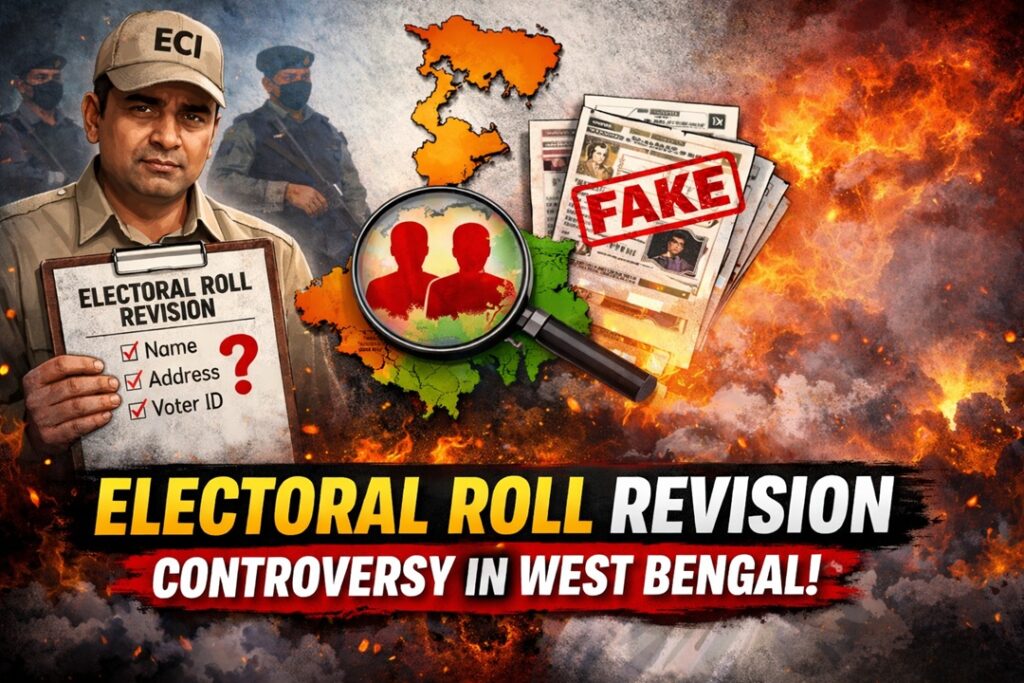
The recent controversy over the Special Intensive Revision (SIR) of electoral rolls in West Bengal, along with directions issued by the Supreme Court of India, has sparked concerns regarding electoral integrity, institutional roles, and citizens’ voting rights.
Understanding the Revision Exercise
Nature of the Exercise:
Special Intensive Revision (SIR) is an exceptional verification process conducted by the Election Commission of India to ensure accuracy in electoral rolls.
Unusual Features in Bengal:
Unlike routine revisions, the exercise in West Bengal was marked by large-scale scrutiny, algorithm-based discrepancy detection, and involvement of external observers.
Scale of Impact:
Despite no strong evidence of inflated voter lists, an extensive verification led to identification and eventual deletion of a significant number of voters.
Mass Deletion Controversy
Extent of Removal:
Around 27 lakh names were reportedly deleted, raising fears of widespread disenfranchisement.
Transparency Concerns:
The multi-layered process—from flagging to deletion—has been criticised for lack of clarity and consistency.
Limited Remedies:
Affected individuals face challenges in seeking timely redress, especially close to elections.
Judicial Response and Its Limits
Court Directive:
The Supreme Court instructed publication of a supplementary voter list but did not explicitly address the magnitude of exclusions.
Reliance on Tribunals:
The Court emphasized appellate mechanisms via tribunals, shifting focus from immediate relief to procedural remedies.
Time Constraints:
With electoral rolls frozen before elections, many affected voters may not regain voting rights in time.
Process-Related Shortcomings
Weak Verification Standards:
Authorities allegedly did not examine all submitted documents, leading to arbitrary exclusions.
Questionable Exclusions:
Even individuals with valid credentials—such as officials and defence personnel—were reportedly removed.
Lack of Accessible Data:
Absence of machine-readable and publicly verifiable data reduced transparency and accountability.
Patterns Raising Alarm
Regional Disparities:
Higher deletions were observed in select districts, indicating uneven impact.
Community-Level Concerns:
Reports suggest disproportionate exclusions among certain communities, leading to allegations of bias.
Need for Investigation:
While claims require verification, their plausibility highlights the need for institutional vigilance.
Impact on Electoral Democracy
Electoral Arithmetic:
Removal of nearly 5% of voters could influence outcomes in closely contested constituencies.
Democratic Legitimacy:
Large-scale exclusion undermines the principle of universal adult suffrage.
Public Confidence:
Perceived unfairness risks eroding trust in electoral institutions.
Role of Judiciary and Constitutional Powers
Use of Article 142:
The Court invoked extraordinary powers under Article 142 of the Constitution of India to facilitate dispute resolution.
Procedural Complexity:
Such intervention, though well-intended, may complicate established statutory processes.
Broader Consequences Beyond Voting
Citizenship Linkages:
Electoral rolls often serve as identity proof for welfare access and legal recognition.
Socio-economic Impact:
Deletion can affect access to schemes, documentation, and entitlements.
Temporary vs Lasting Effects:
Even short-term disenfranchisement can have enduring consequences on participation and inclusion.
Reform Imperatives
Transparent Verification:
Adopt uniform, rule-based, and auditable procedures.
Efficient Appeals:
Ensure fast-track, accessible grievance redressal mechanisms.
Judicial Clarity:
Define limits of electoral interventions, especially near elections.
Open Data Systems:
Publish detailed, machine-readable datasets for public scrutiny.
Institutional Autonomy:
Strengthen independence of the Election Commission to maintain credibility.
Way Forward
The SIR episode in West Bengal is not merely administrative—it represents a critical test of India’s democratic framework. The evolving interaction between the Election Commission and judiciary will shape future electoral governance.
Ensuring that democratic participation remains inclusive, transparent, and constitutionally grounded.
The strength of democracy lies not just in conducting elections, but in safeguarding every citizen’s right to participate without exclusion.
Source : The Indian Express