
Electric Cooking Transition in India: Balancing Energy Security and Grid Stability
Context
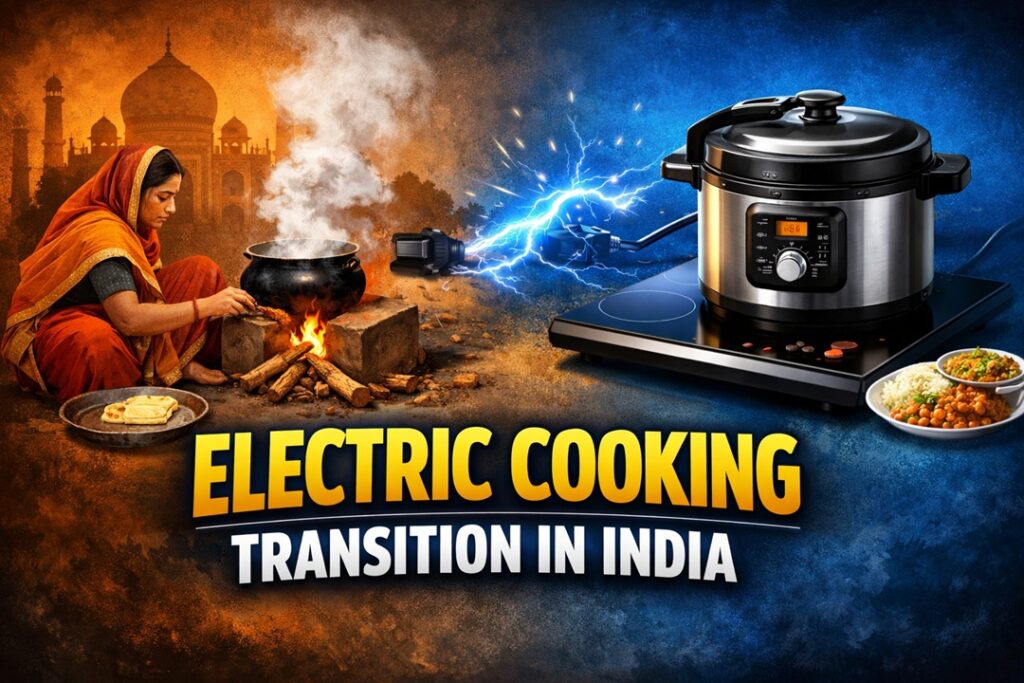
India spends nearly $26.4 billion annually on importing cooking gas, making household cooking fuel a significant component of the country’s energy import bill. Recent studies suggest that electric cooking has become cheaper than using unsubsidised LPG, but transitioning millions of kitchens from gas stoves to electric appliances raises concerns about grid capacity, peak electricity demand, and the cost of infrastructure upgrades.
Why is the LPG-based clean cooking transition slowing?
Expansion of LPG connections:
India’s LPG connections expanded significantly from 150 million in 2015 to about 332 million in 2025.
Dependence on imports:
Around 60% of LPG and 50% of natural gas are imported, while nearly 37% of households still rely on traditional biomass fuels such as firewood and dung.
Rising import expenditure:
According to the Institute for Energy Economics and Financial Analysis (IEEFA), India’s combined LPG and natural gas import bill reached $26.4 billion in FY 2024–25, increasing by about 50% over six years.
Exposure to global tensions:
Escalations in West Asian geopolitical conflicts often cause sudden spikes in energy prices, directly affecting household cooking fuel costs in India.
Can electric cooking compete with gas economically and practically?
Cost advantage:
Research by IEEFA shows that electric cooking is about 37% cheaper than unsubsidised LPG and 14% cheaper than piped natural gas for a typical family in Delhi.
Role of subsidies:
Only LPG supplied through the Pradhan Mantri Ujjwala Yojana remains cheaper due to heavy government subsidies, which impose significant fiscal costs.
Higher energy efficiency:
Induction cooktops deliver roughly 85% energy efficiency, while conventional LPG burners transfer only about 40% of heat to the vessel.
Performance of electric pressure cookers:
Cooking trials under the Modern Energy Cooking Services (MECS) programme found that electric pressure cookers consume the least energy among tested cooking devices.
Complexity of Indian cooking habits:
Indian kitchens often involve simultaneous cooking of multiple dishes such as chapatis, dal, and tempering. Institutions like The Energy and Resources Institute (TERI) highlight the need for multi-pot induction technologies to make electric cooking viable.
Gradual urban adoption strategy:
Policy researchers including the International Institute for Sustainable Development recommend prioritising urban households first, allowing scarce LPG supplies to be redirected toward rural areas where electricity access remains unreliable.
Understanding electricity “peak demand”
Definition:
Electricity consumption varies throughout the day, with demand surging in the afternoon and again during evening hours (9–11 p.m.) when households simultaneously use lights, appliances, and cooling devices.
Rising national peak:
India’s peak electricity demand increased from 148 GW in 2014 to about 242.5 GW by December 2025.
Impact of climate change:
The International Energy Agency notes that every 1°C rise in average daily temperature can add more than 7 GW to peak electricity demand.
How utilities manage demand surges:
- Purchase electricity in the spot market, where prices can jump from ₹3.5/unit to ₹9–10/unit.
- Activate gas-based peaking power plants.
- Release stored energy from hydropower reservoirs.
- Use grid-scale battery storage systems, such as those deployed by BSES Rajdhani Power Limited in Delhi.
- Implement load shedding, resulting in temporary power outages.
Implication for electric cooking:
Large-scale adoption of induction cooktops during evening cooking hours could intensify the peak demand curve, increasing grid costs and the probability of outages.
Can digital demand management stabilise electricity use?
Automated Demand Response (ADR):
ADR technologies allow devices such as smart cooktops, EV chargers, and thermostats to automatically adjust electricity consumption during peak periods.
OpenADR standard:
The OpenADR protocol enables two-way communication between utilities and smart appliances, allowing automatic demand adjustment.
Origins:
The system emerged after California’s 2002 energy crisis and now integrates with modern smart-grid infrastructure.
India’s early experiments:
Tata Power Delhi Distribution Limited conducted India’s first OpenADR pilot involving 167 industrial and commercial consumers, achieving around 14% peak demand reduction.
Potential benefits:
Studies suggest around 7% peak demand reduction nationwide if such systems are implemented across Indian buildings.
International experience:
South Korea’s Auto-Demand Response programme reduced electricity consumption by about 24%, with investments typically recovering costs within four years.
Key challenges:
Indian distribution companies still lack complete ADR infrastructure, including compliant servers, smart-meter communication modules, and aggregator platforms.
Can decentralised solar energy reduce peak pressure?
Rise of the ‘prosumer’:
Households equipped with rooftop solar panels and battery storage become both producers and consumers of electricity.
Peak demand advantage:
Solar panels generate electricity during the day while batteries store excess energy that can power evening cooking loads.
International findings:
A 2025 Australian study found that combining rooftop solar, batteries, and off-peak scheduling reduced peak demand by nearly half and cut grid reinforcement costs by about 75%.
India’s rooftop expansion:
Solar rooftop capacity is projected to grow from 24 GW in 2026 to over 41 GW by 2030, supported by the PM Surya Ghar Muft Bijli Yojana.
Peer-to-peer electricity trading:
Digital platforms allow households to sell excess solar electricity directly to neighbours.
India’s pilot initiative:
South Asia’s first blockchain-based P2P solar trading pilot was conducted in Lucknow by the India Smart Grid Forum and Powerledger, under regulatory approval from the Uttar Pradesh Electricity Regulatory Commission.
Outcome:
The pilot achieved about 43% reduction in electricity purchase cost compared with standard retail tariffs.
Recent policy step:
In February 2026, the Union government announced plans to enable P2P electricity trading under the India Energy Stack framework in Delhi and western Uttar Pradesh.
Neighbourhood-scale virtual power plants:
Clusters of solar-powered homes could collectively operate as micro power plants, supplying electricity locally during evening cooking hours and reducing grid stress.
What policy actions are necessary?
International policy trend:
The All-Electric Buildings Act in New York mandates all-electric construction for buildings below seven storeys from 2026, extending to taller buildings by 2029.
India’s existing initiatives:
- Go Electric Campaign promoting electric appliances.
- National Efficient Cooking Programme targeting 2 million induction stoves.
- Bureau of Energy Efficiency introducing star labelling for induction cooktops.
Policy reforms proposed:
- Redirect ₹40,000 crore annual LPG subsidies toward capital support for induction appliances.
- Expand bulk procurement through Energy Efficiency Services Limited (EESL) to reduce appliance prices.
- Introduce time-of-use electricity tariffs for cooking loads.
- Require OpenADR compatibility in smart meters and appliances.
- Invest in R&D for multi-pot induction stoves suited to Indian cooking styles.
- Encourage all-electric residential construction in major cities.
The road ahead
Heavy dependence on imported LPG exposes India to global supply disruptions and geopolitical volatility, particularly around strategic maritime chokepoints like the Strait of Hormuz. Transitioning to electric cooking powered by domestic renewable energy can strengthen energy security and economic resilience.
Urban areas are likely to lead the transition due to stronger grid infrastructure and higher appliance adoption. The crucial challenge will be aligning policy, technology, and grid management before the next global energy shock accelerates the shift.
Source : The Hindu