
Employees’ State Insurance Corporation Completes 75 Years
Context
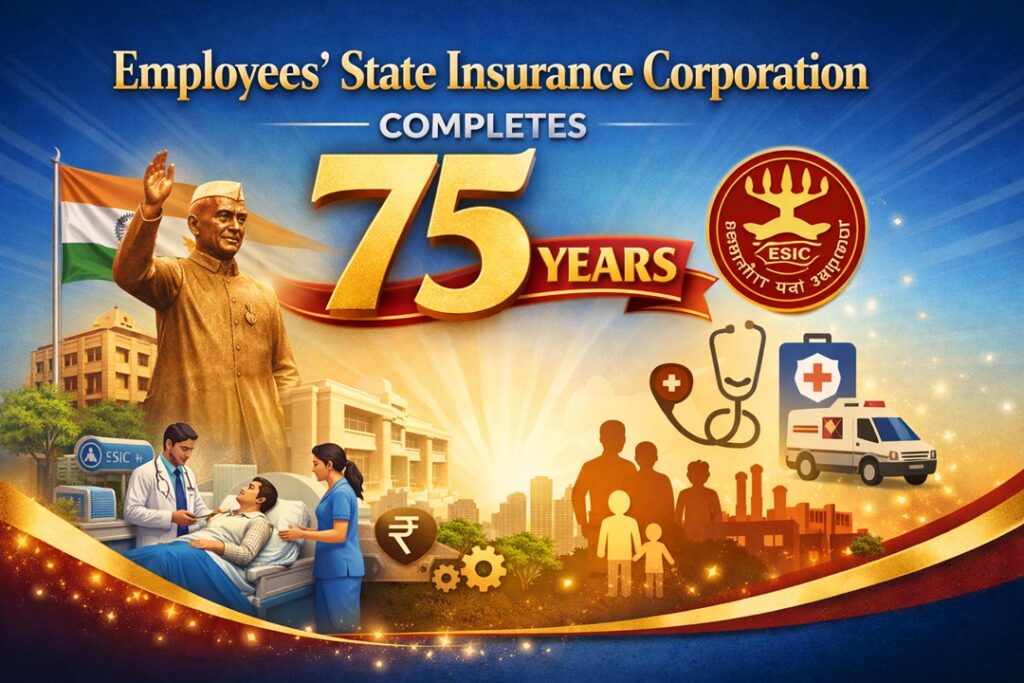
The Employees’ State Insurance Corporation (ESIC) has initiated commemorative programmes to mark 75 years since the launch of the Employees’ State Insurance Scheme, underscoring its sustained contribution to India’s worker-centric social security framework.
ESIC: Seven and a Half Decades of Social Protection
Organisational Overview:
ESIC is a statutory institution under the Ministry of Labour & Employment, entrusted with administering the Employees’ State Insurance (ESI) Scheme that provides healthcare services and income security to insured employees and their dependents.
Legislative Basis and Timeline:
- Enabling Law: Employees’ State Insurance Act, 1948
- Operational Start: February 24, 1952 (observed annually as ESIC Foundation Day)
Formative Phase:
- Conceptual Roots: The framework for social health insurance in India was proposed in the Health Insurance Report (1944) by Prof. B.P. Adarkar, popularly known as the Indian Beveridge.
- Scheme Rollout: The ESI Scheme was inaugurated at Kanpur and Delhi by Prime Minister Jawaharlal Nehru, the first honorary insured individual.
- Early Administration: Dr. C.L. Katial served as ESIC’s first Director General.
Major Welfare Provisions:
- Medical Care Coverage: Comprehensive healthcare from primary to tertiary levels for insured persons and their families.
- Income Support Mechanisms: Cash benefits during periods of certified sickness and maternity.
- Employment Injury Safeguards: Pensionary benefits in cases of permanent disablement due to workplace injuries.
- Family Protection Measures: Financial assistance to dependents in case of death arising from occupational injury or disease.
- Preventive Health Initiatives: Periodic health screenings for workers aged 40 years and above under the new Labour Codes.
Current Significance:
- Serves as a key pillar of India’s social security architecture, mitigating health and income-related risks for workers.
- Healthcare delivery is being strengthened through convergence with Ayushman Bharat (via NHA) and adherence to NABL quality standards.
Source : PIB