
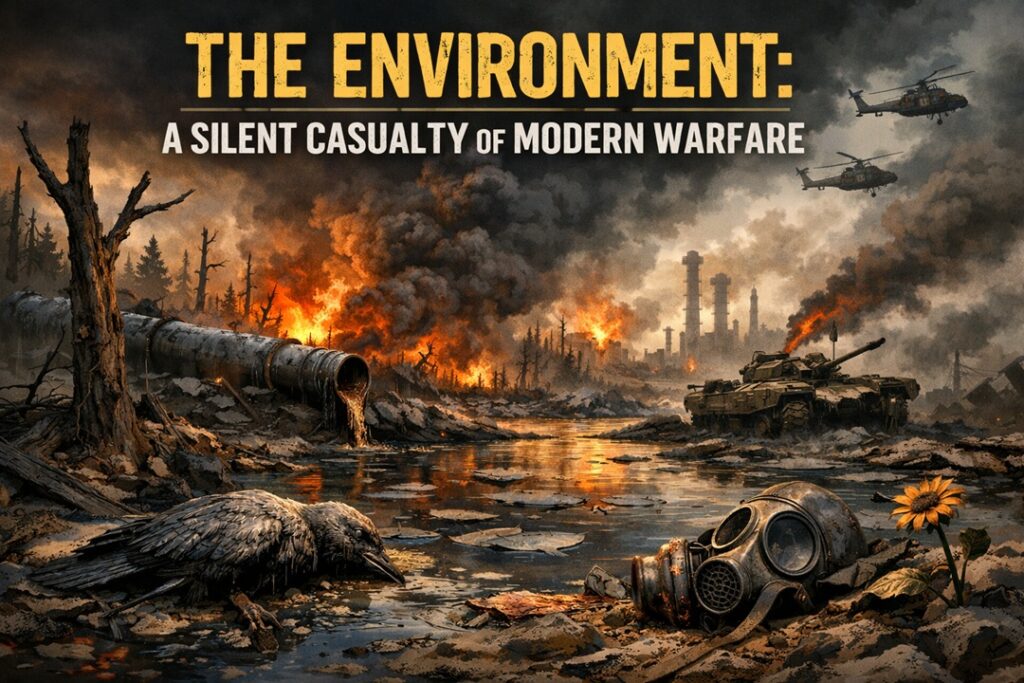
Environment as a Silent Casualty of Modern Warfare
Context
Amid escalating tensions in West Asia, especially the US–Israel confrontation involving Iran, environmental degradation has evolved from isolated incidents into a continuous and compounding crisis, making nature an often overlooked victim of modern conflicts.
How do contemporary conflicts affect the environment?
Carbon footprint of warfare – Military campaigns are energy-intensive, generating large-scale greenhouse gas emissions in short durations. Activities like troop deployment, aerial strikes, and infrastructure destruction intensify global warming trends.
Air toxicity and chemical hazards – Bombing of oil facilities releases soot, particulate matter, and toxic gases, leading to phenomena like black rain. This triggers severe health issues such as respiratory and cardiac ailments, worsened by chemicals like glyphosate.
Damage to marine ecosystems – Regions like the Persian Gulf face high risks due to oil spills from damaged tankers and ports. This harms coral reefs, fisheries, and marine biodiversity, with long-term ecological consequences.
Land and groundwater pollution – Destruction of industrial infrastructure releases heavy metals and hazardous substances into soil and aquifers, affecting agriculture and potable water availability.
Collapse of essential services – Targeting of desalination plants and water systems in arid regions disrupts water security, linking environmental damage directly to human survival.
What lessons emerge from past conflicts?
Global wars and ecological loss –
- World War I resulted in massive deforestation (~350,000 hectares).
- World War II saw deliberate flooding and ecosystem destruction across Europe.
Vietnam conflict as a turning point – The use of Agent Orange marked the deliberate use of environmental destruction as a war strategy, causing long-term ecological and health damage.
1991 Gulf War impact – Massive oil spills in the Persian Gulf created one of the worst environmental disasters, severely damaging coastal and marine systems.
Recent conflicts (Russia–Ukraine) – Even protected biodiversity zones have been affected, indicating the vulnerability of conservation areas during war.
Emerging trend: Persistent ecological stress –
- Shift from localized to multi-domain warfare (land, sea, air, cyber)
- Rise of long-term pollution and emissions
- Accumulation of damage accelerating climate change and biodiversity loss
What global norms regulate environmental protection in war?
ENMOD Convention – Bans use of environmental modification as weapons, but has limited scope.
Geneva Conventions Additional Protocol I –
- Article 35(3): Prohibits widespread, long-term, severe damage
- Article 55: Calls for environmental protection during war
Rome Statute of the International Criminal Court – Recognises environmental war crimes but sets a high threshold for liability.
UN International Law Commission (2022 Principles) – Offers guidelines for protection and restoration, but remains non-binding.
What are the key shortcomings?
Stringent liability standards – The requirement of “widespread, long-term, severe” damage restricts accountability.
Weak enforcement – Absence of independent monitoring bodies leads to poor compliance.
Neglect of military emissions – War-related carbon emissions are largely excluded from climate frameworks.
Non-binding frameworks – Many recent guidelines lack legal enforceability.
Inadequate reparations – Limited focus on ecosystem restoration and compensation.
What is the concept of Ecocide?
Definition – Refers to extensive destruction of ecosystems, whether intentional or due to negligence.
Importance –
- Broadens accountability beyond wartime
- Lowers prosecution thresholds
- Recognises intrinsic ecological value
Potential significance –
- Acts as a deterrent against environmental harm
- Enables action against both state and non-state actors
- Promotes environmental justice and restoration
What reforms are needed?
Legal strengthening – Broaden definitions and reduce thresholds for environmental war crimes.
Binding global agreements – Convert voluntary norms into enforceable treaties.
Monitoring mechanisms – Establish independent international bodies for real-time assessment.
Climate integration – Include military emissions in global carbon accounting.
Focus on restoration – Ensure post-war ecological recovery alongside reconstruction.
Recognition of ecocide – Incorporate it into international criminal law.
Way Forward
The transformation of environmental damage from temporary disruption to a sustained global crisis highlights the urgent need for reform. Recognising ecological protection as central to peace, security, and sustainability, and adopting frameworks like ecocide, can ensure accountability and long-term resilience. Without such steps, warfare will continue to impose irreversible costs on both humanity and the planet.
Source : The Indian Express