
Forests as Engines of Sustainable Growth in India
Context
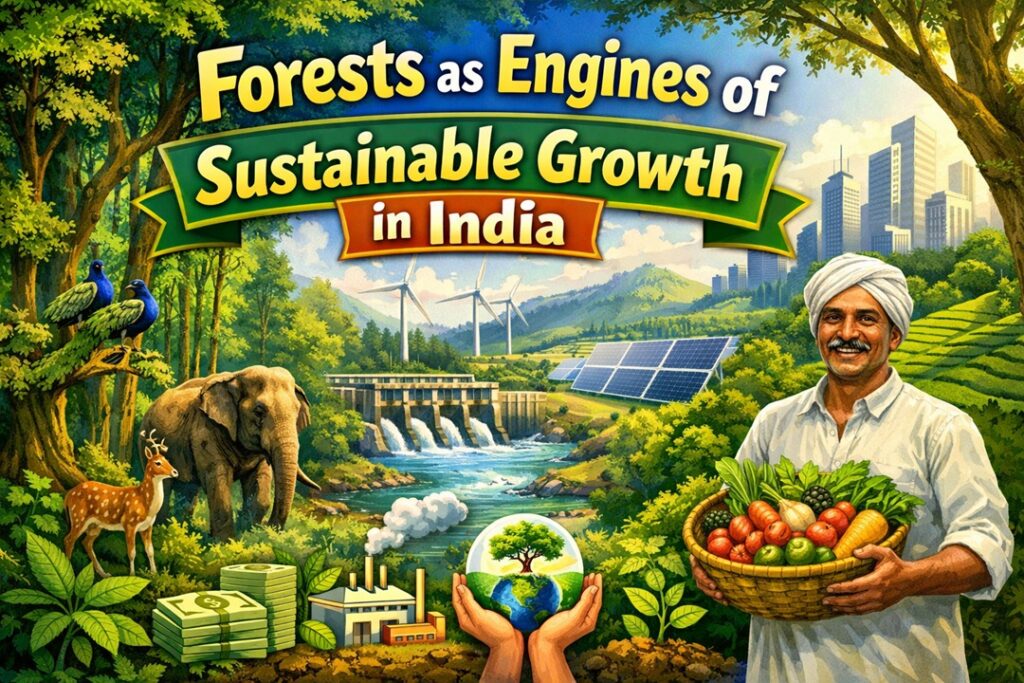
Forests are increasingly recognised as vital for India’s ecological balance, rural livelihoods, and transition towards a sustainable bioeconomy.
How Healthy are India’s Forest Resources?
Current Snapshot – As per the India State of Forest Report 2023, forest and tree cover together account for 25.17% of India’s total geographical area.
Socio-economic Role – Forest ecosystems sustain millions, especially tribal and forest-dependent populations.
Sustainability Shift – India is advancing towards a bio-based economic model, where forests and tree systems form a key resource base.
Global Recognition – The theme of International Day of Forests (March 21), “Forests and Economies”, highlights the linkage between ecological protection and economic growth.
How Do Forests Support Rural Livelihoods?
Economic Backbone – Forests provide both timber and non-timber forest products (NTFPs) such as bamboo, honey, tendu leaves, resins, and medicinal plants.
Income Generation – These products support local markets, small enterprises, and rural value chains.
Food & Nutrition – Wild foods and forest produce enhance nutritional security.
Cultural Significance – Forests remain integral to tribal traditions and indigenous knowledge systems.
Bamboo Economy – Known as “green wealth”, bamboo drives industries like handicrafts, construction, and eco-materials.
Shock Absorber – Forests act as a fallback source of income during crop failures or economic distress.
Global Dependence – Around 1.6 billion people worldwide rely on forests for livelihoods.
How Do Forests Enable Ecological and Economic Stability?
Water Security – Forests regulate hydrological cycles, maintain watersheds, and recharge groundwater.
Soil Protection – Tree cover reduces erosion and improves soil fertility.
Biodiversity Support – Forests sustain pollinators and biodiversity essential for agriculture.
Climate Regulation – Acting as carbon sinks, forests mitigate climate change and extreme weather risks.
Food Security Link – These ecosystem services underpin long-term agricultural productivity.
Why is Agroforestry a Game Changer?
Concept – Integration of trees with crops and livestock systems.
Income Diversification – Generates revenue from timber, fruits, fodder, and biomass.
Soil & Input Efficiency – Improves soil quality and reduces dependence on chemical inputs.
Resilience Building – Enhances ecosystem stability and buffers against crop failure risks.
Traditional Knowledge – India has long-standing indigenous agroforestry practices.
Climate Alignment – Supports carbon sequestration and land restoration goals.
What Role Do Forests Play in the Bioeconomy?
Bioeconomy Defined – An economic system based on sustainable use of biological resources.
Industrial Inputs – Forests provide renewable raw materials for multiple sectors.
Green Substitutes – Enable eco-friendly alternatives to fossil fuel-based products.
Circular Economy Push – Bamboo and forest resources are used in biodegradable packaging, construction, and textiles.
Employment Potential – Strengthening forest-based value chains can boost rural jobs and incomes.
What are the Key Constraints?
Deforestation Pressure – Expansion of infrastructure, urbanisation, and over-extraction.
Climate Risks – Rising forest fires, droughts, and pest infestations.
Biodiversity Threats – Habitat fragmentation affecting species survival.
Market Barriers – Limited access to fair pricing and value addition for forest communities.
Governance Gaps – Weak implementation of forest rights and conservation policies.
What Policy Actions are Needed?
Institutional Strengthening – Promote community-led forest management and agroecological practices.
Agroforestry Promotion – Develop region-specific models and incentivise adoption.
Inclusive Support – Focus on small farmers, women, and tribal populations.
Value Chain Development – Improve processing, branding, and market access for NTFPs.
Quality Inputs – Ensure availability of certified planting material and nursery systems.
Sustainable Practices – Encourage scientific harvesting and certification mechanisms.
Tech & Innovation – Use digital tools, research, and data-driven forest management.
Climate Integration – Align forest strategies with national climate commitments.
Collaborative Approach – Foster public-private partnerships and global cooperation.
What is the Way Forward?
Economic Asset – Forests must be viewed not only as ecological resources but also as drivers of economic growth.
Resilience Strategy – They offer a pathway for climate adaptation, rural livelihoods, and sustainable industries.
Strategic Priority – Strengthening forest governance and sustainable utilisation is essential for India’s long-term development and ecological security.
Source : The Hindu