
From MGNREGA to Pujya Bapu Gramin Rozgar Yojana
Context
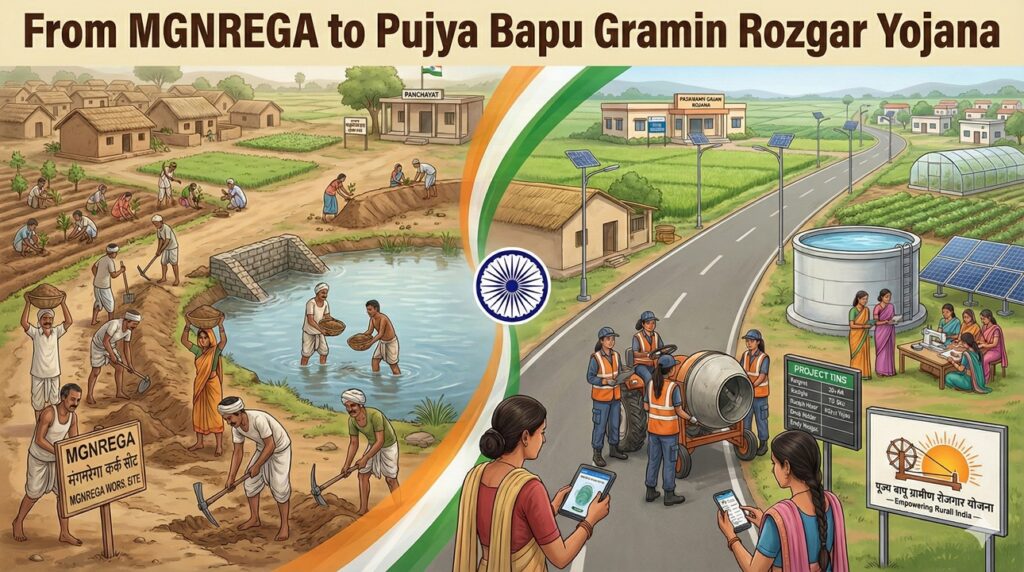
The Union Government proposes to amend the MGNREGA Act, 2005 to rename the scheme as Pujya Bapu Gramin Rozgar Yojana and increase the guaranteed employment from 100 days to 125 days.
About MGNREGA
MGNREGA is a demand-driven, rights-based rural wage employment programme guaranteeing unskilled manual work to rural households. It aims at livelihood security and creation of durable rural assets.
Launch and Background
The scheme was enacted in 2005 and implemented nationwide in phases from 2006. It drew inspiration from the Employment Assurance Scheme, 1993 and Food for Work Programme, 2004. Conceived as a legal right to work, it reflects Gandhian ideals of self-reliant villages and has become the largest social security programme in the world.
Objectives of the Scheme
The primary objective is to guarantee 100 days of wage employment, proposed to be enhanced to 125 days. It seeks to reduce distress migration, strengthen rural livelihoods, and promote decentralized planning through Panchayati Raj Institutions.
Key Features
The scheme provides a statutory entitlement to employment for adult rural household members, along with a right to unemployment allowance if work is not provided within 15 days.
It follows a 60:40 wage-material ratio at the Gram Panchayat level.
Women participation is emphasized, with a mandated minimum of one-third beneficiaries, while actual participation exceeded 58 percent in 2024–25.
Payments are largely digital, with over 99 percent wage payments through e-FMS and linked to Aadhaar-Based Payment System.
The scheme prioritizes natural resource management, including water conservation, afforestation, land development, and soil moisture restoration, supported by mandatory social audits by Gram Sabhas.
Recent Amendments and Proposals
The 2025 proposal suggests renaming MGNREGA as Pujya Bapu Gramin Rozgar Yojana, increasing employment to 125 days, introducing exclusion clauses linked to state economic indicators, and modifying the funding pattern.
A September 2025 amendment to Schedule I prioritizes water conservation by earmarking 65 percent funds for over-exploited and critical blocks, 40 percent for semi-critical blocks, and 30 percent for safe blocks.
Project UNNATI, launched in 2019, focuses on skill upgradation of MGNREGA workers, with 90,894 workers trained against a target of 2 lakh by March 2025.
Conclusion
The proposed changes aim to expand employment support and rebrand MGNREGA, while retaining its rights-based and decentralized framework, reinforcing its role as a cornerstone of rural development and social security in India.
Source : The Hindu