
GST Reforms: Empowering Manipur’s Farmers and Artisans
Context:
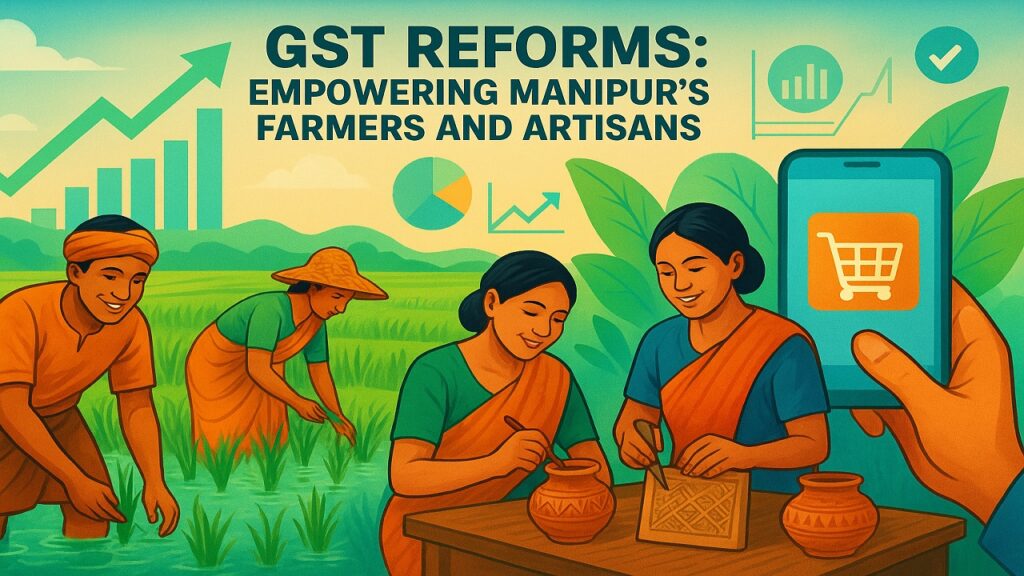
The Government of India has introduced new GST reforms aimed at promoting inclusive growth and improving the ease of doing business.
- These reforms are particularly beneficial for small traders, artisans, and local entrepreneurs.
- States like Manipur are expected to gain significantly, with positive impacts across agriculture, crafts, handlooms, and other local industries.
Economic Status of Manipur
- Gross State Domestic Product (GSDP): ₹37,761 crore (2021-22); projected to rise to ₹60,112 crore by 2025-26.
- Economic Base: Primarily agriculture-based, with rice as a major crop, along with forest products, mining, industries, and tourism.
- The state’s economy also relies on small-scale industries, traditional crafts, handloom, and agro-based livelihoods, which are highly responsive to GST reforms.
Sectors Benefited by GST Reforms
1. Arabica Coffee
- GST reduced from 18% to 5%, providing relief to producers and consumers.
- Key districts: Ukhrul, Senapati, Chandel.
- Around 10,000 farmers engaged in coffee cultivation.
- Benefits include employment in processing, packaging, and distribution, improved profitability, affordability, and competitiveness in domestic and export markets.
- Encourages organic and sustainable farming practices.
2. Bamboo and Cane Crafts
- Concentrated in Churachandpur, Ukhrul, Tamenglong; around 1.2 lakh artisans involved.
- GST reduced from 12% to 5% on furniture, baskets, mats, and wooden crafts.
- Expected outcomes: lower product prices, higher demand, and growth of SMEs and SHGs.
3. Handloom Textiles
- Products include Phanek, Innaphi, Rani, crafted mainly by women in Imphal, Thoubal, Bishnupur, Senapati.
- Approximately 2.5 lakh weavers benefit.
- GST reduction from 12% to 5% improves consumer affordability, market competitiveness, and global appeal, while preserving traditional weaving techniques.
4. Stone Carving and Sculpture
- Key districts: Imphal, Churachandpur, Ukhrul; around 50,000 artisans engaged.
- GST reduction from 12% to 5% on ceramic tableware lowers costs and boosts affordability and global competitiveness.
- Supports preservation of traditional carving techniques.
5. Processed Foods
- Concentrated in Imphal, Senapati, Chandel; employs around 1.5 lakh workers in SMEs and SHGs.
- GST reduced from 12% to 5% on items like pickles, bamboo shoots, fermented foods, and vegetable preparations.
- Benefits: lower prices, increased market reach, higher demand, and better incomes.
6. Dairy Products
- Key districts: Imphal, Thoubal, Bishnupur; over 1 lakh dairy farmers and cooperative members involved.
- GST reduced to Nil/5% on ghee, butter, paneer, and cheese.
- Expected outcomes: lower production costs, higher profit margins, and improved competitiveness in domestic and export markets.
Key Takeaways
- Handloom textiles: 5% GST improves affordability and global appeal; benefits 2.5 lakh weavers.
- Bamboo and cane crafts: 1.2 lakh artisans benefit; SMEs & SHGs expected to grow.
- Processed foods: 1.5 lakh workers gain from higher demand and better income.
- Dairy products and coffee: 1 lakh+ dairy farmers and 10,000 coffee growers see improved profits and market reach.
Conclusion / Way Forward
- The revised GST rates are a significant step toward broader economic reforms across India.
- Reducing the tax burden on essential and value-added sectors is expected to:
- Boost production, affordability, and market competitiveness
- Empower local farmers, artisans, and entrepreneurs
- Support inclusive and balanced growth, enabling Northeastern states like Manipur to contribute more significantly to India’s economy
Source : PIB