
Honouring Supreme Sacrifice India’s Param Vir Chakra Legacy
Context
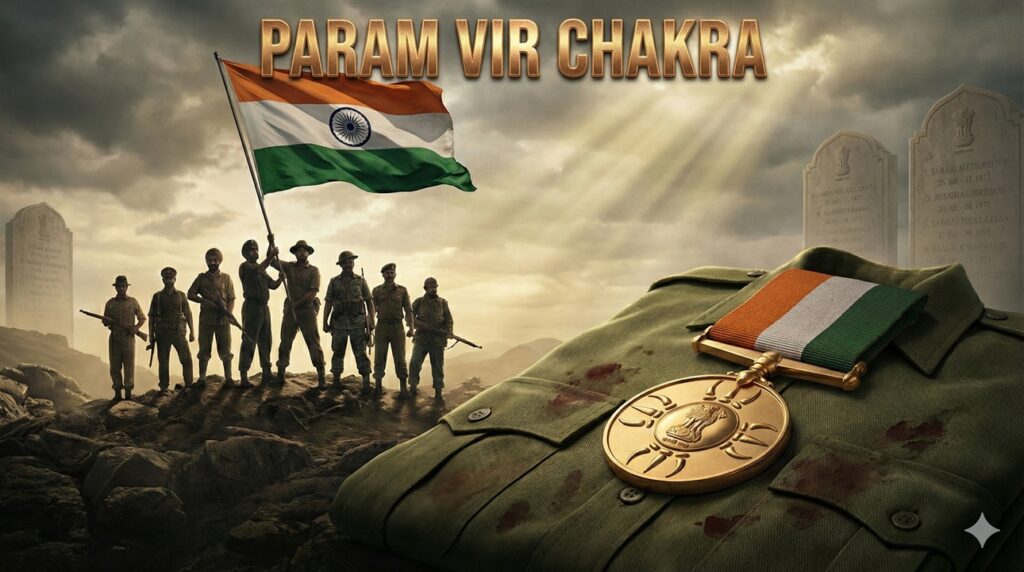
On Vijay Diwas 2025, President Droupadi Murmu inaugurated the Param Vir Dirgha at Rashtrapati Bhavan, displaying portraits of all 21 Param Vir Chakra awardees. This replaced portraits of British Aide-de-Camps, reflecting India’s effort to shed colonial legacies and honour indigenous military valour.
Param Vir Dirgha Significance
Highlights India’s highest tradition of military bravery
Symbolic removal of colonial-era representations
Strengthens national memory and respect for armed forces
Param Vir Chakra Overview
India’s highest military gallantry award for most conspicuous bravery in the presence of the enemy
Instituted on 26 January 1950 along with the Constitution of India
Eligibility and Scope
Open to all ranks of Army, Navy, Air Force, Territorial Army, and other lawfully constituted forces
Awarded only during wartime
Provision for posthumous award
Key Features
Monthly honorarium of ₹3,000 plus ₹3,000 per bar
Recognises exceptional courage, indomitable spirit, and supreme sacrifice
Award Statistics
Total 21 awardees till date
14 awarded posthumously
Conferred across four major wars fought by India
Aide-de-Camps Background
Personal military officers attached to President, Governors, or Service Chiefs
Usually of rank Major, Lieutenant Commander, or Squadron Leader
Functions of Aide-de-Camps
Management of official schedules and engagements
Coordination of ceremonial, protocol, and state functions
Liaison between Rashtrapati Bhavan and civil military authorities
Conclusion
The establishment of Param Vir Dirgha marks a decisive step towards decolonising national institutions while reinforcing India’s sovereign military heritage and inspiring future generations through examples of supreme sacrifice and valour.
Source : The Hindu