
India–AI Impact Conclave 2026: Youth-Centric AI Transformation
Context
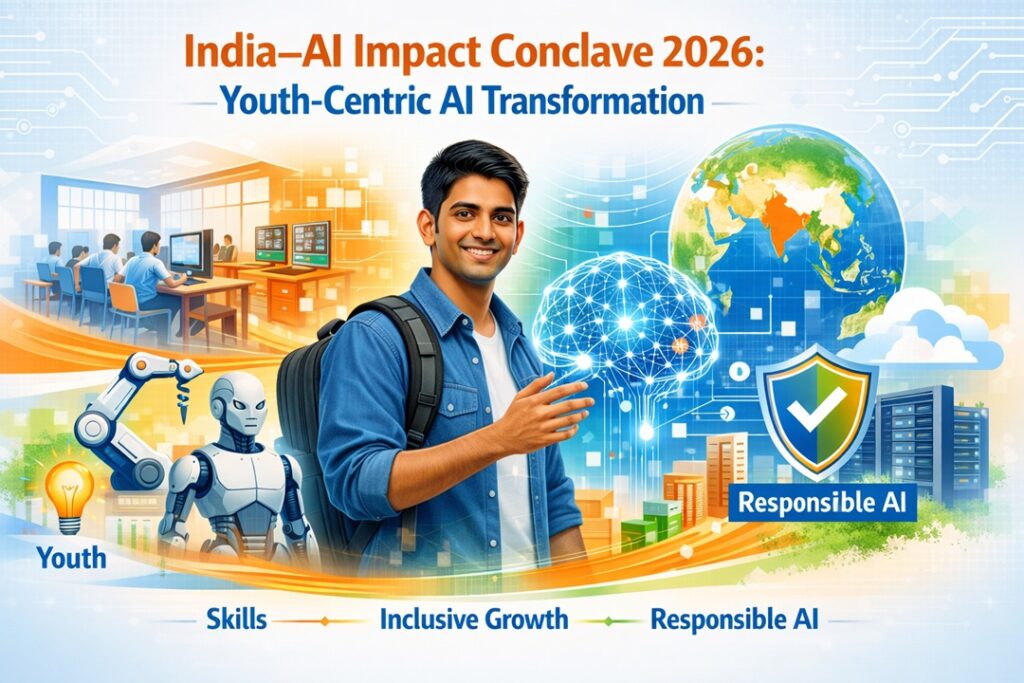
The India–AI Impact Conclave 2026 was inaugurated in New Delhi with a strategic focus on positioning India’s youth as the primary stakeholders in the country’s Artificial Intelligence (AI) ecosystem. The conclave highlighted AI as a present-day driver of economic restructuring, employment creation, and productivity enhancement, rather than a distant technological aspiration.
Overview of the India–AI Impact Conclave 2026
Event Profile: A five-day international conclave on Artificial Intelligence held in New Delhi.
Global Significance: As the first major AI summit hosted by a Global South country, it underscored India’s ambition to shape inclusive and development-oriented AI governance.
Central Idea: “Shared Prosperity, Collective Well-being” — emphasising practical outcomes and societal impact over theoretical discussions.
Strategic Framework (3 Anchors):
- Human-Centred Innovation
- Ecological Responsibility
- Technological Advancement
Functional Tracks (7 Focus Areas):
- Workforce Development
- Social Inclusion & Empowerment
- Responsible and Trustworthy AI
- Scientific Research
- Resilience and Efficiency
- Open Access to AI Resources
- AI for Economic Growth & Public Good
Education–Industry Convergence: The conclave promoted active engagement by aligning academic learning with industry requirements.
Priority Objectives: Improving employability, enhancing productivity, and enabling smoother transitions from education to AI-enabled careers.
Participation Platforms: Innovation challenges, startup showcases, technology demonstrations, and skill-matching forums.
Employment Potential: Significant job creation expected in Animation, VFX, Gaming, and Comics, with nearly 20 lakh jobs projected by 2030.
Larger Vision: Integrating youth skilling, global collaboration, and employment generation to transform India’s demographic dividend into an AI-ready workforce.
AI as a Strategic Opportunity for India’s Youth
Demographic Strength: With over two-thirds of its population below 35 years, India enjoys a unique advantage in scaling AI-driven growth.
Career Transformation: AI is redefining occupations, raising productivity, and enabling inclusive development, offering future-oriented career pathways for young Indians.
Growing Demand for AI Skills:
- AI-related vacancies in South Asia expanded sharply between 2023 and 2025.
- Demand for AI competencies is growing substantially faster than traditional job roles.
Shifting Labour Market: Employers increasingly value digital fluency, advanced technical skills, and interdisciplinary expertise.
Policy Support for AI Employment:
- Union Budget 2026–27 recognised AI as a key employment multiplier.
- Special emphasis on the Orange Economy, including gaming, animation, digital content, and immersive media.
- Establishment of AI-enabled content and creator labs in schools and higher education institutions.
- Formation of a committee to assess AI’s impact on employment and skill ecosystems.
Expanding Access to AI Infrastructure:
- Nationwide availability of compute power, datasets, and AI tools.
- Expansion of GPU capacity to ensure participation from Tier-2 and Tier-3 regions alongside metropolitan centres.
National Initiatives to Build an AI-Skilled Workforce
Integrated Talent Development Strategy: India is creating a layered AI education ecosystem spanning school education, vocational training, higher education, and continuous professional upskilling.
School-Level AI Exposure
Curricular Reforms: Digital and AI literacy embedded across school curricula.
Computational Thinking: Introduced at early grades to strengthen problem-solving, logic, and ethical awareness.
Student Innovation Platforms: Programmes enabling school students to design AI-based solutions to real-world challenges.
Mass AI Literacy: Multilingual national courses aimed at foundational AI awareness for citizens.
Industry-Oriented Skill Development
Vocational AI Training: Integration of AI modules into Skill India programmes with industry partnerships.
Professional Upskilling: Large-scale certification initiatives in AI, data analytics, and cloud technologies.
Unified Digital Platforms: Nationwide portals offering AI courses from beginner to advanced levels.
Advanced Research and Specialisation
Higher Education Support: Fellowships and scholarships to promote AI research at undergraduate, postgraduate, and doctoral levels.
Decentralised AI Infrastructure: Establishment of AI and data labs in non-metro cities and technical institutes to reduce regional disparities.
Indicators of India’s Emerging Global AI Talent Leadership
Beyond Metros: A growing share of startups now originate outside metropolitan regions, reflecting distributed innovation.
High Skill Penetration: India’s AI skill intensity significantly exceeds the global average.
Enterprise Adoption: Widespread deployment of AI solutions across Indian industries.
Youth Engagement: A large, digitally adaptable youth population actively participating in AI learning and innovation.
Ethical AI Outreach: Mass participation in responsible AI pledges promoting transparency, privacy, and accountability.
Way Forward
Strategic Outlook: India’s demographic advantage is evolving into a decisive asset in the AI-driven global economy.
Policy Continuity: Sustained investment in skilling, innovation, and digital infrastructure is strengthening the national talent base.
Conclave Significance: The India–AI Impact Conclave 2026 showcased youth-led innovation, responsible AI adoption, and strong industry alignment.
Long-Term Vision: As India moves towards Viksit Bharat, empowering its youth with AI capabilities will remain central to economic resilience, productivity growth, and global leadership.
Source : PIB