
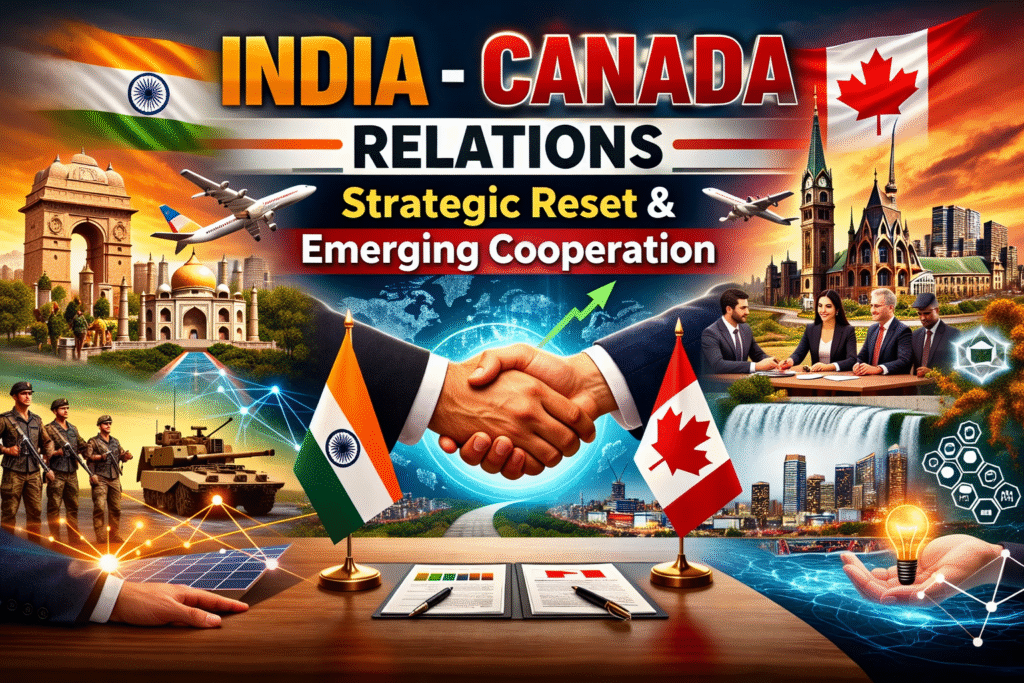
India–Canada Relations : Strategic Reset and Emerging Cooperation
Introduction
India and Canada have recently taken steps to restore and strengthen bilateral relations following the visit of Canadian Prime Minister Mark Carney to India and his high-level discussions with the Prime Minister of India. After a period of diplomatic tensions in recent years, both countries are attempting to rebuild cooperation with a focus on energy security, trade expansion, Indo-Pacific stability, and diaspora welfare.
Context
Bilateral relations between India and Canada have undergone a strategic reset after Prime Minister Mark Carney’s visit to India. The meeting signaled the revival of diplomatic engagement and economic cooperation following earlier tensions linked to security allegations and political disagreements.
Nature of India–Canada Bilateral Relations
Strategic Partnership
India and Canada share a Strategic Partnership based on democratic values, rule of law, and strong people-to-people connections. Cooperation spans sectors such as nuclear energy, trade and investment, education, science and technology, and Indo-Pacific maritime security.
Evolution of India–Canada Relations
Early Nuclear Cooperation
India and Canada historically maintained close cooperation, particularly in the civil nuclear sector, until the relationship was disrupted in the 1970s after India’s nuclear tests.
Growing Economic Engagement
Over the past two and a half decades, economic ties have strengthened significantly. Nearly 600 Canadian companies operate in India, reflecting deepening investment and trade relations.
Diplomatic Strain During Trudeau Era
Relations deteriorated during the tenure of Prime Minister Justin Trudeau due to allegations related to the killing of Hardeep Singh Nijjar, which triggered a major diplomatic dispute.
Improvement Under Mark Carney
After Mark Carney assumed office, both countries initiated efforts to restore trust through high-level visits and the resumption of trade negotiations.
Emergence of Strategic Reset
The relationship is now moving toward a Strategic Energy Partnership and middle-power cooperation to address global geopolitical and economic challenges.
Need for Reset in India–Canada Relations
Energy Security Cooperation
India requires reliable long-term partners to meet its growing energy demand through nuclear and renewable sources. The recently announced 2.6 billion dollar, 10-year uranium supply agreement from Canada is crucial for supporting India’s nuclear energy programme.
Trade Expansion and Diversification
Both countries aim to unlock the full potential of bilateral trade through a formal Comprehensive Economic Partnership Agreement. Leaders have set a goal to increase bilateral trade to 50 billion dollars by 2030.
Managing Global Economic Protectionism
Rising global protectionism and trade restrictions have encouraged middle powers to strengthen economic partnerships. Enhanced India–Canada ties can help both countries respond to restrictive tariff policies imposed by major economies.
Indo-Pacific Strategic Cooperation
Both nations share an interest in maintaining maritime security and a rules-based order in the Indo-Pacific region. A proposed defence dialogue mechanism aims to strengthen security cooperation.
Diaspora and Educational Linkages
Canada hosts one of the largest Indian diaspora populations. Nearly 1.8 million Indo-Canadians and around 400000 Indian students live in Canada, making people-to-people ties a crucial pillar of bilateral relations.
Challenges in India–Canada Relations
Security and Sovereignty Concerns
Allegations related to extrajudicial activities and sovereignty violations remain sensitive issues. The diplomatic crisis surrounding the Hardeep Singh Nijjar case highlighted the fragility of bilateral relations.
Trade Negotiation Barriers
Differences in regulatory frameworks and policy priorities pose challenges in finalizing the Comprehensive Economic Partnership Agreement.
Extremism and Diaspora Politics
India has repeatedly raised concerns about separatist and extremist activities linked to Khalistan groups in Canada, which it believes threaten diplomatic personnel and bilateral trust.
Nuclear Cooperation Constraints
Expansion of nuclear cooperation requires compliance with strict international regulatory frameworks and safeguards, which may slow implementation of planned projects.
Impact of Global Geopolitics
Changing global power dynamics and unpredictable trade policies of major powers such as the United States may influence the strategic alignment between India and Canada.
Way Forward
Conclusion of Comprehensive Economic Partnership Agreement
Both countries should conclude the Comprehensive Economic Partnership Agreement by 2026 to provide a stable legal framework for trade and investment.
Operationalization of Strategic Energy Partnership
India and Canada should accelerate cooperation in nuclear energy, liquefied natural gas, solar energy, and green hydrogen.
Strengthening Security Dialogue
Institutionalizing a defence and security dialogue will enhance cooperation in maintaining maritime security in the Indo-Pacific.
Critical Minerals Cooperation
Canada’s reserves of critical minerals such as lithium, cobalt, and nickel can support India’s green energy transition and advanced technology sectors.
Protection of Students and Diaspora
Both governments should ensure a safe and supportive environment for Indian students and diaspora communities, strengthening the human dimension of bilateral relations.
Conclusion
The strategic reset in India–Canada relations marks an important transition from diplomatic tensions to pragmatic cooperation focused on energy security, trade expansion, and geopolitical coordination. By rebuilding trust and strengthening institutional cooperation, both countries can emerge as influential middle powers contributing to economic stability, regional security, and the welfare of the large Indian diaspora in Canada.
Source : Deccan Herald