
India–GCC FTA: Towards a Comprehensive Economic Partnership
Context
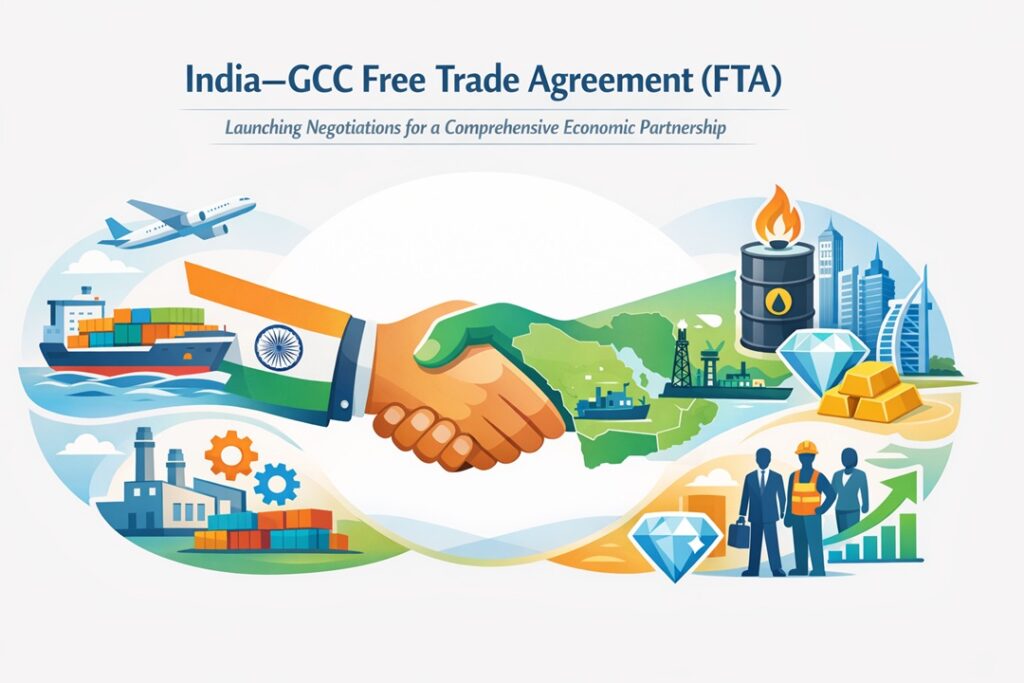
India and the Gulf Cooperation Council (GCC) have agreed on the Terms of Reference (ToR), marking the official start of negotiations for a comprehensive India–GCC Free Trade Agreement (FTA).
About Gulf Cooperation Council (GCC)
Character – A regional intergovernmental organisation comprising six hydrocarbon-rich states of the Gulf region in West Asia.
Objective – To deepen economic, political, and strategic collaboration among member countries.
Member States – Saudi Arabia, United Arab Emirates (UAE), Qatar, Kuwait, Bahrain, and Oman.
Established – 1981.
Secretariat Location – Riyadh, Saudi Arabia.
Demography – Population of around 61.5 million.
Economic Standing – Combined GDP of nearly USD 2.3 trillion (current prices), placing it among the world’s top ten economies.
What is a Free Trade Agreement?
Concept – A preferential trade arrangement between countries or regional groupings aimed at lowering or removing tariffs and other trade barriers to stimulate cross-border commerce.
India–GCC Trade Pact
Role of ToR – Provides the framework and negotiating parameters for the proposed FTA.
Parties Involved – India’s Department of Commerce and the GCC General Secretariat.
Bilateral Trade Value (FY 2024–25) – USD 178.56 billion, accounting for 15.42% of India’s total trade.
Trend – Around 15.3% average annual growth over the past five years.
India’s Key Exports – Engineering products, cereals (rice), textiles, machinery, gems and jewellery.
Key Imports – Crude oil, liquefied natural gas (LNG), petrochemicals, and gold.
People-to-People Connect – About 10 million Indians live and work in GCC countries.
Remittance Share – GCC contributes nearly 38% of India’s inward remittances (2023–24).
Investment Footprint – Cumulative GCC FDI in India stands at USD 31.14 billion (as of September 2025).
Overall Importance – The GCC region is central to India’s energy needs, expanding trade base, investment inflows, and overseas employment opportunities.
Source : PIB