
India – League of Arab States (LAS) Engagement
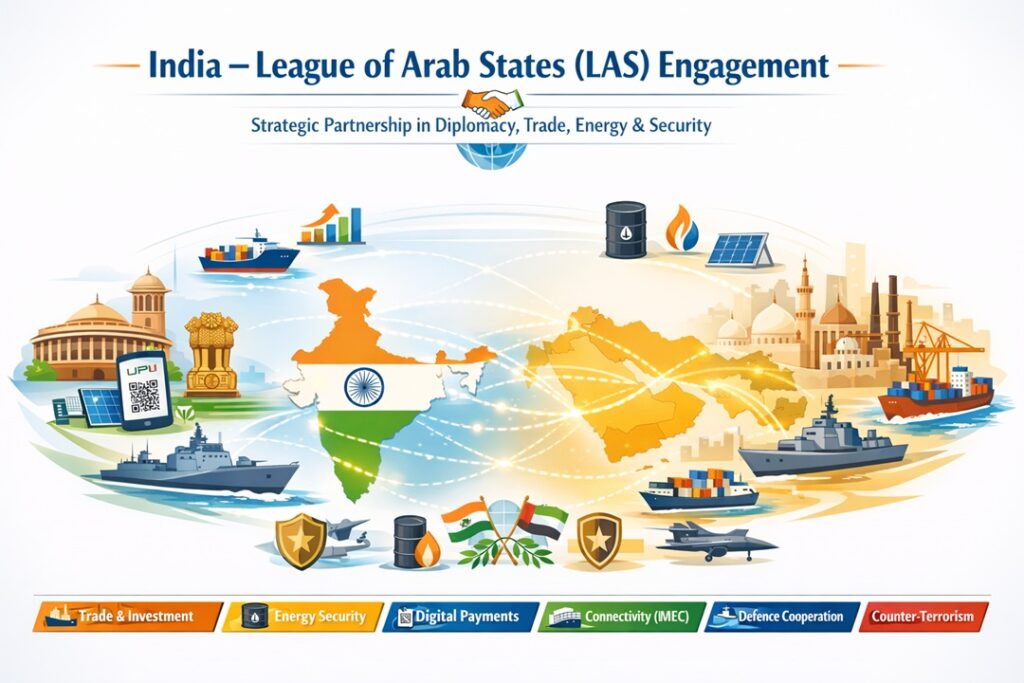
Context
India will convene the Second Ministerial Dialogue with the League of Arab States (LAS) in New Delhi on 30–31 January 2026. The gathering will see participation from all 22 Arab League members, underscoring India’s expanding diplomatic footprint in West Asia at a time of intense regional turbulence and shifting global power equations.
Arab League: Institutional Profile
Character – Pan-Arab intergovernmental organisation of Middle East and North Africa countries.
Formal Name – League of Arab States (LAS).
Origin – Founded on 22 March 1945 at Cairo.
Core Purpose – Enhance coordination in political, economic, social and cultural spheres and preserve state sovereignty.
Seat – Cairo, Egypt.
Decision-Making – Council-based system; one-country-one-vote; resolutions binding only for consenting states.
Original Members – Egypt, Iraq, Jordan, Lebanon, Saudi Arabia, Syria, Yemen.
Present Strength (22) – Algeria, Bahrain, Comoros, Djibouti, Egypt, Iraq, Jordan, Kuwait, Lebanon, Libya, Mauritania, Morocco, Oman, Palestine, Qatar, Saudi Arabia, Somalia, Sudan, Syria, Tunisia, UAE, Yemen.
Syria Reinstated – May 2023 after prolonged suspension.
Observer Countries – India, Brazil, Armenia, Greece, Eritrea, Venezuela, Chad, among others.
India–LAS Partnership: Evolutionary Path
Civilisational Contacts – Maritime trade and cultural exchanges since antiquity.
Institutional Framework – MoU signed in 2002 establishing structured engagement.
Dialogue Mechanism – Annual interaction between India’s External Affairs Minister and LAS Secretary-General.
Arab–India Cooperation Forum – Launched 2008; first session held in 2016 (Bahrain).
Diplomatic Linkage – Indian Ambassador to Egypt also serves as Permanent Representative to LAS.
Economic Interface – Biennial India–LAS Partnership & Investment Summit.
2026 Milestone – Establishment of India–Arab Chambers of Commerce, Industry & Agriculture.
Major Dimensions of Cooperation
1. Global & Regional Diplomacy
India advocates Arab interests in plurilateral forums such as BRICS and SCO and projects itself as a connector between Asia, Africa and Europe.
2. Alignment of Developmental Blueprints
Convergence between India’s Viksit Bharat 2047 and Arab national visions (Saudi Vision 2030, UAE Centennial 2071, Oman Vision 2040, Kuwait Vision 2035).
India is a designated strategic partner in Saudi Arabia’s Vision 2030.
3. Commerce, Capital & Supply Chains
Total trade surpasses $240 billion.
CEPAs with UAE and Oman.
India–UAE trade around $115 billion, with target of $200 billion by 2030.
Large-scale investment pledges from UAE, Saudi Arabia and Qatar.
4. Connectivity Corridors
India–Middle East–Europe Economic Corridor (IMEC) unveiled at G20 2023 to strengthen multimodal connectivity.
5. Fintech & Monetary Linkages
RuPay operational in UAE.
Rupee–Dirham trade settlement arrangement in place.
UPI accepted in UAE, Bahrain, Saudi Arabia and Qatar.
6. Energy Partnership
West Asia supplies majority of India’s crude oil, natural gas and fertilisers.
Key suppliers – Iraq, Saudi Arabia, UAE.
UAE collaboration in India’s Strategic Petroleum Reserves.
Long-term LNG contracts with Qatar and ADNOC.
7. Defence, Security & Stability
Defence cooperation agreements with multiple Arab states.
Maritime cooperation under India’s SAGAR vision.
Strategic partnerships expanded from Oman to UAE, Saudi Arabia, Egypt and Qatar.
Access to Duqm Port strengthens Indian naval logistics.
Shared counter-terrorism outlook and condemnation of attacks against India.
Growing interest in Indian defence platforms (Tejas, BrahMos, Akash).
New areas – cyber security, space cooperation, unmanned systems.
Future Trajectory
India’s engagement with the Arab world is transitioning from transactional to strategic.
The ministerial meeting in New Delhi provides an opportunity to deepen political trust, widen economic integration and reinforce security cooperation, anchoring India–Arab relations in a long-term strategic partnership.
Source : The Hindu