
India–New Zealand Free Trade Agreement: Strategic and Economic Implications
Context
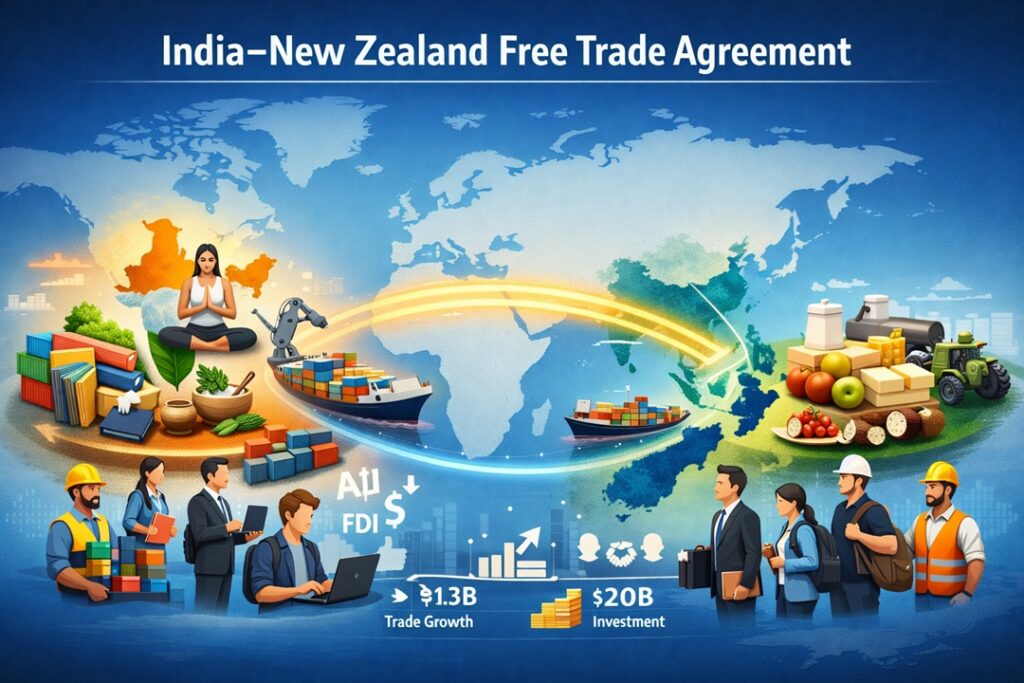
India has recently concluded a Free Trade Agreement with New Zealand to diversify trade partners, expand global market access, and strengthen long-term economic and strategic cooperation.
Key Features of the Agreement
Market Access Provisions
• Zero-duty market access for 100 percent of Indian exports to New Zealand
• Improved competitiveness of Indian goods and services
Tariff Liberalisation by India
• Tariff reduction on 95 percent of imports from New Zealand
• 57 percent of products duty-free from day one
• Safeguards retained for sensitive sectors
Investment and FDI Commitments
• 20 billion dollars FDI commitment over 15 years
• Clawback mechanisms to ensure adherence to timelines
• Coverage across 118 sectors focusing on services and skill mobility
Services and New Areas of Trade
• Market access for Ayurveda, Yoga, and traditional medicine services
• Expansion of India’s services exports and soft power
Mobility and Skill Development
Skilled Workforce Mobility
• Easier movement for IT professionals, engineers, yoga instructors, chefs, and music teachers
• Opportunities in healthcare, education, and construction sectors
Youth and Student Opportunities
• Work permits up to 20 hours per week during studies
• Extended post-study work visas for Indian students
Support to Domestic Economy
MSMEs and Labour-Intensive Sectors
• Boost to textiles and apparel, leather and footwear, gems and jewellery
• Support for engineering goods and processed food sectors
Protection of Sensitive Sectors
• Exclusion of dairy and key agricultural products
• Includes milk, cheese, butter, yogurt, sugar, edible oils, spices, onions, and rubber
• Protection of Indian farmers and MSMEs
Development Cooperation
Agriculture and Horticulture Support
• Focus on exotic fruits such as kiwifruit, apples, and honey
• Establishment of centres of excellence
• Improved planting material and capacity building
• Better post-harvest practices and food safety systems
Strategic and Economic Significance
Gateway to Oceania
• Enhanced access to Oceania and Pacific Island markets
• Strengthening India’s presence in the Indo-Pacific
Trade and Diaspora Linkages
• Bilateral trade at 1.3 billion dollars
• Target to double trade in five years
• Indian diaspora forms about 5 percent of New Zealand’s population, nearly 3 lakh people
Rationale for India’s FTA Push
Trade Diversification Strategy
• Reduced dependence on the U.S., EU, and China
• Expansion into new and high-income markets
Development and Industrial Alignment
• Support to Make in India and PLI schemes
• Integration into global value chains
• WTO-plus commitments in services, digital trade, and investment
Challenges and Criticism
Concerns in New Zealand
• Exclusion of dairy and agriculture, the largest domestic industry
• Political opposition within New Zealand
Concerns in India
• Fear of trade deficits and asymmetric gains
• Effectiveness of safeguards to be tested during implementation
Conclusion
The India–New Zealand Free Trade Agreement balances trade liberalisation with protection of sensitive sectors. Effective implementation, strengthening domestic competitiveness, and increased investment in research and development will determine its long-term success.
Source : The Hindu