
India’s Creative Economy: The Rise of the Orange Economy
Context
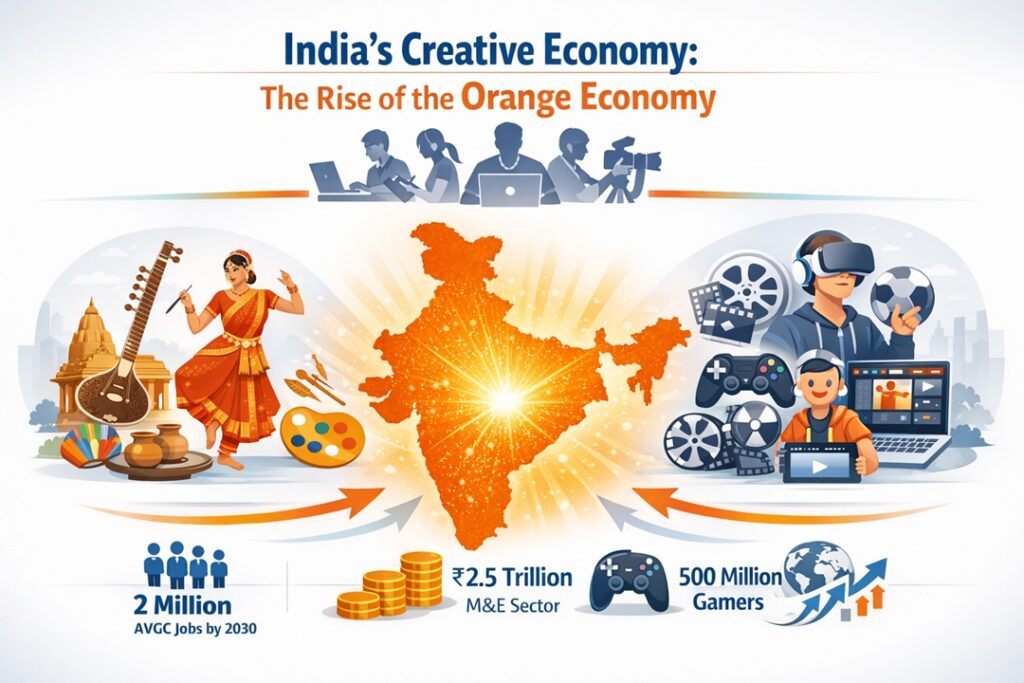
The creative industries have gained renewed policy attention following the Union Budget 2026–27 and the Economic Survey 2025–26. The Survey projects a demand for nearly 2 million professionals in the AVGC sector by 2030, while the Budget announced the establishment of 15,000 Content Creator Labs in schools, signalling a strategic push towards the creative economy.
Creative Industries as Growth Engines
Concept – Orange Economy:
The Orange Economy—a term coined by Iván Duque and Felipe Buitrago—refers to an ecosystem of economic activities where value is primarily generated from creativity, culture, and intellectual property. It bridges traditional cultural expressions (arts, crafts, festivals) with modern digital domains (gaming, VFX, OTT platforms). In the Indian context, it marks a shift where imagination itself becomes a globally tradeable commodity.
Key Statistics on India’s Creative Economy (2024–26)
Sectoral Size: India’s Media and Entertainment sector reached about ₹2.5 trillion ($30 billion) in 2024, with projections of ₹3.06 trillion by 2027.
Employment Potential: The sector supports over 10 million direct and indirect livelihoods, with creative occupations paying nearly 88% higher wages than non-creative roles.
Export Diversification: Creative services exports grew by 20% in 2023, helping diversify India’s services basket beyond traditional IT.
Gaming Growth: India has emerged as one of the world’s largest gaming markets, with revenues of ₹232 billion and a user base of around 500 million gamers.
VFX Intensity: Contemporary Indian films allocate 25–30% of production budgets to visual effects, reflecting rising technological sophistication.
Why the Creative Economy is a Growth Engine
Youth Employment Generator: The AVGC-XR sector is labour-intensive and absorbs young talent, particularly from non-metro regions.
Example: Projections of 2 million jobs by 2030 have catalysed animation and design studios in Tier-2 cities such as Pune and Indore.
Soft Power and Cultural Diplomacy: Global dissemination of Indian content reshapes narratives and boosts tourism.
Example: International success of films like RRR and Project K has transformed filming locations into global tourist attractions.
Urban Multiplier Effect: Live events stimulate allied sectors such as hospitality, transport, and retail.
Example: Large-scale concerts in Ahmedabad and Navi Mumbai (2025) led to a 40% surge in hotel bookings and short-term gig employment.
Technological Spillovers: Advances in gaming and VFX find applications in healthcare, education, and defence through tools like digital twins.
Example: Game engines are increasingly used for immersive medical training simulations in India.
Democratisation of Opportunity: Digital platforms enable creators from remote regions to directly monetise talent.
Example: Creator’s Corner on DD National has integrated rural micro-influencers into the national advertising ecosystem.
Key Government Initiatives
WAVES Summit (2025): Established a global marketplace (WAVES Bazaar) for trading scripts and music rights.
IICT Mumbai: The Indian Institute of Creative Technologies set up as a National Centre of Excellence for AVGC-XR skilling.
Content Creator Labs: Budget 2026 allocated ₹250 crore to establish labs in 15,000 secondary schools for early exposure to digital storytelling.
Create in India Challenge: A nationwide talent hunt across 33 categories linking winners to international cultural platforms.
Challenges in the Creative Economy
Platform Dependence: Heavy reliance on global digital platforms exposes creators to opaque algorithmic risks.
Example: Policy changes on short-video platforms recently caused a 30% revenue drop for many Indian micro-influencers.
IP Financing Constraints: Creative MSMEs face credit shortages due to lack of physical collateral.
Example: Animation studios often depend on high-interest private credit as banks hesitate to recognise IP as collateral.
Skill–Industry Mismatch: Technical software proficiency often outweighs foundational storytelling and design skills.
Example: Industry feedback at IGDC 2026 highlighted a shortage of original game designers despite abundant technical manpower.
Infrastructure Gaps: High costs of rendering and cloud computing limit small studios.
Example: Many firms still outsource advanced CGI rendering overseas due to inadequate domestic HPC infrastructure.
Regulatory Bottlenecks: Live events require multiple clearances, causing delays and rent-seeking.
Example: Several international music festivals planned for early 2026 were scaled down due to complex local permissions.
Way Forward
IP-Backed Lending: Develop an RBI-supported framework to allow copyrights and trademarks as collateral.
AVGC Policy Roll-out: Finalise and operationalise the Model State AVGC Policy for uniform incentives nationwide.
AI-Native Creative Tools: Invest in indigenous AI tools for animation, dubbing, and localisation to cut production costs.
Single-Window Clearances: Operationalise the proposed Live Entertainment Development Cell (LEDC) to streamline approvals.
Focus on Original IP: Transition from being a global outsourcing hub to a creator of original Indian intellectual property.
Conclusion
India’s shift towards a robust Orange Economy marks a strategic transformation where creativity is systematically converted into a scalable economic asset. By aligning early-stage skilling with global market access, India is converting its demographic dividend into a creative dividend. Over the next decade, the label “Created in India” is poised to become as globally synonymous with quality as Designed in California.
Source : PIB