
“India’s Economic Reforms 2025: Building a Future-Ready Economy”
Context
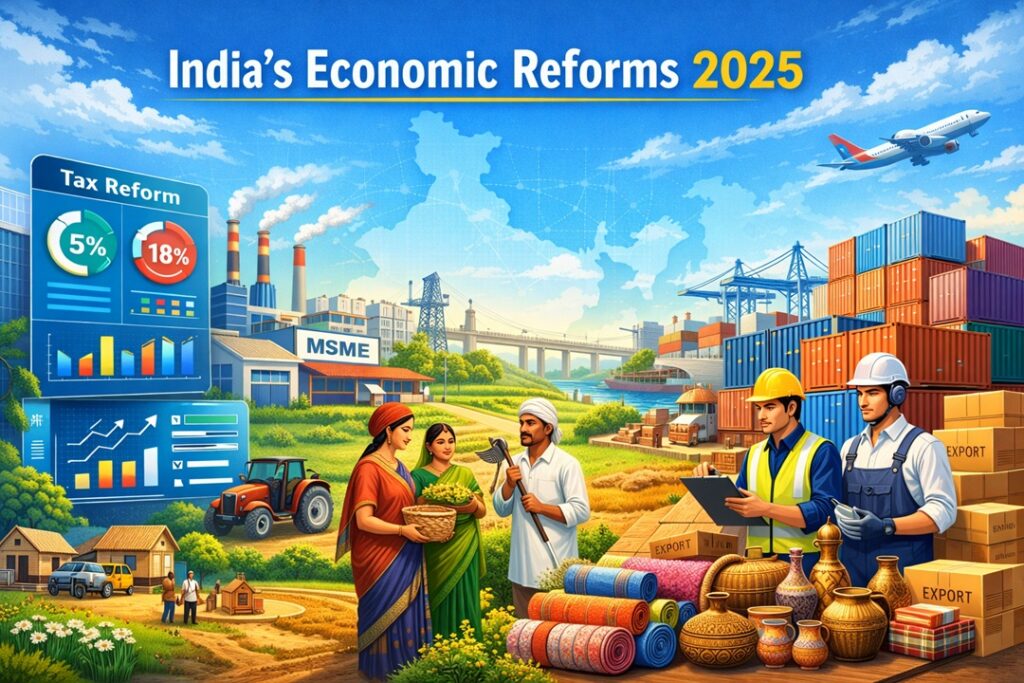
In 2025, the Indian government introduced a series of landmark reforms aimed at modernizing governance, simplifying regulatory frameworks, and promoting sustainable economic growth. These reforms focus on delivering tangible outcomes for citizens, businesses, and rural communities, while strengthening India’s global competitiveness.
Key Reforms Shaping Growth and Opportunity
Income Tax Reforms
- Annual incomes up to ₹12 lakh are exempt from income tax, with salaried individuals benefiting up to ₹12.75 lakh through standard deductions, boosting disposable income.
- The New Income Tax Act, 2025 simplifies the tax system, removes obsolete provisions, consolidates compliance requirements, and strengthens digital enforcement, enhancing transparency and efficiency.
Labour Reforms
- 29 labour laws consolidated into four Labour Codes: Wages, Industrial Relations, Social Security, and Occupational Safety, Health & Working Conditions.
- Key measures:
- Wages: Uniform definitions and minimum wage standards across all sectors.
- Industrial Relations: Simplified trade union processes and dispute resolution.
- Social Security: Expanded benefits for gig and platform workers, including health, maternity, and provident funds.
- Workplace Safety: Enhanced safety measures, especially for women and migrant workers.
- Covers over 500 million workers, creating a unified and future-ready workforce.
Rural Employment Reforms
- The Viksit Bharat – Guarantee for Rozgar and Ajeevika Mission (Gramin) Act, 2025 replaces MGNREGA.
- Key provisions:
- Extended Employment: 125 days of wage employment per rural household.
- Integrated Rural Employment: Labour availability during peak agricultural seasons.
- Asset Creation: Focus on rural infrastructure and water security.
- Decentralized Planning: Local communities plan projects integrated with national schemes.
- Aims to provide sustainable rural employment and long-term economic resilience.
Ease of Doing Business Reforms
- Measures focus on reducing bureaucratic hurdles and boosting MSME growth.
- Quality Control Orders (QCOs): Ensure products meet international standards while supporting MSMEs.
- Access to Finance: Loans linked to external benchmarks, credit guarantees up to ₹100 crore, and collateral-free loans for micro and small enterprises.
GST 2.0 Reforms
- Introduces a two-slab GST system (5% and 18%) to simplify compliance.
- Key benefits:
- Reduces cost of living by lowering taxes on essential goods.
- Simplifies GST registration, refunds, and returns for MSMEs and startups.
- Expands the tax base to over 1.5 crore taxpayers.
Export Promotion Mission
- ₹25,060 crore allocated for FY 2025–26 to FY 2030–31 to strengthen India’s export ecosystem.
- Key measures:
- Affordable trade finance for MSMEs.
- Improved market access for Indian products globally.
- Support for labour-intensive sectors like textiles and handicrafts.
- Leverages digital tools and unified frameworks to boost exports from underserved regions.
Driving Outcomes
- Provides a major push for India’s economic growth and global competitiveness.
- Simplifies systems, reduces compliance burdens, and strengthens transparency.
- Aligns with India’s Vision 2047, focusing on inclusivity, digital transformation, and sustainable long-term growth.
Conclusion
The 2025 economic reforms represent a comprehensive strategy to modernize India’s economy, enhance labour and business efficiency, boost rural employment, and strengthen export competitiveness. By emphasizing outcome-based governance, inclusivity, and sustainability, these measures lay a robust foundation for a future-ready India capable of thriving in a complex global landscape.
Source : PIB