
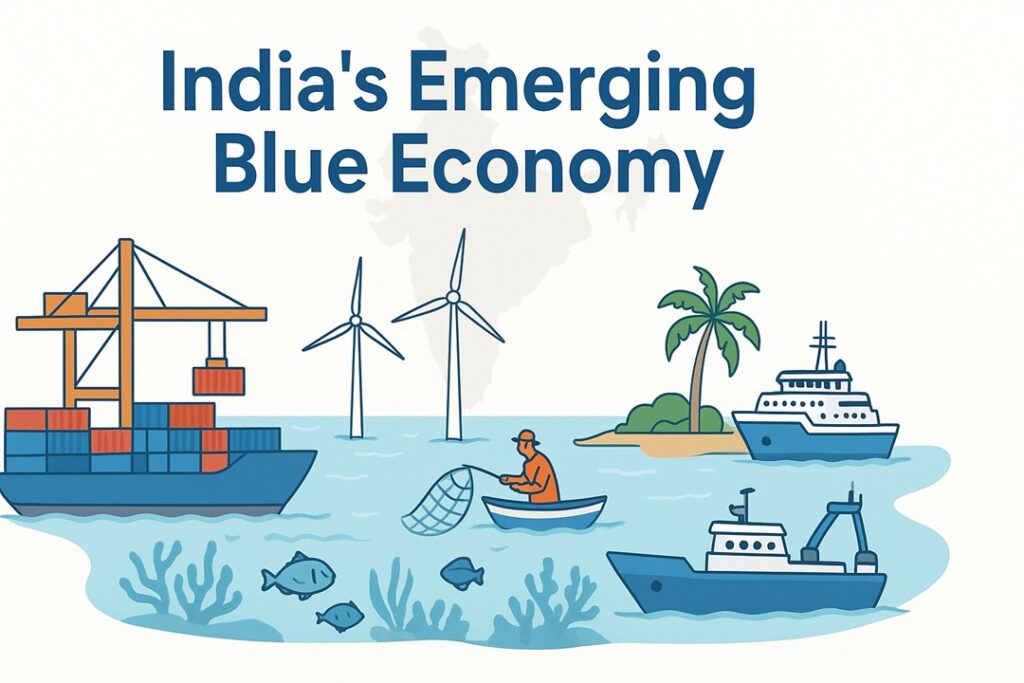
India’s Emerging Blue Economy: Opportunities and Challenges in Fisheries and Aquaculture
Context
World Fisheries Day 2025 underscored India’s fast-growing fisheries and aquaculture sector, alongside the FAO’s call for renewed commitment to “India’s Blue Transformation.”
The FAO representative emphasised that although India has emerged as the world’s second-largest aquaculture producer, challenges related to sustainability, ecosystems, and long-term resource management demand urgent policy reinforcement.
India’s Fisheries & Aquaculture:
Trends & Data
1. Rapid Production Growth (1980s–2023)
India’s total aquatic output rose dramatically—from 4.4 million tonnes in the 1980s to 17.54 million tonnes in 2022–23, marking a seven-fold increase largely driven by inland aquaculture.
2. Global Aquaculture Leader
As per FAO SOFIA 2024, India contributed 23 million tonnes of aquatic animals, becoming the world’s second-largest aquaculture producer, after China.
3. Rising Marine Export Strength
Marine product exports grew by 8%, from USD 0.81 billion (Oct 2024) to USD 0.90 billion (Oct 2025), fuelled by high-value shrimp aquaculture and improved value-addition.
4. Inland Aquaculture as the Growth Engine
Between 2013–14 and 2024–25, India’s fish output doubled from 96 lakh tonnes to 195 lakh tonnes. Inland fisheries alone expanded 140%, solidifying their role as the sector’s key driver.
5. Sectoral Footprint & Livelihoods
The fisheries sector supports 30 million livelihoods, with 3,477 coastal fishing villages contributing nearly 72% of national output, reflecting strong dependence on coastal ecosystem health.
Opportunities for India
1. Expanding Global Seafood Markets
Competitive labour markets, a strong shrimp sector, and GST cuts (from 12% to 5% on key fish products) provide India an export edge in the U.S., EU, and East Asian markets.
2. Blue Economy Potential via EEZ Rules
The Sustainable Harnessing of EEZ Rules (2025) open deep-sea fishing avenues for FPOs, enabling utilisation of underexploited pelagic stocks.
3. Digital Governance & Traceability
Platforms such as ReALCraft, NFDP, and the National Traceability Framework can enhance compliance, raise export premiums, and reduce rejection rates.
4. Climate-Resilient Aquaculture Models
FAO-supported climate-resilient pond systems in Andhra Pradesh demonstrate reduced environmental footprint—offering scalable models for other coastal States.
5. Women-Led Sectoral Growth
Under PMMSY, women receive up to 60% support, enabling participation in retail kiosks, value-addition, and processing units, furthering inclusive sectoral development.
Major Initiatives
1. PM Matsya Sampada Yojana (PMMSY)
With an outlay of ₹20,312 crore (2020–26), PMMSY has created 730 cold storages, 26,348 transport facilities, and 6,410 kiosks, significantly reducing post-harvest losses.
2. Climate-Resilient Coastal Fishermen Villages (CFVs)
100 coastal villages are being upgraded with cyclone-resilient housing, early warning systems, and diversified livelihood support.
3. EEZ Sustainable Harnessing Rules, 2025
These rules prioritise cooperatives for deep-sea access, introduce a digital Access Pass via ReALCraft, and prohibit destructive fishing practices to conserve marine biodiversity.
4. Marine Fisheries Census 2025
Using VyAS-NAV, BHARAT, and SUTRA apps, the census geo-references 2 million households across 5,000 villages, creating real-time socio-economic datasets for targeted policy.
5. Fisheries Infrastructure Development Fund (FIDF)
With a ₹7,522 crore corpus, FIDF finances ports, cold chains, and aquaculture parks.
By July 2025, 178 projects worth ₹6,369 crore had been approved with interest subvention.
Challenges
1. Overfishing & Declining Stocks
Intense coastal fishing and juvenile catch have depleted nearshore stocks, particularly sardines and mackerel.
2. Habitat Degradation & Pollution
Seagrass loss, sedimentation, and port pollution are harming nursery habitats crucial for commercial species.
3. IUU Fishing
Illegal, unreported, and unregulated fishing continues to strain resources, disadvantaging small-scale fishers.
4. Post-Harvest Losses & Cold Chain Gaps
India still loses 15–20% of fish post-harvest due to inadequate hygienic handling, grading, and value-addition.
5. Limited Access to Credit & Insurance
Small-scale fishers struggle with loans, insurance, and working capital despite schemes like PM-MKSSY.
Way Forward
1. Science-Based Stock Management
Adopt zone-wise stock assessments, mesh-size regulation, and seasonal restrictions aligned with FAO’s ecosystem-based management.
2. Expand Deep-Sea Fishing Capacity
Upgrade cooperative vessels, improve onboard storage, and enhance deep-sea navigation training to shift pressure from coastal zones.
3. Strengthen Traceability & Certification
Implement the National Traceability Framework across hatcheries, landing sites, and exporters to meet EU/U.S. standards.
4. Boost Aquaculture Biosecurity
Ensure hatchery certification, disease-free seed systems, and water quality monitoring to reduce vulnerability to disease outbreaks.
5. Invest in Climate-Resilient Infrastructure
Upgrade harbours, build cyclone-resilient structures, deploy early warning systems, and adopt climate-adaptive pond designs.
Conclusion
India’s fisheries and aquaculture sector is undergoing a pivotal transformation driven by strong growth, digital reforms, and expanding global opportunities. By strengthening sustainability measures, enhancing climate resilience, and ensuring inclusive support for small fishers, India can build a robust, competitive, and environmentally secure Blue Economy for the future.
Source : The Hindu