
India’s Expanding Drone Ecosystem and Governance Transformation
Context
Unmanned Aerial Systems (UAS) have rapidly evolved into a critical enabler of modern governance worldwide. In recent years, India has significantly accelerated the deployment of drones across administrative, economic, and strategic domains, fundamentally transforming public service delivery, infrastructure monitoring, agricultural practices, disaster response mechanisms, and national security operations.
How Has India Built a Robust Drone Framework?
From Experiments to Scale
India’s drone sector has progressed from isolated pilot initiatives to a large-scale, innovation-oriented ecosystem, supported by regulatory certainty, policy stability, and targeted fiscal incentives.
Ecosystem Maturation
The growing adoption of drones reflects the emergence of a well-integrated value chain comprising manufacturers, software developers, analytics firms, service providers, training institutions, certified pilots, start-ups, research organisations, and digital platforms operating under a unified regulatory architecture.
Government as a Catalyst
The State has acted as a key enabler by introducing progressive reforms, simplifying compliance requirements, and deploying digital-first governance tools to reduce procedural friction and enhance transparency.
Equity-Oriented Expansion
Special emphasis has been placed on women-led enterprises, rural outreach, and indigenous manufacturing, ensuring inclusive participation and balanced sectoral growth.
Cross-Sectoral Deployment
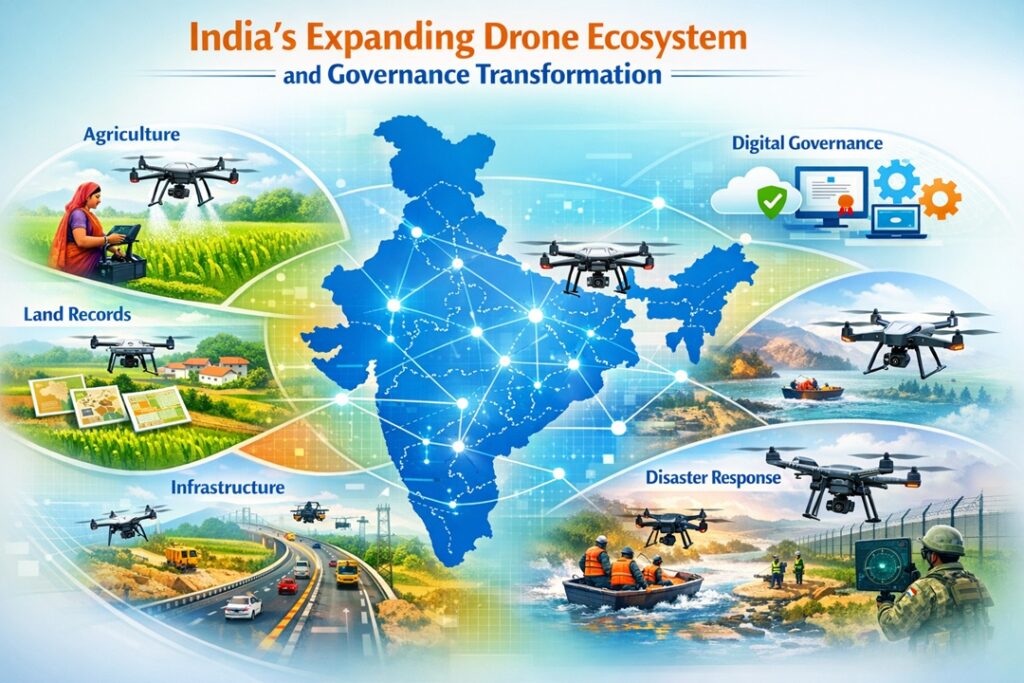
Drones are now routinely used across agriculture, land administration, infrastructure supervision, disaster mitigation, defence preparedness, and civic services, enhancing speed, accuracy, and accountability in governance.
Foundational Drivers
Reformed drone regulations, digital approval systems, skill-development initiatives, and manufacturing incentives have collectively:
- Reduced procedural complexity
- Improved ease of compliance
- Enabled seamless integration of drones into flagship schemes and routine administrative workflows
In What Ways Have Drones Reshaped Public Service Delivery?
Governance Applications
Drones support multiple national and state programmes by enabling high-precision data collection, real-time monitoring, and evidence-based decision-making.
Precision Agriculture and Rural Livelihoods – Namo Drone Didi Initiative
Launched in 2023, the initiative provides drones to Women Self-Help Groups (SHGs) for agricultural services, accelerating the transition towards technology-enabled farming.
Outcome: Over 1,000 drones deployed; SHGs deliver spraying services, enhancing incomes and social empowerment.
Land Governance and Property Rights – Drone-Based Surveys
Drone mapping of rural habitation areas has strengthened land record accuracy, reduced disputes, and improved access to institutional finance.
Outcome: Coverage extended to over 95% of targeted villages, with crores of property cards issued nationwide.
Transport Infrastructure Oversight
Mandatory drone videography for highway construction ensures transparent progress assessment and strengthens accountability mechanisms.
Captured data is archived digitally and used as verifiable evidence in arbitration and judicial proceedings.
Disaster Preparedness and Emergency Operations
High-endurance drones are deployed during floods, landslides, and natural calamities to provide live aerial intelligence, enabling faster rescue, relief, and damage assessment.
Railway Safety and Surveillance
Drones are used for track and bridge inspections, as well as aerial surveillance for crowd management, security monitoring, and anti-intrusion operations.
Strategic and Defence Uses
Drones play a critical role in border surveillance, reconnaissance, and precision operations. Recent military deployments highlighted the effectiveness of indigenous drones integrated with radar and air-defence networks for rapid threat neutralisation.
What Policy Measures Have Accelerated Drone Penetration?
Revised Regulatory Framework
Successive reforms simplified procedures by drastically reducing forms, approvals, and fees, while expanding permissible civilian operations and liberalising airspace access.
Manufacturing and Innovation Incentives
Targeted incentive schemes promote domestic production of drones and components, enabling start-ups and MSMEs to scale while reducing import dependence.
Tax and Cost Rationalisation
Lower GST rates on drones and training equipment have reduced costs, improved affordability, and strengthened the skilling ecosystem.
Digital-First Governance Architecture
Integrated platforms streamline drone registration, pilot certification, flight permissions, and airspace management through a single interface, significantly improving regulatory efficiency.
Capacity Building and Technology Promotion
National expos, certified training programmes, capacity-building initiatives, and innovation challenges promote indigenous technology development and expand the skilled workforce.
Way Forward
India is set to deepen the integration of drones across governance and development programmes while strengthening indigenous manufacturing and advanced pilot training. With sustained public investment, innovation support, and strategic deployment, India is building a future-ready drone ecosystem that balances economic growth, technological self-reliance, and inclusive development—positioning the country as a global leader in unmanned aerial systems.
Source : PIB