
India’s First Underwater Road–Rail Tunnel Across the Brahmaputra
Context
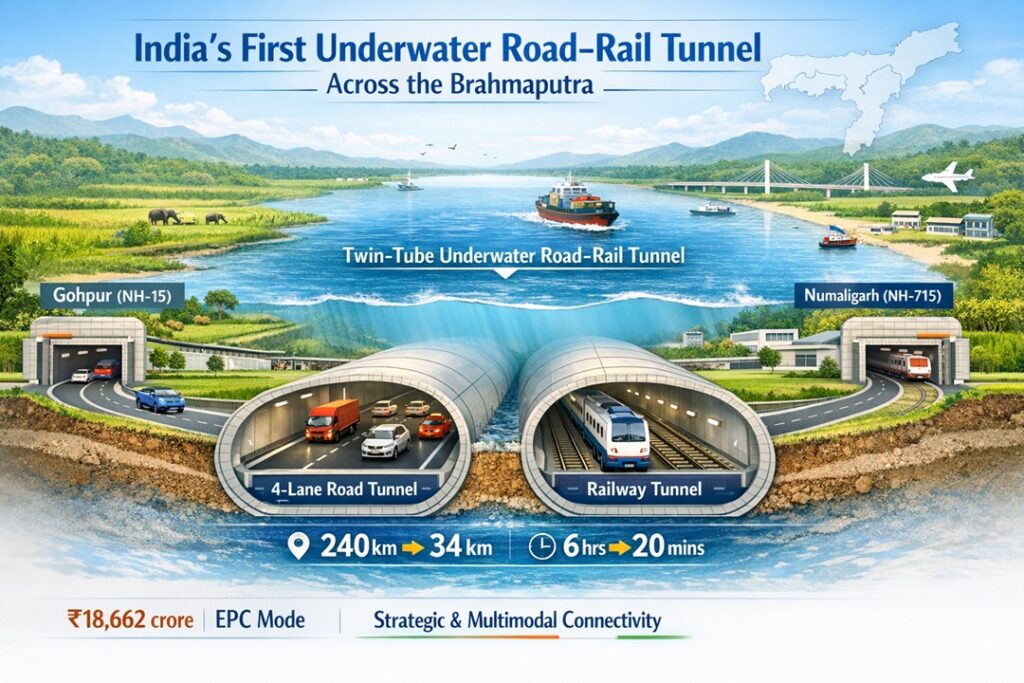
The Union Cabinet has accorded approval for India’s first underwater road-cum-rail tunnel, a landmark infrastructure initiative and only the second such integrated tunnel project globally.
Administrative & Geographic Details
- Region: Brahmaputra river basin, Assam
- Approval Authority: Cabinet Committee on Economic Affairs (CCEA)
- Project Stretch: Gohpur (NH-15) to Numaligarh (NH-715)
- Highway Configuration: 4-lane, access-controlled greenfield corridor
- Distinct Feature: First-ever underwater road–rail connectivity in India
Technical Specifications
- Overall Length: 33.7 km
- Sub-river Tunnel Section: Twin-tube tunnel of 15.8 km
- Estimated Project Cost: ₹18,662 crore
- Execution Model: Engineering, Procurement and Construction (EPC)
Mobility Gains
- Route Optimisation: Distance compressed from 240 km to 34 km
- Time Savings: Travel duration reduced from nearly 6 hours to around 20 minutes
Railway Linkages
- Northern Interface: Rangia–Mukongselek railway section (Gohpur side)
- Southern Interface: Furkating–Mariani loop line (Numaligarh side)
Employment & Livelihood Impact
- Employment Potential: Nearly 80 lakh person-days of direct and indirect employment
Network Integration
- Urban & Regional Coverage:
Numaligarh, Tezpur, Gohpur, Dibrugarh (Assam) and Itanagar (Arunachal Pradesh) - Transport Nodes Covered:
- Air Connectivity (02): Donyi Polo Airport (Itanagar), Tezpur Airport
- Rail Hubs (04): Numaligarh, Gohpur, Golaghat Town, Simaluguri Junction
- Inland Waterways (02): Biswanath Ghat and Tezpur terminals
- Social & Developmental Nodes:
- 1 Tribal District – Dima Hasao
- 2 Aspirational Districts – Udalguri and Darrang
- Tourism & Heritage Assets:
Kaziranga National Park, Deopahar Archaeological Site
(along with 11 additional economic nodes)
Why It Matters
- Strategic Utility: Enhances rapid mobility, logistics resilience, and disaster-response capability in Northeast India
- Inter-State Integration: Strengthens connectivity among Assam, Arunachal Pradesh, Nagaland, and neighbouring states
- Economic Efficiency: Reduces logistics costs, supporting industrial growth and trade
- Tourism Push: Improves access to key eco-tourism and heritage destinations
- Multi-Modal Synergy: Integrates road, rail, air, and inland water transport systems
Source : PIB